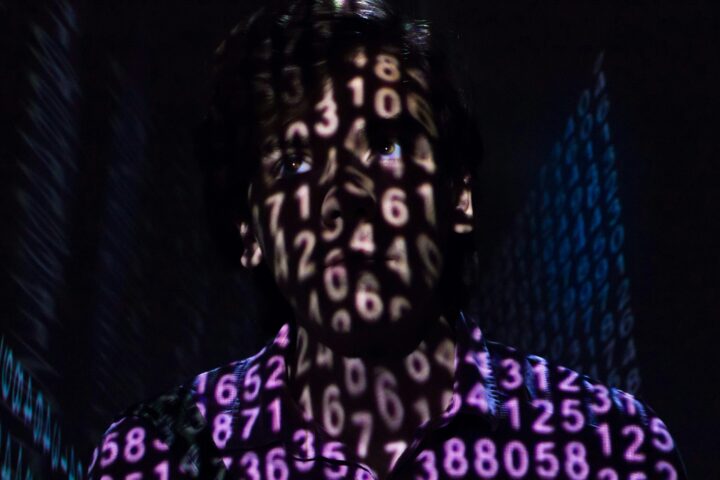
2026 Critical Legal Conference: Stream on Performing data-bodies
The stream Performing data-bodies: How data comes to (just) matter has been accepted within the 2026 Critical Legal Conference. The conference will take place in person at the University of Westminster (London), in September 9-11. Organisers of the stream are: Joaquín Santuber, University of Linz, Austria; Miriam Tedeschi, University of Turku, Finland; Judy Radul, Simon Fraser University, Canada; Lene Vollhardt, Westminster Law School.
Update! The schedule and the programme of the conference are out here: https://www.lawandtheory.com/programme. Registrations for the conference are open, here.
Stream description
Data is not merely an abstraction. It is material. It is felt. It is sensed. It leaves traces on bodies and everyday spacetimes and subtly modulates them. It affects who is in/excluded, who is surveilled, and who is harmed, and how this happens. It produces multiple data-selves by extracting and aggregating biometric information, affective and emotional profiling, and behavioural tracking. Such data-selves precede and exceed legally binding individual consents, live their own (in)dependent data-life while subtly (re)infiltrating into the ‘original’ human selves. Yet data tends to be treated as external, objective, disconnected from the embodied lives it marks and the socio-spatial injustices it may produce. It also remains out of touch in daily human-machine interactions: powerfully invisible and intangible, yet very material.
This interdisciplinary stream brings together critical legal and socio-legal scholars, philosophers, social scientists, human, digital, feminist and legal geographers, designers, computer and data scientists and beyond to experiment with and perform everyday datafication as data mattering: as an embodied, sensorial, material and spatiotemporal phenomenon leading to hard to detect yet pervasive forms of (in)just practices. We ask, for example: In what ways does data come to (just) matter? How can we make it sensorial, and how does such sensoriality and materiality intersect the law? And how can we trick or avoid or perform other forms of resistance to its invasive presence?
We seek performances that engage with and expand legal data protection frameworks into experiments with physicalisation of data-bodies. The performances can take any form, including digital/physical, data visualisation performance, performance workshops, collective experiences, etc.
The performances can address, without being limited to, the following themes on data mattering:
– data-bodies as legal subjects
– sensorialities of data and socio-legal awareness
– data-harms, social sorting and discrimination
– missing data, tricking data, data obfuscation and absence of data
– intimate data
References
Cheney-Lippold, J. (2017). We are data. New York University Press.
Chun, W.H.K. (2021). Discriminating data. MIT Press.
D’Ignazio, C., & Klein, L.F. (2020). Data feminism. MIT Press.
Kitchin, R. (2021). Data lives. Bristol University Press.
Lupton, D. (2017). Feeling your data: Touch and making sense of personal digital data. New Media & Society, 19(10): 1599–1614. https://doi.org/10.1177/1461444817717515
Lupton, D. (2020). Thinking with care about personal data profiling: A more-than-human approach. International Journal of Communication, 14: 3165–3183. https://ijoc.org/index.php/ijoc/article/view/13540
Lupton, D. (2021). ‘Not the real me’: Social imaginaries of personal data profiling. Cultural Sociology, 15(1): 3–21. https://doi.org/10.1177/1749975520939779
Offenhuber, D. (2023). Autographic design: The matter of data in a self-inscribing world. MIT Press.
Offenhuber, D., Perovich, L. J., & Rogowitz, B. (2025). Data at hand: Exploring the tactile perception of data physicalizations. In: Proceedings of the 2025 Computer-Human Interaction (CHI) Conference on Human Factors in Computing Systems (CHI ‘25). New York, NY, USA: Association for Computing Machinery (ACM), Article 1176, pp. 1–15. https://doi.org/10.1145/3706598.3713212
Ruckenstein, M. (2023). The feel of algorithms. University of California Press.
Tucker, I.M. (2024). The emotional in-formation of digital life. Distinktion: Journal of Social Theory, 25(3): 282–296. https://doi.org/10.1080/1600910X.2023.2224523
Wong, W.H. (2023). We, the data. MIT Press.