ICCAP 2026 Kraków: Days 2 and 3
In this blog post, we share highlights from the second and third days of our conference trip to Kraków. As in our post about the first day, we include both updates from the ICCAP 2026 conference and our culinary and cultural adventures outside the conference.
Friday morning began with a varied and delicious breakfast at the hotel, after which we walked along a now familiar route to the conference venue. The day started with a plenary session by Professor of German Linguistics Arnulf Deppermann (University of Mannheim), Professor of German Linguistics Anja Stukenbrock (Heidelberg University), and Professor of Psychotherapy and Psychoanalysis Carl Scheidt (University of Freiburg). Their presentation guided us into the topic of therapeutic change. The plenary focused on the development of linguistic practices, routines, and social relationships over the course of interactional histories. As examples, they analyzed different metaphors used by therapists and patients to describe the patient’s situation and experiences during the therapy process. The development of these metaphors reflected the patient’s increasing agency.
Changes in patient agency were also addressed by Assistant Professor of Applied Linguistics Claudio Scarvaglieri (Ghent University). He presented observations on how patients act agentively in relation to their recovery and express their agency in therapeutic interaction. In his data, for example, patients showed resistance in situations where therapists framed them as helpless or lacking independence.
A wide range of emotions
On Friday afternoon, we attended an interesting presentation by Tara Romani on multimodal interaction in music therapy. At its core was affect attunement, which in this context referred to how the music therapist responded to the emotional expressions of a child in therapy. Among other things, the therapist imitated the child’s laughter by playing a similar melody on flute, and together they built the flow of interaction through different musical instruments.
Saturday morning began on a solemn note: Assistant Professor Peter Muntigl (Simon Fraser University) gave a memorial speech for Professor of Psychology Adam Horvath, with whom Muntigl had had the honor of collaborating for many years. The transition from the memorial to the presentation was emotionally demanding, as Muntigl’s talk analyzed laughter in interpreter-mediated psychotherapy. In his data, therapists often laughed, which appeared to be connected to the emphasis on non-verbal communication in the absence of a shared language, while also signaling affiliation.
Assistant Professor of Psychiatry Bernatte Janusz (Jagiellonian University) and Professor Emeritus of Sociology Anssi Peräkylä (University of Helsinki) brought the audience back to serious themes as they examined how “why” questions are handled in couple therapy with parents whose child has died by suicide. Their analysis provided insightful perspectives on the transformation of themes of guilt and acceptance.
Key features of psychotherapy interaction
The conference concluded with a panel discussion on key features of psychotherapy interaction. Professor of English Joanna Pawelczyk (Adam Mickiewicz University) emphasized that in therapeutic interaction, the therapist works on the contributions produced by the patient in conversation, focusing on expressing, describing, and validating emotions. Entrepreneur and Professor of Educational and Career Guidance Sanna Vehviläinen (University of Eastern Finland) highlighted that psychotherapy interaction involves both an inquiry orientation and an orientation to emotion. She also pointed out the cyclical nature of interaction: the same topics are revisited repeatedly, and processes are often long-term. Assistant Professor of Psychology John Rae (University of Roehampton) added that psychotherapists typically follow a particular model or manual. As interesting directions for future research, the panelists mentioned, among other things, how therapists disclose information about themselves to patients and what patients’ lived experiences of therapeutic interaction are like.
From Wawel Hill to the hipster district
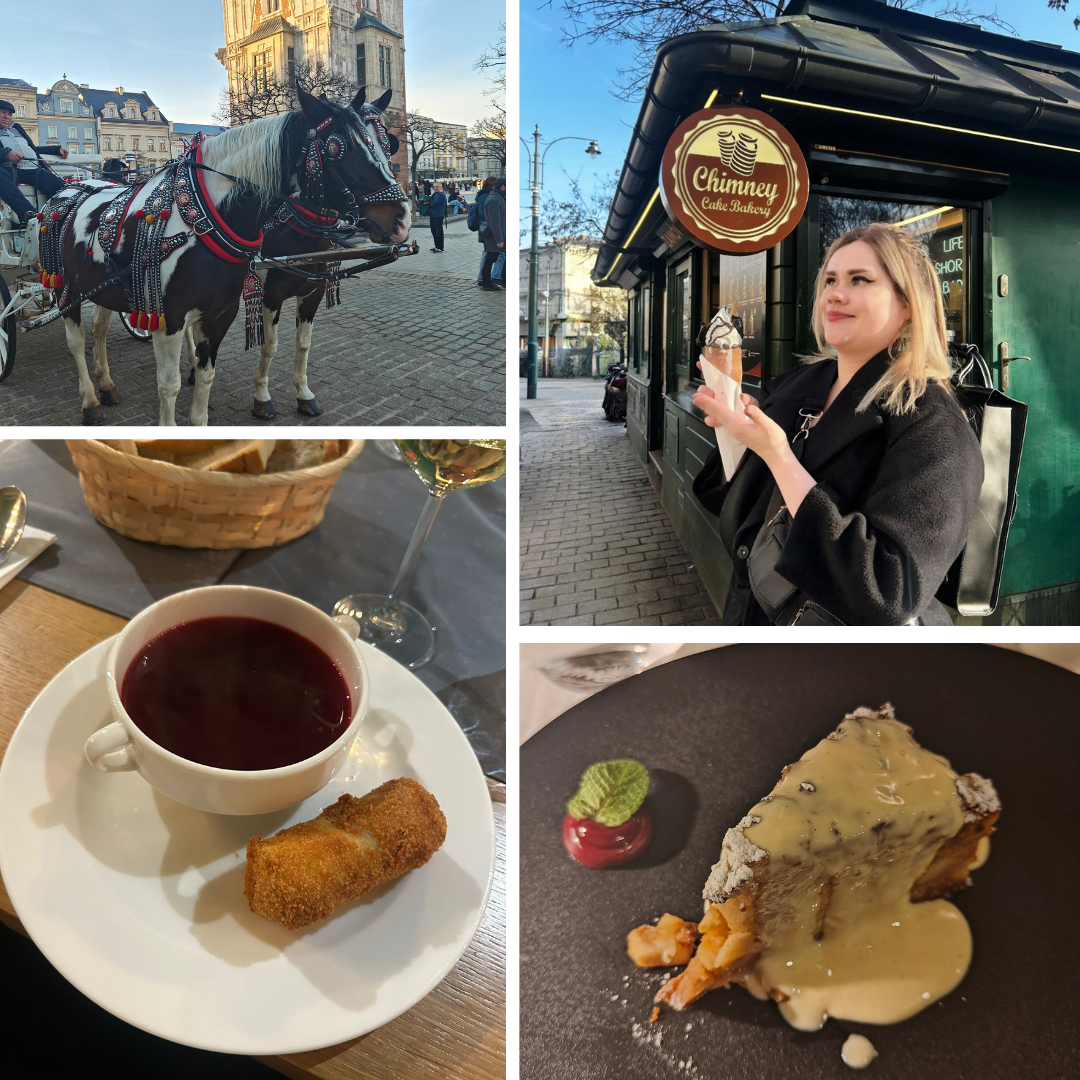
On the second day, we had time to do a bit of shopping near the Old Town. We visited a shopping center called Galeria and came across a stall selling chimney cakes. You could have them filled with ice cream, which was Kati’s choice on that sunny spring day. This is definitely a treat we would love to try again!
This time, we did not choose the restaurant ourselves but attended the conference dinner at the elegant Pod Gruszką restaurant. There, we got to taste, among other things, borscht soup in beautiful surroundings and, of course, to chat with other conference participants. We discussed, for example, about similarities and differences between Finnish and Hungarian. After dinner, we felt like having dessert and stopped by a nearby Michelin star restaurant (Kogel Mogel) for slices of apple pie. Jenny also ordered an interesting mocktail combining basil and grapefruit flavors. It was surprisingly good! During our walks in the Old Town, we saw several horse-drawn carriages, clearly part of the city’s weekend offerings, though we decided to skip them this time.
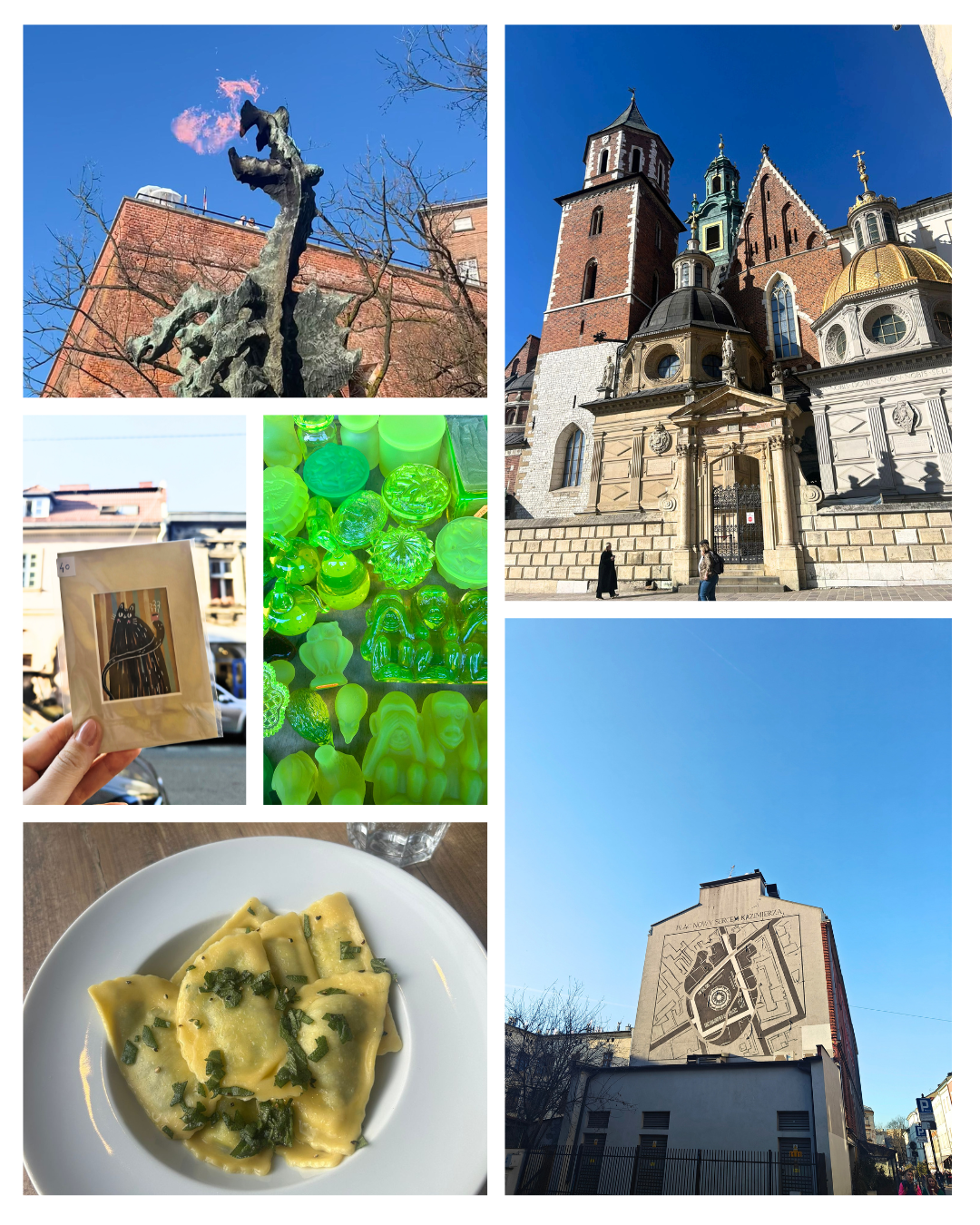
For the final day, we saved two popular attractions: Wawel Hill and the Kazimierz district. We only had time to admire Wawel Castle from the outside, but we bought tickets to visit the more compact cathedral. The cathedral was quite ornate, and from the bell tower there was a view over the city of Kraków. Of course, we also walked to the famous dragon statue and waited until we saw it breathe fire. The day was sunny; crocuses were blooming on the hill, and a hot air balloon floated in the sky. The dragon would probably be more impressive in dimmer light, but it’s hard to beat a walk in spring weather.
From Wawel Hill, we headed to Kazimierz, which had been recommended to us as a “hipster area.” It truly lived up to the description: the area was full of charming cafés and bars, colorful flea markets, small craft and art shops, and young, stylish people. We had planned to eat at one of the trendy spots, but Saturday turned out to be such a popular time that we couldn’t get in anywhere! As souvenirs, however, Kati found cat-themed art, and Jenny bought glowing uranium glass as a gift for her sister. We only managed to eat on the way back to the hotel. On the verge of starvation, we ended up in a modest-looking Italian restaurant, where Jenny had absolutely excellent ravioli in sage butter sauce!
In the evening, we set up a UMK watching session in our hotel room. We bought snacks from nearby shops and kiosks, and thanks to the affordable prices, we also stocked up on sweets and drinks to take home. Jenny warmly recommends the pink Polish raspberry gin Gin Białowieski Malina. We also found treasures on the biscuit and chocolate shelves, such as strawberry-and-basil filled chocolate and chocolate cookies containing dried blackcurrants. We also recommend trying pretzels from the street stalls around the city.
All in all, we were left with a very positive impression of the trip! People in Kraków were friendly, the city was beautiful, and the service was polite. The ICCAP conference was also a great success, so we will most likely attend the next one, which will be held in London in 2028.
Jenny and Kati