Chemistry and physics learning paths
The main goal of the project is to develop and study solutions that support learning in lower secondary school chemistry and physics education. The key objectives are:
-
To create a learning environment that supports and promotes chemistry and physics teaching, learning, and motivation.
-
To explore how digital learning materials can enhance engagement, motivation, and student agency.
-
To produce research-based knowledge on learning of concepts and skills, as well as the role of engagement, agency, and emotions in different learning activities.
The research focuses on, among other things, the role of making mistakes in learning and the importance of experimental work in blended learning, where online learning is combined with traditional classroom teaching. Additionally, the study examines how science capital and socio-emotional skills influence learning. The aim is to strengthen learning, student agency, and engagement, as well as to boost learning motivation in chemistry and physics education.
Participating teachers and their student groups will be provided an access to chemistry and physics learning path materials in the ViLLE learning environment, maintained by the University of Turku’s Centre for Learning Analytics: https://en.learninganalytics.fi/. Research data will be collected over several years through questionnaires embedded in the digital learning path and learning analytics derived from student performance.
The project is part of the EDUCA – Education for the Future Flagship, funded by the Academy of Finland (https://educaflagship.fi/), and is carried out in collaboration between the Department of Chemistry and the Turku Research Institute for Learning Analytics at the University of Turku (TRILA consortium). The principal investigator is Senior Lecturer, PhD Veli-Matti Vesterinen, Head of the Chemistry Education Research Group, University of Turku (veli-matti.vesterinen@utu.fi).
Get to know the learning path materials
Contents
The learning path materials are designed for lower secondary school chemistry and physics, covering all topics outlined in the Finnish national curriculum. The learning path consists of two types of activities: tutorials and general exercises.
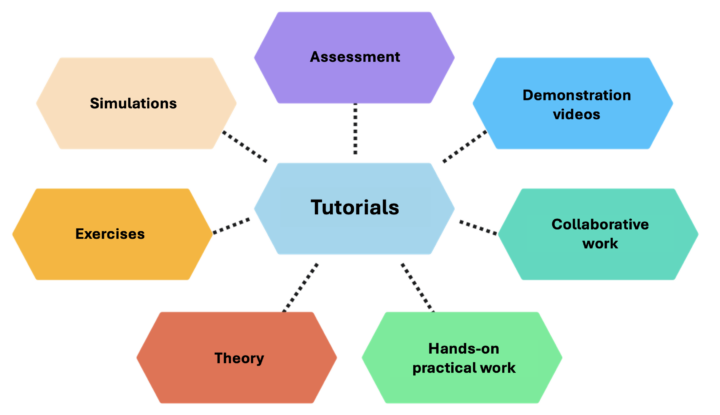
Tutorials are structured units designed for learning specific content areas, where the topic is studied step by step through exercises, instructional texts, simulations, demonstration videos, and hands-on experimental work.
Exercises are designed to test, reinforce, and deepen the content that has already been learned.
Exercises
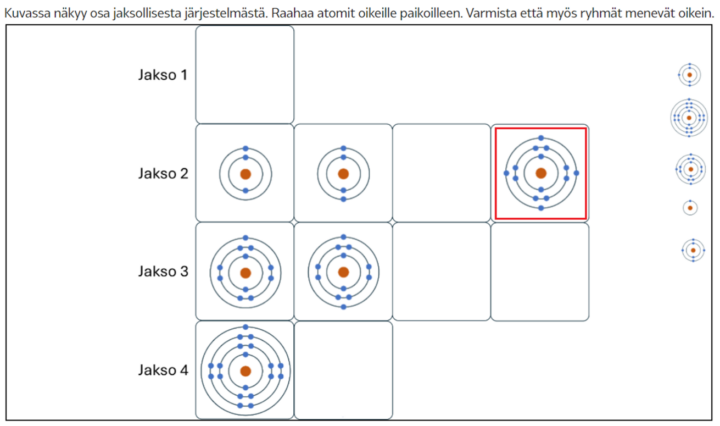
The exercises have been created to align with the Finnish chemistry and physics curriculum content on the topic, without being tied to any specific textbook. In addition, the exercises include supportive material that enables the student to learn the content independently, for example, in situations where they have been absent from instruction.
The exercises are automatically assessed, and students are provided with continuous feedback whenever possible.
Tutorials
Theory is taught directly in the tutorials, so instead of teaching the topic at the same pace for all students, the teacher has more time to assist students who need extra support in understanding the material. Completing the group work tutorials takes about 30–45 minutes, so they can be used as part of a regular lesson, but also, for example, as homework or additional assignments.
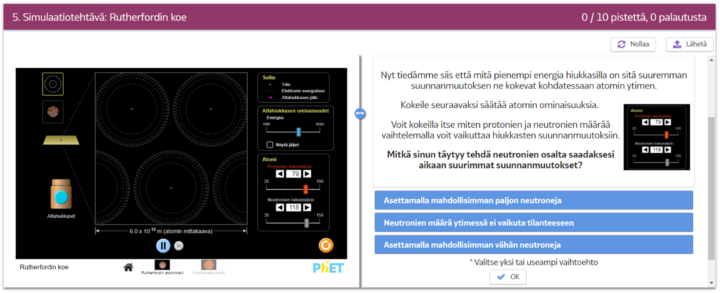
The tutorials aim to make the most versatile use of the advantages brought by technology. Wherever possible, simulations or animations related to the topic have been included alongside the theoretical sections. These simulations, which are directly embedded in the materials, are designed for educational use to enable comprehensive exploration of the subjects. Learning is reinforced through tasks associated with the simulations.
There is a possibility of completing the tutorials in a collaborative mode.
Hands-on experimental work
In addition to regular tutorials, the material includes hands-on experimental work tutorials. The purpose of these tutorials is to provide students with ready-made instructions for conducting topic-related experiments during the lesson. In addition, the tutorial offers the necessary theory, serves as an answer template, and automatically provides feedback based on the responses.
Demonstration videos
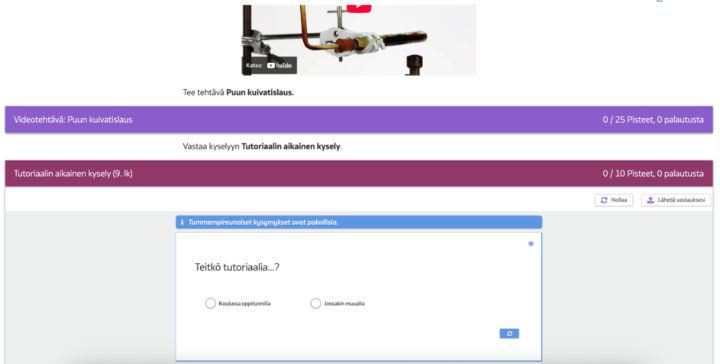
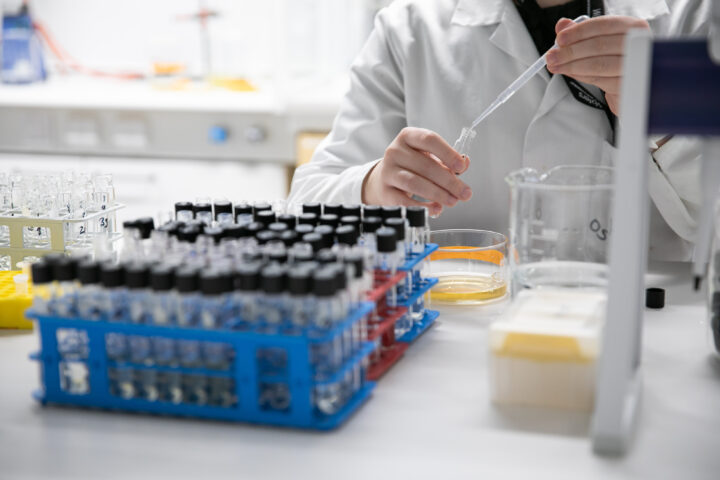
The materials include demonstration videos created by professionals as an alternative approach to hands-on practical work. These allow students to observe the essential parts of the experiment even when, for one reason or another, the experiment cannot be conducted by the students. To ensure learning, the video tutorials include questions and tasks related to the topic.
Research data
The research data consists of questionnaires and automatically collected learning analytics information from each student. The questionnaires are administered within the digital learning path, and they include pre-questionnaires, on-task ecological momentary assessment questionnaires, and post-questionnaires.