8/2026 The Decolonization of Pre-Christian Religion: Aawambo Case Study
The Decolonization of Pre-Christian Religion: Aawambo Case Study
Prof. Leila Koivunen, our FinNamKnow host and collaborator, requested in advance the primary sources authored by the earliest transformed community members we engaged during our visit to Finland in September 2025. This was my first visit to oSoomi, and alongside fellow researchers, I examined several writings by pastors and teachers preserved in the National Archives and National Library in Helsinki.
Establishing a community of teachers and pastors proved challenging for missionaries; however, through perseverance, they eventually succeeded. This is evidenced in the writings collected by Emil Liljeblad from “students” attending the Theological Seminary, locally known as oseminari, and the Female Teachers Training institution, referred to as okagumbo. Notably, I accessed a notebook belonging to my class teacher (1980), Saara Niiye, at Okashandja Primary School, Oshana region.
Employing Anne Stoler’s theoretical framework, which advocates reading colonial accounts both along and against the grain, I discerned that the narratives were heavily influenced by the institutional contexts in which the writers were educated. Their texts reveal that Christianity was presented in an equivocal manner, compelling pastors and teachers to renounce their indigenous culture. Many accounts emphasize the fear of dire consequences as the primary motivation for conversion. Converts documented their former “heathen” lives alongside their new Christian identities in notebooks issued by missionary Emil Liljeblad. These writings explicitly state that early Aawambo conversions were driven by fear rather than genuine voluntary embrace of Christianity, which replaced the Kalunga kaNangombe religion.
Fear of eternal damnation in hell led many converts to abandon their traditional beliefs and cultural practices in favor of Christianity, which promised eternal life in heaven exclusively to its adherents. To secure their place in heaven, converts were required to present evidence to the okangunduhempululithitate – a holy team within the parish responsible for facilitating spiritual approach to Jesus Christ, their savior, who died on the cross to atone for sins. This body also intervened to save those regressing to the heathen life ano ngele taa shuna monima.
One pastor, born into a polygamous family, narrates how he engaged in fornication with his father’s least favored infertile young wife, an act that brought severe punishment including physical beatings and eviction from the family homestead. He describes an incident where feelani caught him in bed with a woman; although no intercourse occurred, the woman was slapped and kicked out of the room. The pastor further narrates his ongoing struggle to control his sexual urges, confessing his sins regularly before the church’s confessing team. In the screenshot below, the pastor tells how he eventually resorted to masturbation – a practice he considered sinful from a Christian perspective –but deemed necessary until marriage. He prayed for divine strength to overcome these desires.
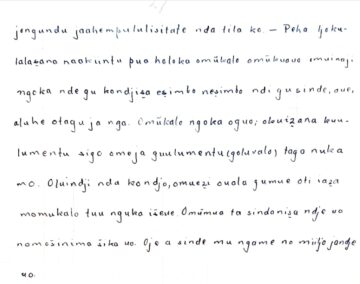
Another pastor confesses to having satisfied his sexual urges through sodomy with cattle, homosexual acts, and eventually with a virgin niece whom he introduced to sex at an early age, resulting in pregnancy. He persuaded her to undergo an abortion, which tragically led to her death. Additionally, a pastor writes about planning and engaging in sexual activities with friends during summer vacations at the Theological Seminary. Knowing this was against Christian morals, they agreed to select one person to confess upon returning. When no one took responsibility, the author joined contract labor where he was haunted by guilt. Eventually, he confessed to the omuhongi and was readmitted to the seminary.
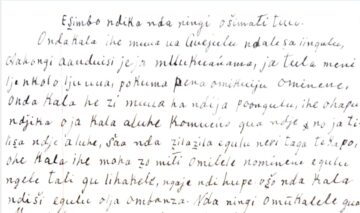
The image above depicts a pastor who, as a young boy, tended pigs at King Uejulu’s palace in Uukuanjama. When German/Rhenish missionaries arrived and established their mission near the palace, local people began attending church services held under large fig trees. The boy was fearful after hearing a sermon from omuhongi describing the collapse of heaven and earth, which led him to hide under huge trees from time to time hoping to survive, when heaven, which he imagined as a dry animal hide (ombanza) fall it will hang on the branches.
One account describes a newly christened man who fell ill and experienced a vision (emoniko) where angels instructed him to spread Christianity among pagans, including his polygamous parents. The angels told him to give each parent a Bible and hymn book to encourage their renunciation of heathen life. Another narrative recalls physical abuse and food deprivation from a maternal uncle, which the author forgave upon receiving Christ.
Finnish missionaries condemned traditional Aawambo healing practices, punishing those who sought traditional healers’ services by excommunication (taa kondwa megongalo) or barring them from church sacraments such as Holy Communion. Two pastors confessed that their parents had used traditional healers (eendudu) who cured their illnesses, which ceased after embracing Christianity. One pastor recounts how his father abandoned traditional healing practices after conversion. Some of the father’s healing objects displayed below (eemwiya depata) are now housed at the Finnish Heritage Agency’s Collection and Conservation Centre. It remains unclear whether these items were handed over by the traditional healer himself or arranged through his son.
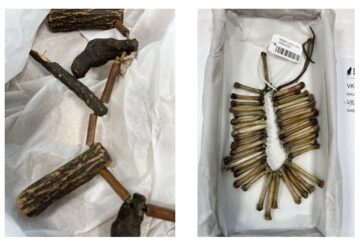
In August 2025, while preparing for my trip to Finland, I interviewed traditional healers in the Ohangwena region of Ovamboland regarding these healing objects. As custodians of ancestral clan lineage, they shared their paths to becoming healers, often involving prolonged illnesses untreatable by modern medicine. Their relatives would cross into Angola to perform ancestral rituals (hano ya ka tumbikwa) to appease spirits. They assert that whoever surrendered these eemwiya depata to outsiders, in this case missionaries, invited an irreversible curse that could haunt their clan for life. The healers concluded that peace would only return after appropriate rituals were performed over a chosen successor to continue the work of the pastor-traditional healer who betrayed the ancestors.
As a child, I wondered how and why the Aawambo converted to Christianity, and whether they were religious before its introduction. In 1996, I enrolled at the University of Namibia as a student teacher majoring in an African language (Oshiwambo) and History. For my fourth-year mini-thesis, I wrote “Thousands of Needy Heathens: Christianization and Cultural Change – Oniipa Case Study”. My interest deepened, and I pursued a Master’s degree expanding my research to “Christianization and Cultural Change in Northern Namibia: A Comparative Study of the Impact of Christianity on Oukwanyama, Ondonga, and Ombalantu, 1870–1971”. The earliest pastors’ self-written histories in the Helsinki archives significantly clarified the process of Aawambo Christianization.
Finally, I urge the custodians of these archival materials to digitize and translate them into English to enhance accessibility for researchers and readers worldwide. This would illuminate the Finnish Missionary Society’s identity, agenda, methods of introducing Christianity, and the cultural consequences it imposed on the Aawambo. These archives reveal a legacy of cultural genocide that necessitates reparative truth-telling regarding the missionaries’ prime motives and their impact on Aawambo culture.
Lovisa Tegelela Nampala
Images: Lovisa Tegelela Nampala
References:
Afrikan lähetyskentän arkisto, Ha 2, Seminaarilaisten elämäkerrat ja kirjoitukset, 1941, 1951, 1956–1960, Suomen Lähetysseura arkisto, National Archives of Finland:
- Teacher Saara ja Niiye (1325–1328)
- Pastor Sem Kaukungwa, Ohalushu, Ohangwena
- Nestori Willinlinen, Pa Harris, KAMA OMUKWANIILWA GUASUANA
- Pastor Matias Sikondombolo
- Pastor Efraim Angula
- Pastor Josua ja Hanjango, Oniipa, 23/9/42
- Pastor Sakaria Hamutenya – Edundja, Uukwanyama book 21, page 37, Yikko 7. G. np 3.973–978 and Ndosaoloka Sakaria, 59, 1979–1981
Miettinen, Kari. 2005. On the Way to Whiteness – Christianization, Conflict and Change in Colonial Ovamboland, 1910–1965. Helsinki: Suomen Historiallinen Seura.
Nampala, L. T. 2006. “Christianisation and Cultural Change in Northern Namibia: A Comparative Study of the Impact of Christianity on Oukwanyama, Ondonga and Ombalantu, 1870–1971,” in V. Shigwedha (ed.), Aawambo Kingdoms, History and Cultural Change: Perspectives from Northern Namibia. P. Schlettwein Publishing, Switzerland.
Shiweda Napandulwe and Lovisa Tegelela Nampala. “Traditional Aawambo Healing Practices that have Survived the Influence of Finnish Missionaries in Northern Namibia,” in Leila Koivunen and Raita Merivirta (eds), Colonial Aspects of Finnish-Namibian Relations, 1870–1990. Finnish Literature Society (SKS), Helsinki, 2024.
Stoler, Ann Laura. 2002. “Colonial Archives and the Arts of Governance,” in Carolyn Hamilton et al. (eds), Refiguring the Archive. Cape Town: David Philip.
Interviews:
Ismael Kaudinge Lazarus, interviewed by Lovisa Tegelela Nampala, 23 August 2025, Etomba, Ondobe, Ohangwena
Hiwanapo Shimwiikileni, interviewed by Lovisa Tegelela Nampala, 24 August 2025, Eeshoke, Ohangwena.