9/2026 Reading Rukwangali in Finnish archives
Reading Rukwangali in Finnish archives
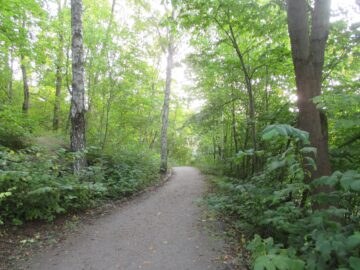
Pathway on University of Turku Campus. Courtesy: Author
Traveling to Turku meant I had to prepare myself for a long flight and anticipate what material I could possibly find in the archives about Kavango. A compulsive and unexpected encounter that demanded a personal reflection on my lineage unravelled along the trip. Being a Kavango, I found myself reading into historical text about the Vakavango settling along the Kavango river and what Kampungu (1965) perhaps referred to as the becoming of ‘Kavangolese’.
Arriving in Turku on a weekday in September 2025, felt like walking on a sticky slippery slope. Heavy wet rainy days followed and persisted. Coming from Namibia, a partly desert country that does not receive so much rain, it was refreshing at the beginning and soon this perception changed. I love the rain, but this much rain got me into a slump mood. Nonetheless, I had to settle down and soon get into the ‘swing of things’ and get some research work done. First thing, I had to get a suitable jacket and an umbrella to brace the weather. I really enjoyed the easiness and open views of Turku, not crowded, no skyscrapers and walking through the woods’ alleys in-between campus buildings really calmed me. I also realize how this rain experience in Turku was different from back home Namibia. Rainfall in Namibia is a short-lived treasured moment, no matter how heavy it is we know that it eventually comes to an end, unless it is mudumbi [rain that persists over a couple of days]. But rainfall in Finland felt like it was not ending soon. I felt like in Namibia rain was considerate and gives us time to go about our daily routine. In Finland it could start raining anytime all day and over days and one must figure out what to do, walk in the rain or change plans. Because it rains in Finland kapi azi seka usinmbu [it doesn’t stop raining soon]. I soon learned that rain or not, you must go on about your day. Like, walking your dog in the rain if you must. From my observations, everyone seemed to be so locked in their daily routines, no gestures of acknowledging someone crossing paths with, like a head knock or something.
‘Follow the blue dots’
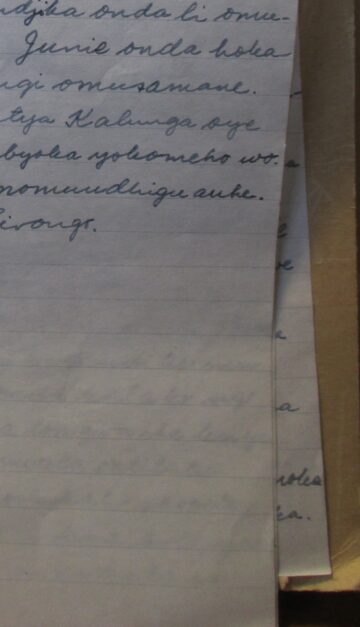
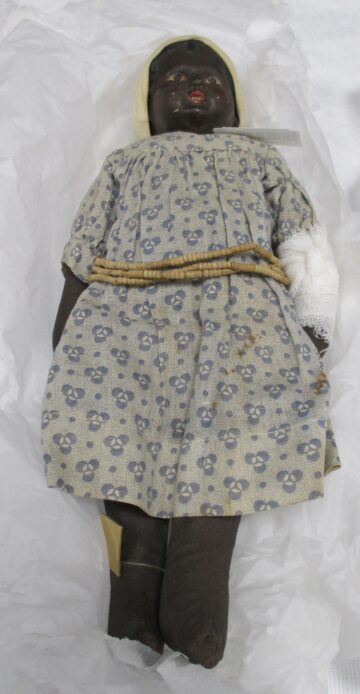
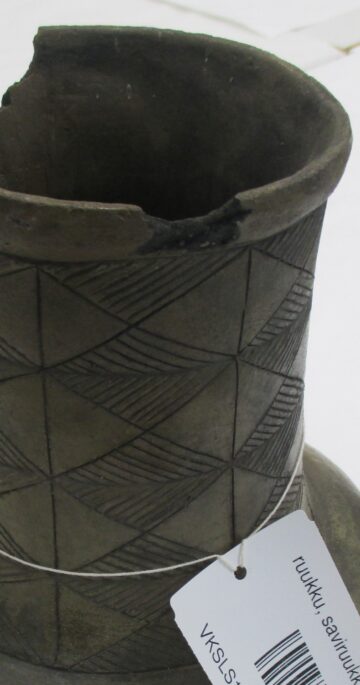
Handwritten biography, black doll and Kavango clay pot. Helsinki, National Library of Finland; Collection and Conservation Centre, Vantaa. Courtesy: Author.
Soon, I became ‘locked in’ with my phone and computer. I appreciated that one could access the needful online. I was comforted by the fact that I could search and make my reservation on sources from the library remotely, including those in Helsinki National Library, while I was in Turku. This made it easy to plan my library visit, as I could block out dates to the library and go through material from the archives. My first visit to the National Library of Finland in Helsinki felt like going through a maze. Although I was given directions on how to access the different parts of the library, getting lost is something I do naturally. I found myself circling back at the reception desk, and the lady at the help desk told me the directions again and cautioned me to follow the blue dots on the floor and that helped. Trailing through narrow corridors, following blue dots leading to a reserved room with my material on the shelf reserved under my name. The few days at the library were about opening old boxes and folios, which felt like a forensic exercise but exciting. I was curious about any material that included Finnish missionary activities in Kavango, as that is not widely covered and my key interest. I was very surprised to come across several old texts which I have not been able to access in Namibia. Rukwangali by Tuulikki Juntunen with illustrations by Raili Toivanen from Omama tava Sanseke (1962), Kwketu KoKavango (n/d) Ose Vakavango (1963), Yokuhamena Episuro lyovanona (1969). These sources were such a joyful find. Most of these texts were used for teaching in Kavango schools including songs, poems and histories about Vakavango people. Some of the texts also covered craftsmanship in basketry and pottery. Though I had little expectations on what I could find in the library, I was surprised that Rukwangali old text was retrievable as these sources could enhance my research. There were also several publications that were in Finnish, with a language barrier that was challenging what to retrieve from them. I had to use Google Translate and Deep L to get a clue about what these materials covered. I am yet to unpack and make sense of all the retrieved material, but I documented most of the sources on my phone and there after emailed to myself, including those in Finnish, perhaps I could ask someone to translate at a later stage.
‘With Vaholi [beloveds]’
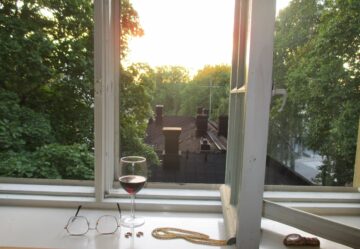
Room window view, Turku. Courtesy: Author.
Turku was isolating, it is so developed that you literally can go days without any human interaction. Later, I deliberately avoided self-checking counters at the shops for me to get some human contact. A simple exchange of ‘moi’ and ‘kiitos’ was comforting and reassuring in ways I can’t explain.
Being away from home created a longing for many things, but the most immediate was not being able to speak or hear Rukwangali being spoken publicly. This is a given, but it manifested in a state of internal self-othering. It was, therefore, a wholesome experience when vaholi [beloveds], Napandulwe, Tegelela and Ndapewoshali finally arrived in Turku. It softened me in ways I did not expect; I now felt connected to my vaholi even in my self-othering moments including the ‘Finnish politeness’ moments. I soon realized ‘Finnish politeness’ came with a lot of silences that lingered longer than my expectations as I was cautioned by some friends who have travelled to Finland before that I do not misjudge it as rudeness. Vaholi and I reflected on archival material which was difficult to unpack as they brought on mixed feelings. Not sure what made it more difficult to unpack the closely scheduling of activities or simply learning how to get to places over Google Maps. In those moments, I appreciated sharing meals with vaholi, even traditional yisima [porridge] and mutete [dry spinach], courtesy of Tegelela as opposed to eating alone. Conversations with vaholi interlaced between work, politics, family, leisure, love life and our individual research in the FinNamKnow research project.
Visiting Finland is incomplete without indulging in Finnish cultural activities, mushrooms and berry picking, and going to sauna was on the programme. I pleasantly enjoyed making mushroom soup from my wild picking and I picked so many blueberries and lingonberries that lasted me long and became part of my breakfast treats. Although it was not my first time going to the sauna, it remains an awkward activity for me. As a veteran hostel-dweller, I don’t find nudity awkward, but basking in a steamy room and dripping sweat in the nude left me baffled. What was I supposed to feel, maybe it’s one of those acquired pleasures. Maybe one day I will enjoy the sauna and even long for it, such a time is yet to come and for now I pack it away in a memory box.
My challenge was making sense out of the experiences from the ‘Finnish politeness’ to an isolating public interaction and being lost in the streets. I do feel the weight of writing a blog to reflect on my experience and thoughts, I must now find the right words to detail my experience. I’m taken back to the biographies we discovered in the archive written by Omusita Matias Sikondomboro, Omama musita Gideon Muremi, Omama musita Aser zaLihongo and Otate Natanael Sirongo, most are no longer with us. Did they face the same compression to writing about their biographies and experiences in Finland for some? Somehow reading their names in the archives was heartwarming as I have close relations with their children and grandchildren. Being in Turku and being part of this research group has challenged me in ways I could have not imagined. Some moments brought difficult conversations that I would have never engaged in. Some conversations were hard and left me puzzled, maybe one day I will be able to ‘follow the blue dots’ and connect the dots. I remain curious…
Maria AN Caley