3/2026 The Decolonial Christian Historian
When I joined the heritage and cultural sector in 2014, unlike many of my colleagues, I did not do so as a historian or anthropologist. In fact, if I believed in coincidences (which I don’t), I might describe it that way. However, I believe that everything that happens in our lives forms part of God’s plan, even when we do not understand it. With that in mind, one of the things I never expected to become was a historian, and certainly not a decolonial one.
I come from generations of staunch Christians. My ancestors converted to Christianity, lived with Finnish missionaries, shared knowledge with them, and worshipped alongside them. At the same time, we are deeply and undeniably African. Because of that, there has always been a quiet curiosity within me about where those worlds meet and where they diverge.
What I never imagined was that I would end up where I am today, confronted with the task of finding my place within this complex relationship between myself and my beliefs, and the beliefs of my parents, grandparents, and great-grandparents, particularly in relation to Finnish-missionary-led Christianity.
As a practising Christian, I often face a question that many historians wrestle with. How do I reconcile the manner in which German missionaries such as Herman Tönjes wrote about the people among whom they lived? How do I reconcile the atrocities committed by missionaries such as Martti Rautanen against the spiritual and cultural lives of the very communities they lived amongst? After a long and winding journey through different ideas, arguments, and perspectives, these questions remain.
It would be dishonest for me to pretend that I do not understand colleagues who have walked similar paths and ultimately rejected Christianity altogether. I also cannot pretend that I do not understand those who feel deep anger towards Christianity and see it purely as an oppressive system used to colonise and suppress African people.
I have felt that same anger myself. I felt it while reading missionaries such as Tönjes describe my ancestors as heathens while writing that his publication Ovamboland was “a humble contribution to the solution of the Ovambo issue”, thanking the colonial office for its support while living among my ancestors to pursue this work.
I felt it while sitting with museum collections filled with the cultural belongings and assets of my people, stored in Finnish museums after having been collected by Finnish missionaries, while those same missionaries had convinced my ancestors that they were evil and needed to be disposed of.
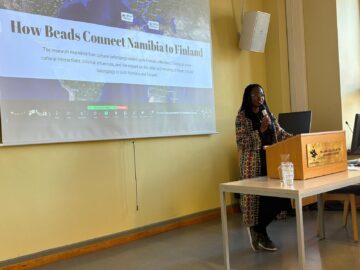
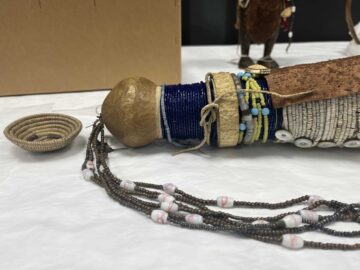
Left: Decolonisation* of Academic Spaces, Black History Month 2025 In Helsinki, Decolonising Finnish-Namibian History, Helsinki Collegium Of Advanced Studies, Helsinki, Finland, Tuesday, 16 September 2025. Photo: Leila Koivunen. Right: Collection and Conservation Centre in Vantaa, National Museum of Finland. Own Photo
It has taken me a long time to answer these questions for myself, and I have spent a lot of time choosing simply, not to. However, with this project, I am finally forced to confront the realities that have caused me so much turmoil and to find a place where I can stand, confident in my convictions.
So, my answer has gradually become this.
While I understand why many African historians reject Christianity altogether, the Bible was not authored by the missionaries I spoke about above. In the context of colonisation, one can argue that it was distorted to fit the colonial narrative and, as a result, was used as a tool for the advancement of colonial activity. However, in the same way that a medicine designed for a particular purpose can be misused by some, the misuse does not erase the original function and value. In that same way, I choose to engage with the Bible in the context for which it was written.
Additionally, perhaps it is easier for me to remain firm in Christianity because, although I was born and raised in a Christian home, my journey with Christianity, like that of my ancestors who chose it, has very much been my own. My confirmation classes were not something I approached lightly. I treated them as an opportunity to read, learn, and understand the Bible for myself. When I said the Apostles’ Creed on the day of my confirmation, and every day after that, I meant and continue to mean every word. That was what I believed then, and decades later, after many twists and turns, moving between churches and sometimes staying away from church altogether for long periods of time, I can still say without reservation that this is what I believe now.
However, what I do reject is Christianity forged as a colonial tool.
Colonial Christianity argues that for a name to be considered Christian, it cannot be in an African language, while everything within African cultures is portrayed as evil or witchcraft. Within this framework, pearls are seen as elegant and beautiful, yet cowrie shells and eenyoka are labelled demonic. A bracelet made from gold mined by enslaved people and earrings set with blood diamonds are admired and coveted, yet uuputu mined by free people are condemned.
These arguments are often framed as Bible-led, righteous criticism of African spirituality. In reality, they are attacks on culture and, more importantly, on the power that comes from knowing one’s own history. They seek to undermine the meaning and knowledge carried within cultural practices, symbols, and attire.
Therefore, my place within the FinNamKnow project goes beyond my research, which centres on exploring how beads connect us across histories, communities, and geographies. It reaches deeper into questions around identity and faith, by engaging cultural belongings and assets, archival records, and our diverse project team, to find the answers to questions for myself and perhaps for others like me, decolonial Christians.
Ndapewoshali Ndahafa Ilunga
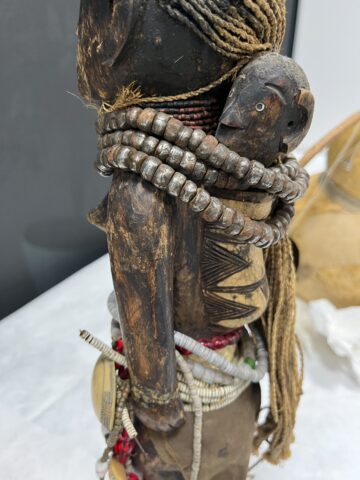
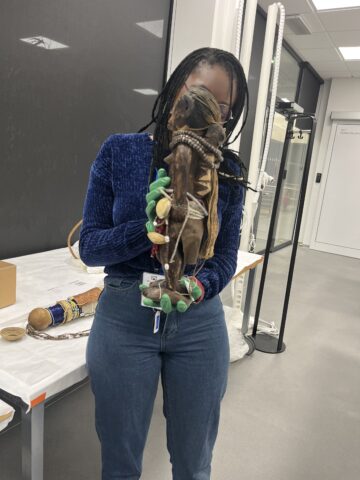
Collection and Conservation Centre in Vantaa, National Museum of Finland. Left: Own Photo, Right, Photo: Napandulwe Shiweda