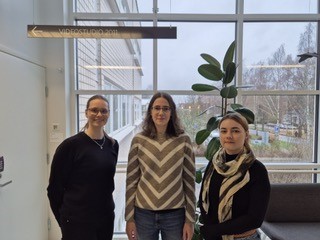
HuDi has three new postdocs!
Meet the new(ish) HuDi postdocs who joined the team in autumn 2026.
Welcome on-board Tatiana, Tina and Susanna!
Tatiana Kachkovskaia is a postdoctoral researcher at the University of Turku, School of Languages and Translation studies. As a linguist and a phonetician, she mainly focuses on language variation and change. At the University of Turku she is trying to disentangle family-related and contact-related features as sources of variation within the Uralic language family, using the UraTyp database (https://uralic.clld.org/) and information about the neighbouring languages; particular focus is drawn to phonological features, both segmental and prosodic. To achieve this goal, Tatiana uses various statistical methods including approaches borrowed from the field of evolutionary biology.
Tina Saupe is a postdoctoral researcher in Archaeogenetics at the Department of Biology and has recently started working in the Elina Salmela’s research group. Her research focuses on the demography history of Eurasia connecting West-Central Asia to the North of Europe through the lens of ancient DNA and the spread of socio-cultural-related pattern. In her new project, she will focus on the ancestral deconvolution of ancient and present-day Finnish subpopulations and explore the effect of inherited genetic traits.
Susanna Ukonaho is a postdoctoral researcher at the Department of Biology, UTU. She investigates the prevalence of diseases, vaccination and survival in historical and contemporary Finnish populations. In her current project, she studies the prevalence and causes of chronic disease in contemporary societies by combining both historical and contemporary multidisciplinary registry datasets from the Finnish Institute for Health and Welfare (THL), and Digital and Population Data Services Agency (DVV) and the National Archives of Finland. Her research investigating spatial patterns of chronic disease is important in identifying how past environments shape health outcomes, providing valuable context for understanding the persistence and evolution of disease risk in human populations.