Event | A Long Road Still Ahead to Achieve Genuine Reconciliation Between the Saami and the State
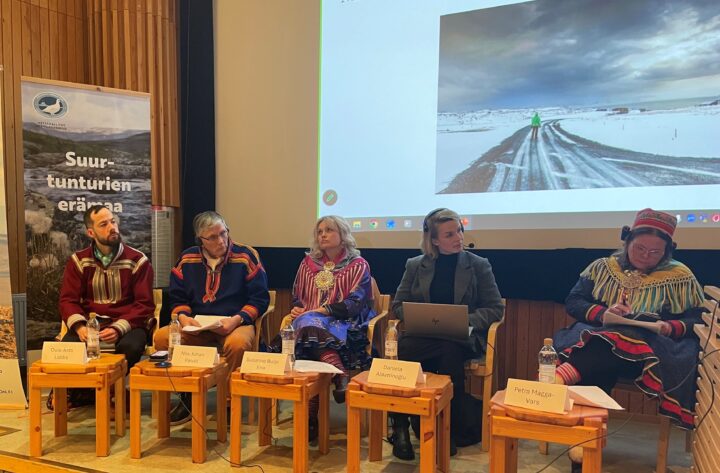
The MARCEN project at the University of Turku, Saami Árvvut ry and the Galggojávri siida jointly organised a panel discussion on Saami rights on 20 March 2026 in Hetta, Finland. The panel addressed, among other topics, the impacts of the Girjás ruling on Saami rights in the wider Sápmi area and the work of the Saami truth and reconciliation commissions. The speakers were Doctor of Laws, Docent and Associate Professor Daniela Alaattinoğlu from the University of Turku; Doctor of Laws, expert witness in the Girjás legal process and Saami reindeer herder Nils-Johan Päiviö from Jokkmokk, Sweden; Saami lawyer and doctoral researcher Susanna Buljo Eira from the Saami University of Applied Sciences from Guovdageaidnu; Saami reindeer herder, lawyer and doctoral researcher Oula-Antti Labba from the Saami University of Applied Sciences from Enontekiö; and Saami reindeer herder, Master of Education and cultural educator Petra B. Magga-Vars from Vuotso. The panel was moderated by Doctor of Philosophy, senior researcher Klemetti Näkkäläjärvi from the University of Turku.
The State Does Not Recognise the Girjás Ruling as a Precedent
Nils-Johan Päiviö depicted the court case between the Girjás (1) (2) Saami village (čearru) and the Swedish state regarding the right to manage small-game hunting and fishing within its territory – a case which the Girjás Saami reindeer herding community (siida) won in the Supreme Court of Sweden in 2020. The Court’s ruling was founded on the principle unbroken immemorial prescription. In Sweden, the state has not changed its general policies regarding Saami land and water rights following the decision, and refrained from making legislative changes. Currently, several ongoing legal cases challenge the Swedish state over the granting of hunting and fishing rights to Saami communities. For the Girjás Saami community, the ruling has had a significant impact, as hunting can now be regulated in accordance with the needs of reindeer herding. Yet, from a broader perspective, the situation remains difficult, because rights must be sought through lengthy legal proceedings when legislation does not safeguard them. The notion of time immemorial, central in the Girjás ruling, can also have implications for Saami rights to land and water in Norway and Finland, since a shared legal system existed between these countries until 1751.
The Girjás Ruling Cannot Be Directly Applied in Finland
Oula‑Antti Labba analysed in his presentation the development of Finnish legislation in relation to the Girjás judgment. In Finland, the key considerations are constitutional provisions on the status of the Saami and the protection of property. Immemorial prescription was part of the Finnish Land Code, which was in force from 1734 until 1996. If it can be proven that a person held such rights before 1996, it is still possible to pursue these rights in court under the old legislation. In Finland, applying the Girjás ruling would be possible in a civil dispute between the state and a Saami reindeer herding community. Labba also noted that the ongoing reform of the Reindeer Herding Act, prematurely commenced before the completion of the Finnish Truth and Reconciliation Commission’s work, lacks concrete measures to protect Saami Indigenous culture.
The Clarification of Land Rights Continues in Norway
Susanna Buljo Eira analysed the 2005 Finnmark Act and compared the Girjás and Kárášjohka court cases (3). Through the Finnmark Act, land ownership and management were transferred to FeFo, whose board members are appointed half by the Saami Parliament and half by the county administration. According to Buljo Eira, the Girjás ruling is a clearer Saami-oriented solution, while the Finnmark Act aimed at balancing interests, as the region is home to a diverse population. The Finnmark Act has been in force for about 20 years, and it mandated the clarification of land rights. In that process, the residents of Kárášjohka (4) were confirmed to have land rights within the municipality, but the Supreme Court of Norway ultimately ruled that land ownership belongs to FeFo. Notably, the Court held that ILO Convention 169 does not contain provisions which would supersede Norway’s national land law.
Truth and Reconciliation Are a Shared Process Between States and the Saami
Daniela Alaattinoğlu analysed transitional justice and Saami truth and reconciliation processes in the Nordic countries. She emphasized that although the commissions have carried out important work documenting linguistic and cultural assimilation and its intergenerational effects, their mandates excluded key issues – particularly land and water rights. This limitation reflects states’ unwillingness to confront the core structures of colonialism. Alaattinoğlu pointed out that transitional justice in the Nordic context is not a transition from authoritarianism to democracy, but rather an internal critique of democracy itself, challenging the notion of the Nordic countries as inherently ‘good states’. She stressed that without the redistribution of power and resources, reconciliation remains symbolic.
Alaattinoğlu also discussed the role of strategic litigation in advancing Saami rights but noted that court rulings alone are insufficient without political implementation. She underlined the responsibility of settler societies to actively participate in the reconciliation process. Finally, she stated that the commissions’ reports are only a starting point: real change requires concrete political measures, especially addressing land and water rights, and strengthening Saami self-government.
Children and Youth to the Center of the Truth and Reconciliation Process
Petra B. Magga-Vars emphasised the need to urgently consider how the truth and reconciliation processes can create a better future for Saami children and youth. Climate change, competing land uses, and the pressures of modern society threaten the continuity of the Saami way of life. Information about the truth and reconciliation commission’s work is needed in basic education throughout Finland – why the process was necessary and what was learned – so that this knowledge is not lost with the current generation. A positive development is the establishment of the Saami Climate Council, where Indigenous traditional knowledge is considered equal to scientific knowledge; this approach should be expanded throughout society.
Improving Legal Status Requires Court Cases
In Finland, Norway and Sweden, legislation does not sufficiently protect Saami rights. The panel concluded that Saami rights are increasingly being resolved in courts. The challenges include lengthy processes, high costs and the exhausting nature of litigation. Although truth and reconciliation commissions have been important steps forward, their mandates excluded land and water rights – raising the question of whether true reconciliation can ever be achieved? The panel presented proposals for how the scientific community could work with the Saami to promote the implementation of the commissions’ findings, and the MARCEN project will continue its collaboration with Saami communities to advance transitional justice.
Text: Klemetti Näkkäläjärvi and Daniela Alaattinoğlu
Photo: Suvi Juntunen