Blog: Project Study Trip to Southern Italy 10.-20.11.2025
In November we did a study trip to Southern Italy with all the project members joining. The purpose of the journey was to meet collaborators, study sources important for our research, and explore the rich cultural history of medieval Italy. In this blog we take you with us on our journey and tell you of our discoveries!
Journey to Rome and round table at Villa Lante
November 10th saw us gathered the Helsinki Airport to catch an evening flight to Rome. After landing we rented a car, which would be vital on our journey to the mountainous south. A long day of traverse had a happy ending as we met with Ned and Jonah, who had travelled to Rome a few days earlier. Ned Schoolman, our collaborator from the US, visited us in the spring, and now brought with him Jonah Bibo, a doctoral researcher under his supervision. Our fellowship had thus gathered!
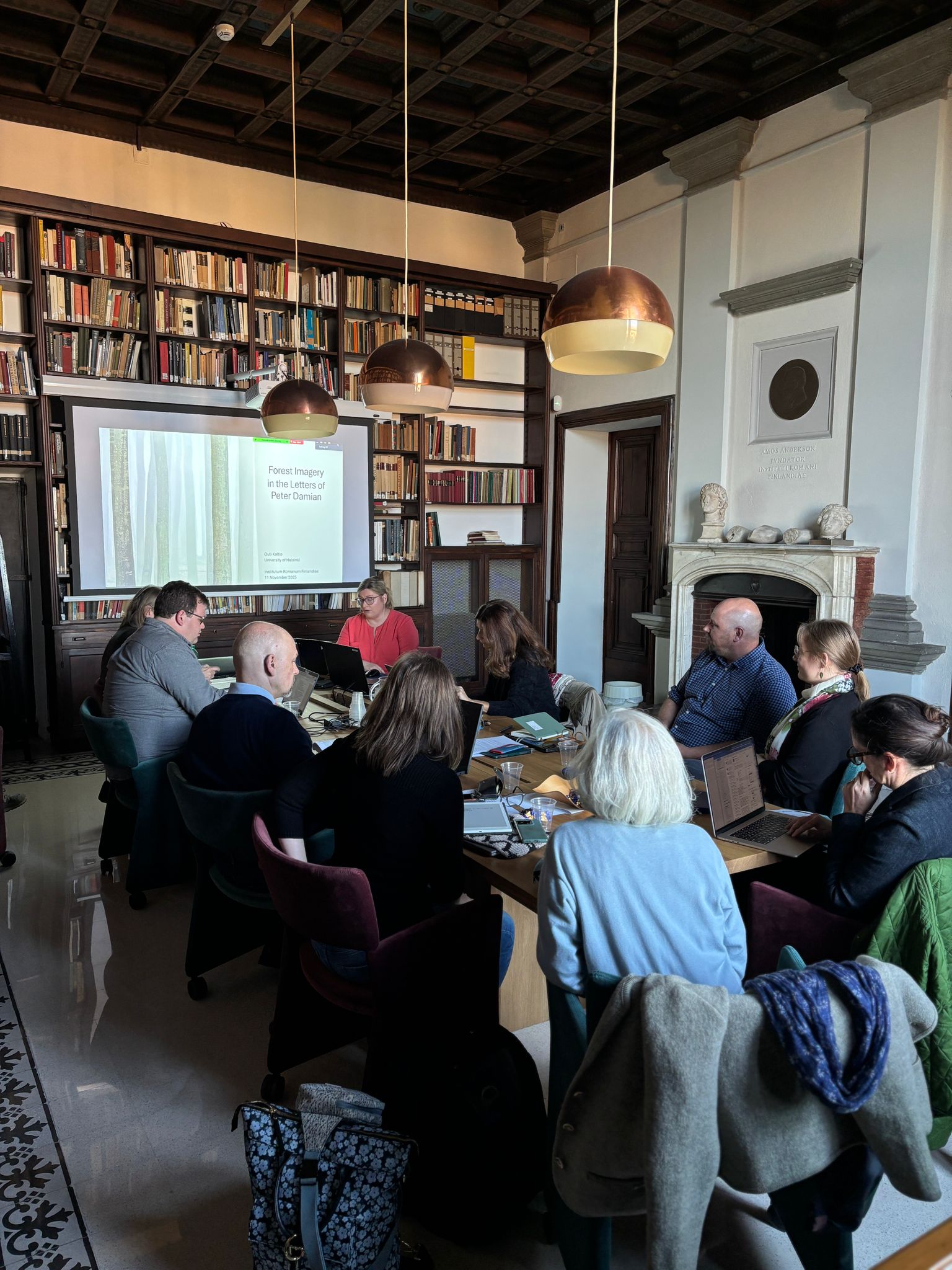
Already the next day was a key moment in our journey, as we held a seminar together with our collaborators working in Italy. The speakers in addition to our project members were Valeria Beolchini (Escuela Española de Historia y Arqueología en Roma), Chiara Paniccia (Ministero della Cultura), Caroline Goodson (American Academy in Rome), and Ria Berg, the director of the Finnish Institute in Rome. The topic of the seminar, Concepts and Uses of Nature in Premodern Italy, inspired the participants to examine the relationship between humanity and nature from a multitude of perspectives, ranging from Antiquity to the High Middle Ages. These perspectives from different fields and periods resonated with each other and created a whole, which shared light on the many changes and continuities in the cultural meanings of nature and environment.
A warm thanks to the Finnish Institute in Rome for the excellent arrangements and hospitality! You can find the program of the seminar on the ‘Papers and lectures’ page.
Departure for South
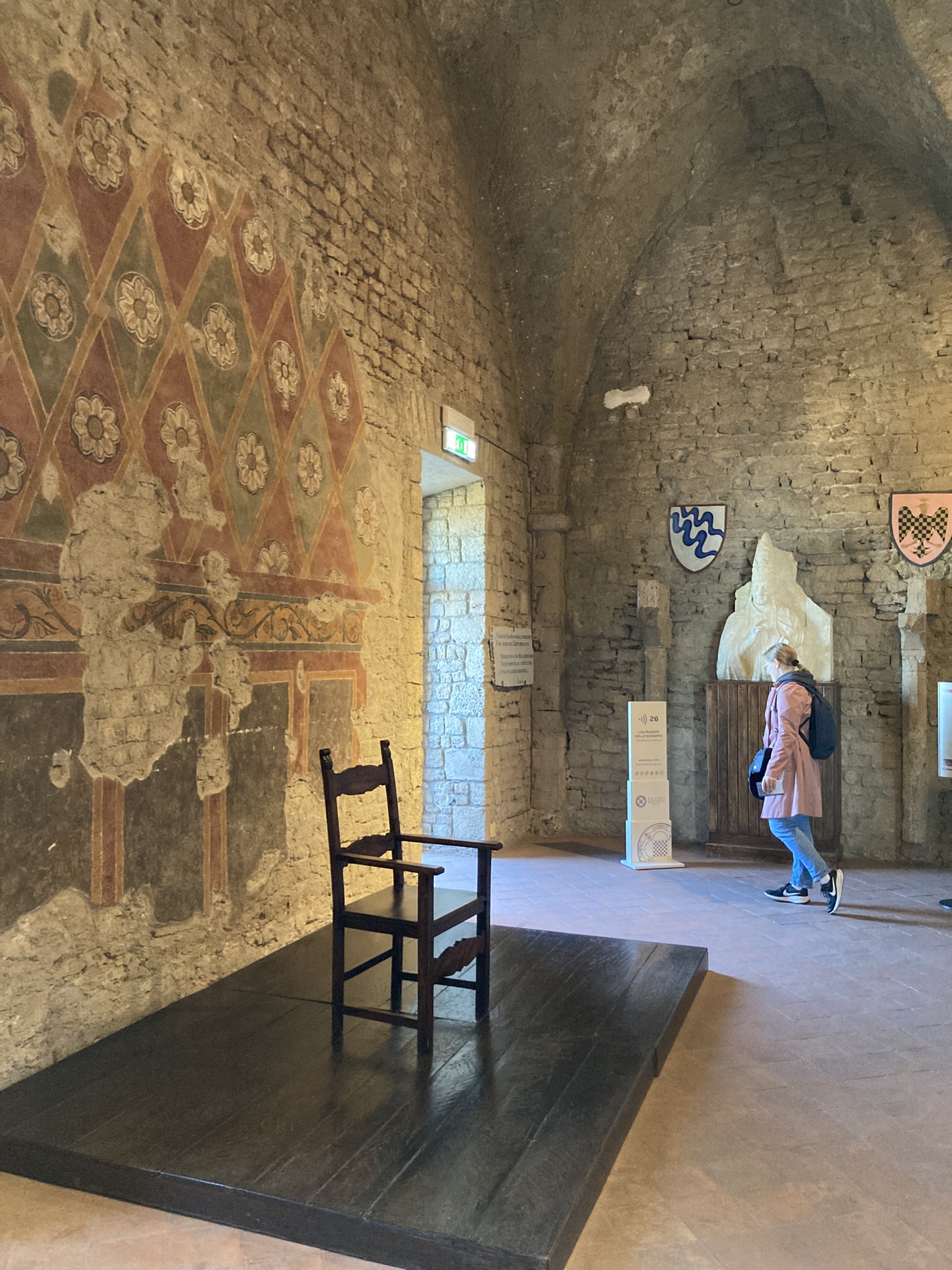
Right after the seminar we drove to Fiuggi for the night, and the next day we travelled to Anagni, a city of great papal significance and strategic importance between Rome and Monte Cassino. The city also functioned as an administrative node for the vast surrounding agrarian and forested lands, and was thus central when decisions were made on the use and felling of forests and on the advancement of settlements and farmlands – that is, of course, on the development of the entire medieval cultural landscape in the region.
Anagni’s political importance is dramatically encapsulated in the year 1303. It was then that Giacomo Sciarra Colonna, a general of forces resisting the papal supremacy captured the city and slapped Pope Bonifatius VIII on the face in his own palace. The gesture was a direct attack – literally – against the Papal States. This was a symbolic turning point, starting the decline of papal supremacy, which never recovered to its former glory. Only a few years later the papal see was transferred to Avignon, which marked the end of this era and kickstarted the change in medieval political power structures.
In Anagni we were especially interested in the crypt of the cathedral, because its 12th–13th century frescoes are some of the best preserved in entire Europe. Not only are they visually stunning, but they also tell us how scientific, medical and philosophical texts merged into the ecclesiastical culture of the High Middle Ages. The result of this fusion was the consciousness in which the ideological justifications and the spiritual frameworks for forest clearing were formed. The crypt also houses one of the earliest depictions of St. Thomas Becket – an important detail for our project’s study of the spread of the cult of saints in Southern Italy.
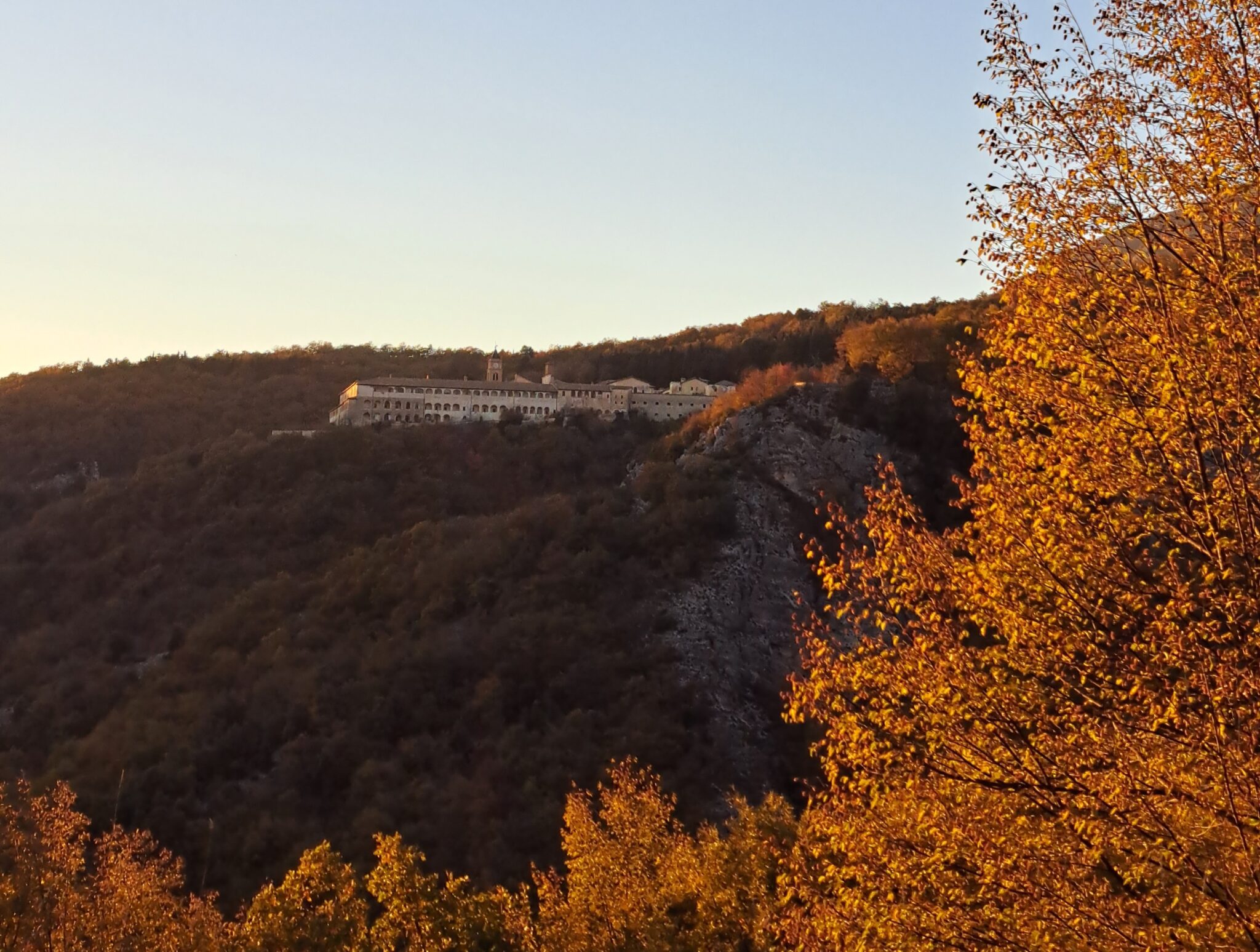
On the same day we headed to the monastery of Trisulti, which was founded by the benedictine monk Dominic of Sora (c. 960–1032) around the year 996. Dominic was a notable ascetic figure and one of the pioneers of the reformist movement in Central Italy: he founded multiple monasteries in remote forests and functioned as their spiritual leader. Local noble families utilized his spiritual charisma and saintly reputation to legitimize the seizing of forest lands and the spreading of settlements. Trisulti was one centre of such actions: Dominicus originally settled in the area to live as hermit, but at the request of his followers he eventually founded a monastery and was its abbot for almost fifteen years.
Arrival to Monte Cassino
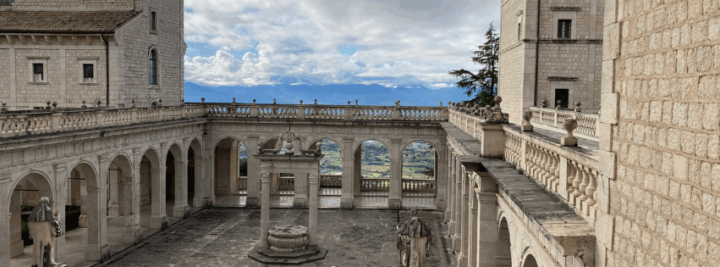
From Trisulti we drove to Cassino for the night, and the next morning it was finally time to climb to the top of the Cassino mountain to explore the monastery of Monte Cassino, the place that dominates the surrounding landscape – and our project, as it is the focal point of our work. Monte Cassino was both the primus motor for the local forest clearing, and a literary centre. In the scriptorium of the monastery treatises on nature, forests and land use were both created and copied. These texts enlighten us on the monastery’s relationship with the surrounding lands and its role as a cultivator of the landscape.
Pope Gregory I (c. 540–604) writes in the Life of Benedict of Nursia (c. 480–543) that before the monastery a temple and grove of Apollo stood on the top of the Cassino mountain. According to him Benedict saw that the temple was destroyed and the trees of the grove felled. As we drove up the serpentine road along the hillside it was easy to understand why this place had been both a scene for religious power and a landmark in the region for centuries – it was as if we were driving in the skies.
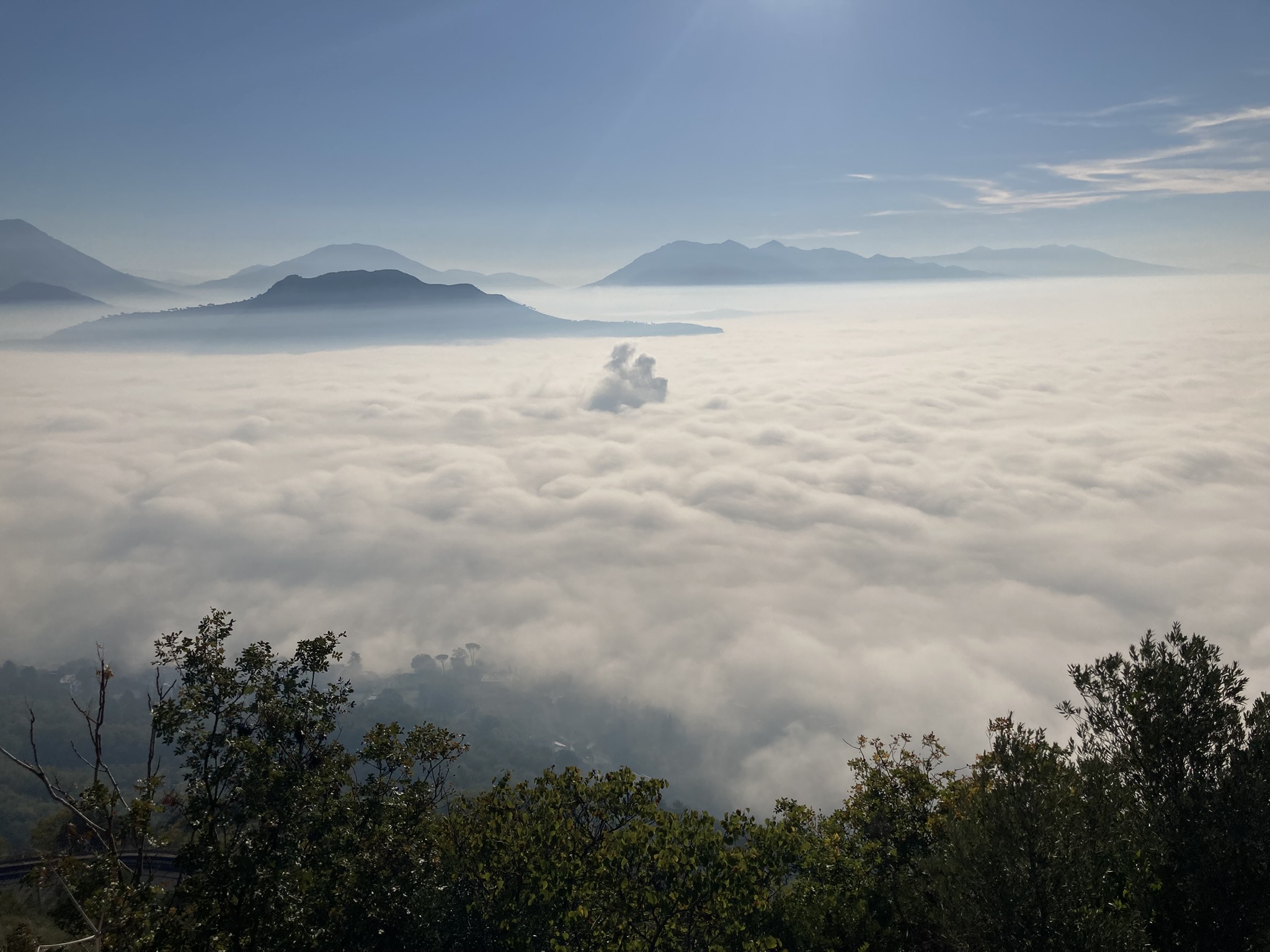
Nowadays nearly nothing is left of the original monastery founded by Benedict. It was first abandoned due to a Longobard attack at the end of the 6th century, and for a second time in the year 883 under a threat of Muslim invasion. A great earthquake in 1349 destroyed the medieval monastery complex, and the last, near complete destruction occurred in 1944 in the bombings of the Allied forces. The present monastery is a reconstruction built after the war, and it imitates the baroque style monastic complex which preceded the destruction.
After exploring the monastery, we had lunch next to the ruins S. Maria in Albaneta, a daughter house of Monte Cassino. Albaneta served as a starting point for a trek up the forested mountain: the goal was to find traces of hermitages, which there were many in the region during the hay day of Monte Cassino. The search was interrupted by the loss of daylight, but trekking and traversing the mountainside in the footsteps of cassinese monks was nevertheless a rewarding experience.

Early medieval monastic splendour
Our fifth day had us visiting two sites: the archaeological park of S. Vincenzo al Volturno and the church of S. Angelo in Formis near Capua. S. Vincenzo al Volturno was one of Italy’s greatest monasteries in the Carolingian period (8th–9th centuries). However, it was destroyed in a Muslim attack in the year 881, after which the site was abandoned for a long time.
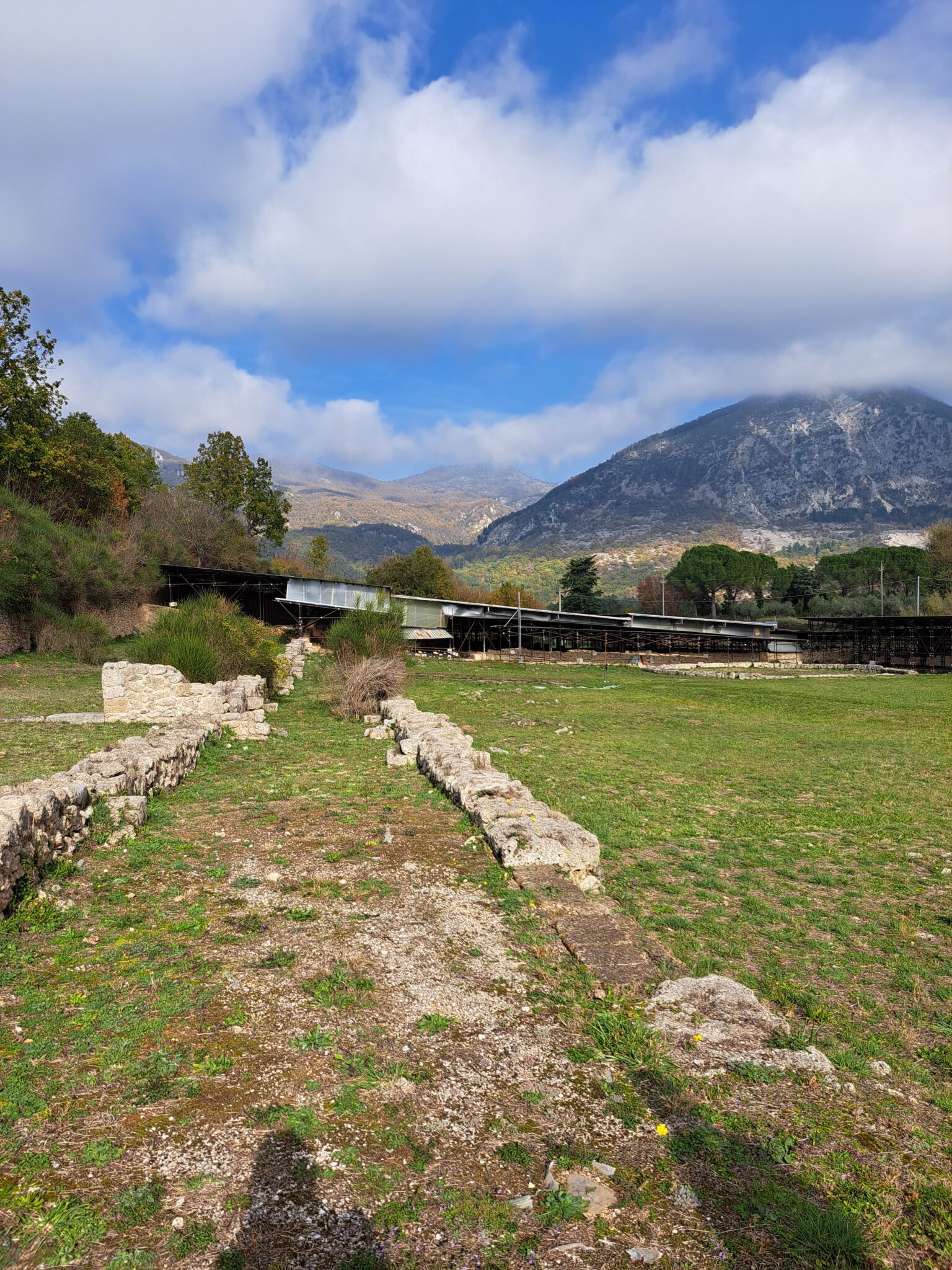
For our project the importance of S. Vincenzo is not confined to its splendour only. In the High Middle Ages it was, alongside Monte Cassino, a key player in land clearing and incastellamento, that is, in erecting new fortified settlements. The monastery had an essential role in the process in which forested areas were seized, settled, and finally tied into the new financial and administrative systems.
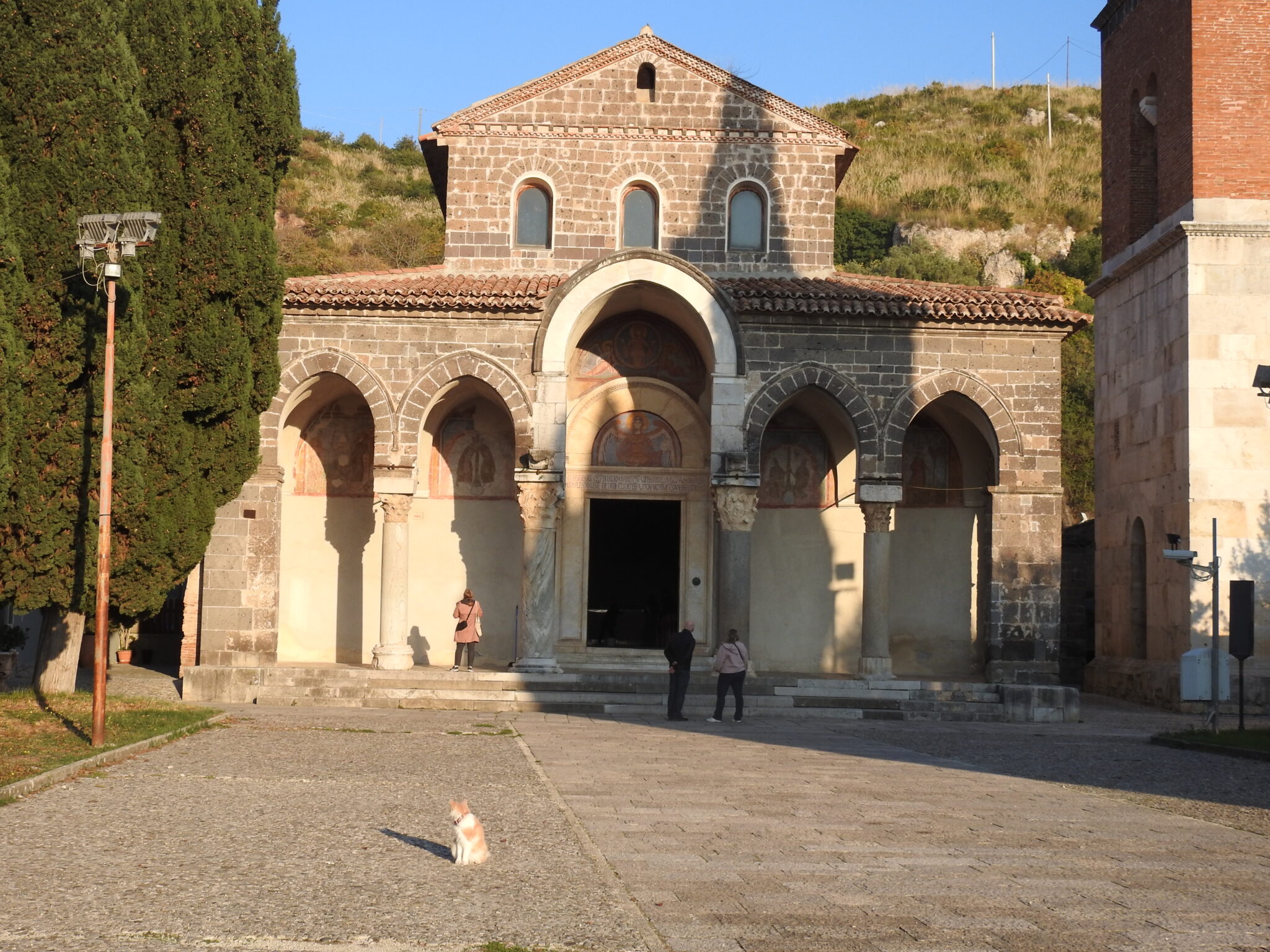
In the afternoon the travelled – in the footsteps of the monks fleeing the destruction of S. Vincenzo – to the lands of Capua. There our destination was the church of S. Angelo in Formis, built on the slopes of Mount Tifata. The church was erected by Desiderius, who was the golden age abbot of Monte Cassino in the years 1058–1087. It houses an exceptional and remarkably well-preserved cycle of frescoes, which runs along the three naves of the church, culminating in a monumental imagining of the Last Judgement on the entrance wall.
S. Angelo in Formis is unique in that it is practically the only preserved example of medieval cassinese art style, which spread to a vast area in Southern Italy due to the great cultural influence of Monte Cassino. At the same time, it is also one of the best-preserved romance painting cycles. Its pictures were part of the visual and spiritual culture which the churches of Monte Cassino’s daughter houses spread in the area, and through which the monastery’s influence also reached the landscape and population.
Tour around Cassino
The last day together with Ned and Jonah was spent on a tour around the area of Monte Cassino. Our first stop was Valleluce, where a Calabrian monk Nilus of Rossano (c. 910–1005) founded a Greek-Byzantine monastery on land gifted by the cassinese abbot Aligerno. Nilus is a centre figure for our project, because his life and actions offer a concrete example of the interplay between Latin and Greek-Byzantine cultures in medieval Southern Italy. From Valleluce he moved to Grottaferrata at the edges of Rome, where he founded a community. Anni’s part in our project is especially focused on Grottaferrata’s efforts in forest clearing and forest rhetoric.
From Valleluce we continued to Castello di Vicalvi, a hill fort which was made a property of Monte Cassino in the beginning of the 11th century, and from there to the church where Dominic of Sora was buried. The last site of the day was the Cistercian monastery of Casamari, which represents a later phase in the development of regional land use and monastic expansion. The tour illustrated tangibly how the network of monasteries, fortified settlements and hermitages shaped the southern Italian landscape, land use and structures of power in the High Middle Ages. In the evening, we said our goodbyes to Ned and Jonah, who left on their journey back to the States.
Short stop in Salerno and archival work in Monte Cassino and Grottaferrata
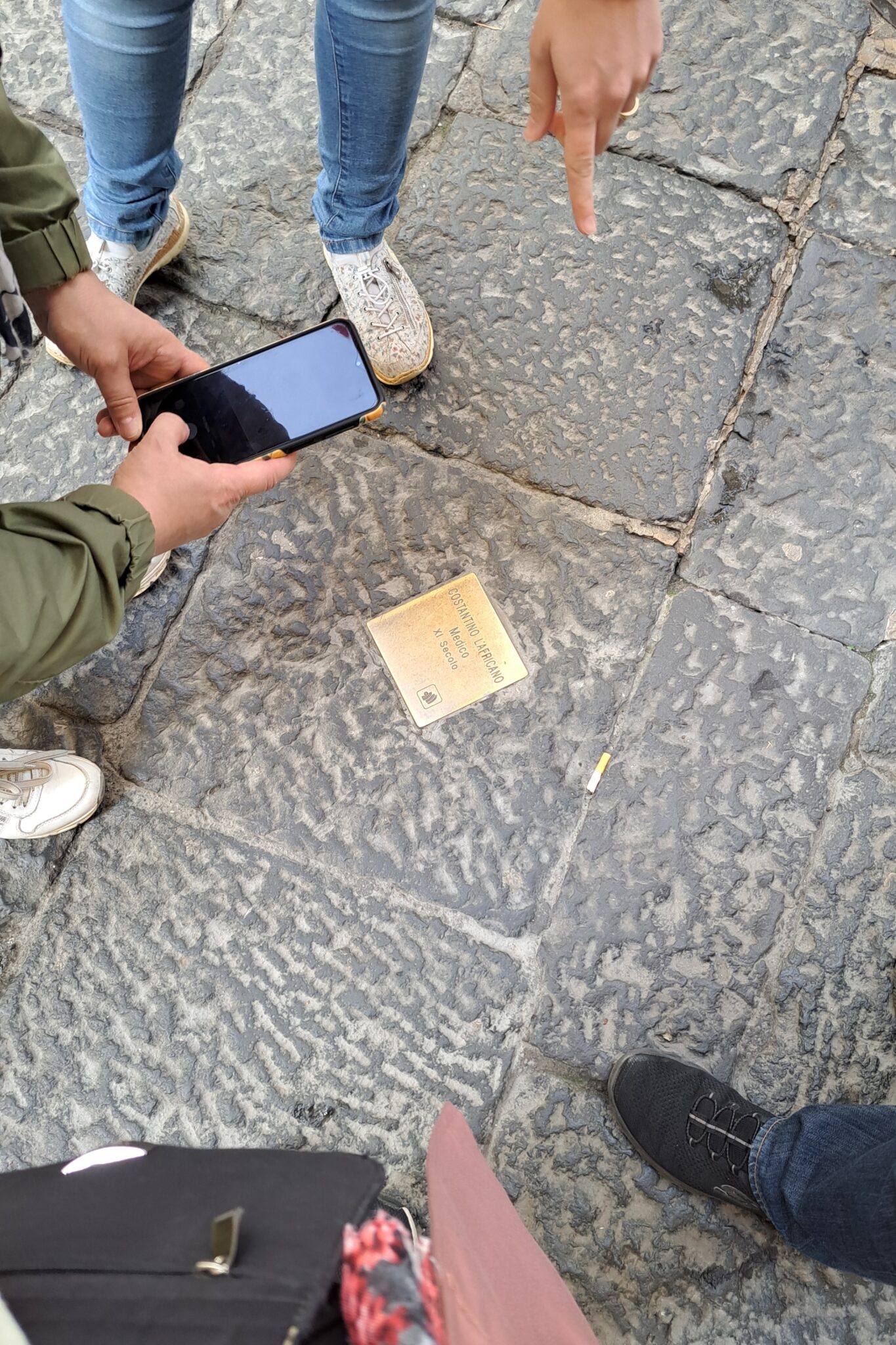
Sunday we spent in Salerno in the footsteps of Constantine the African (d. In the end of the 11th century): a figure who Outi has studies in her doctoral thesis. Constantine, who was originally from Northern Africa, arrived in Salerno in the end of the 1070s, and had a great impact on the city’s development as a centre of medical knowledge. Pantegni, his work which is based on Arabic sources and which he compiled and translated into Latin, revolutionized the conceptions of western medicine. The last decades of his life he spent as a monk in Monte Cassino, where he translated around thirty medical texts from Arabic to Latin. His life and work were a part of the greater cultural and scientifical bloom, under which the new ways of speaking about nature, forests and their control we formed in Monte Cassino.
Anni departed from Salerno to Grottaferrata, and the rest of us returned to Cassino. The next week was to be a key phase of our journey: three days of archival work in the two monasteries. Teemu and Jutta worked with cassinese sanctorals, some of which have not been digitized or edited. Together with Ned they are preparing an article on the connection between forest clearing and the spread of the cults of eremitical saints. Outi, on the other hand, studied manuscripts of Peter Damian’s texts, especially his letters, in which talk of forests and wilderness is tied with the monastery’s spiritual, moral and administrative objectives.
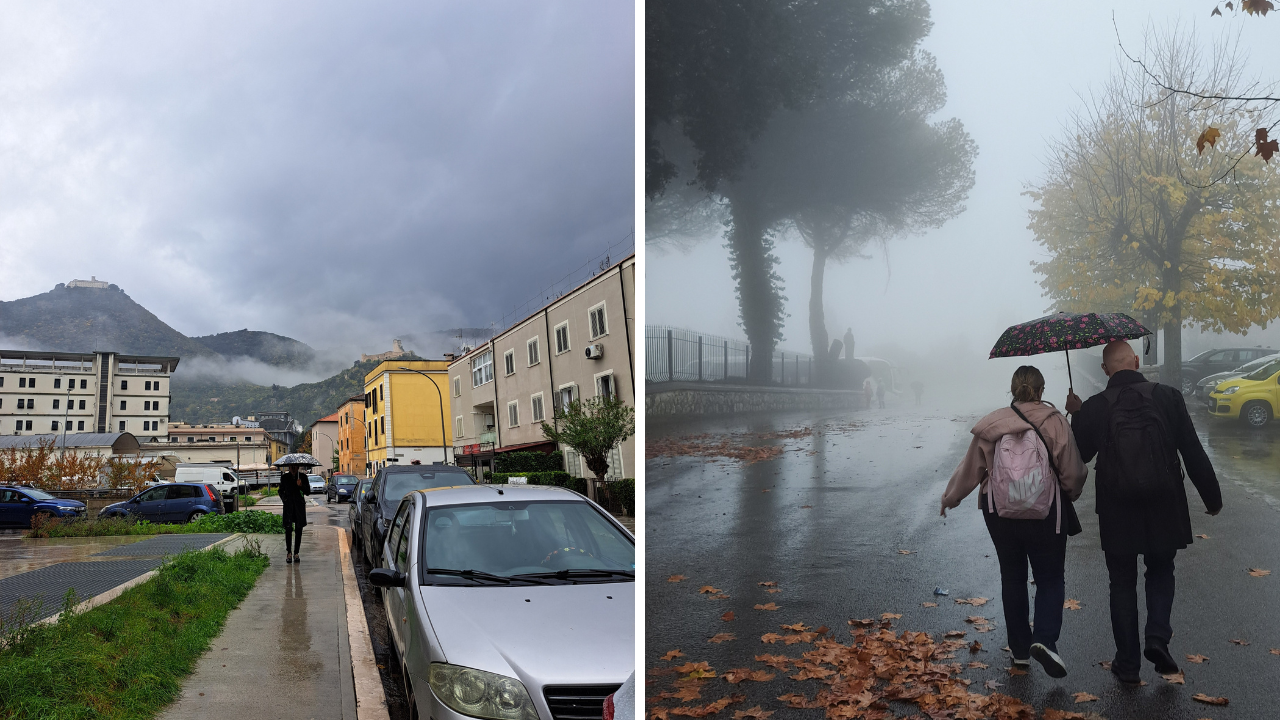
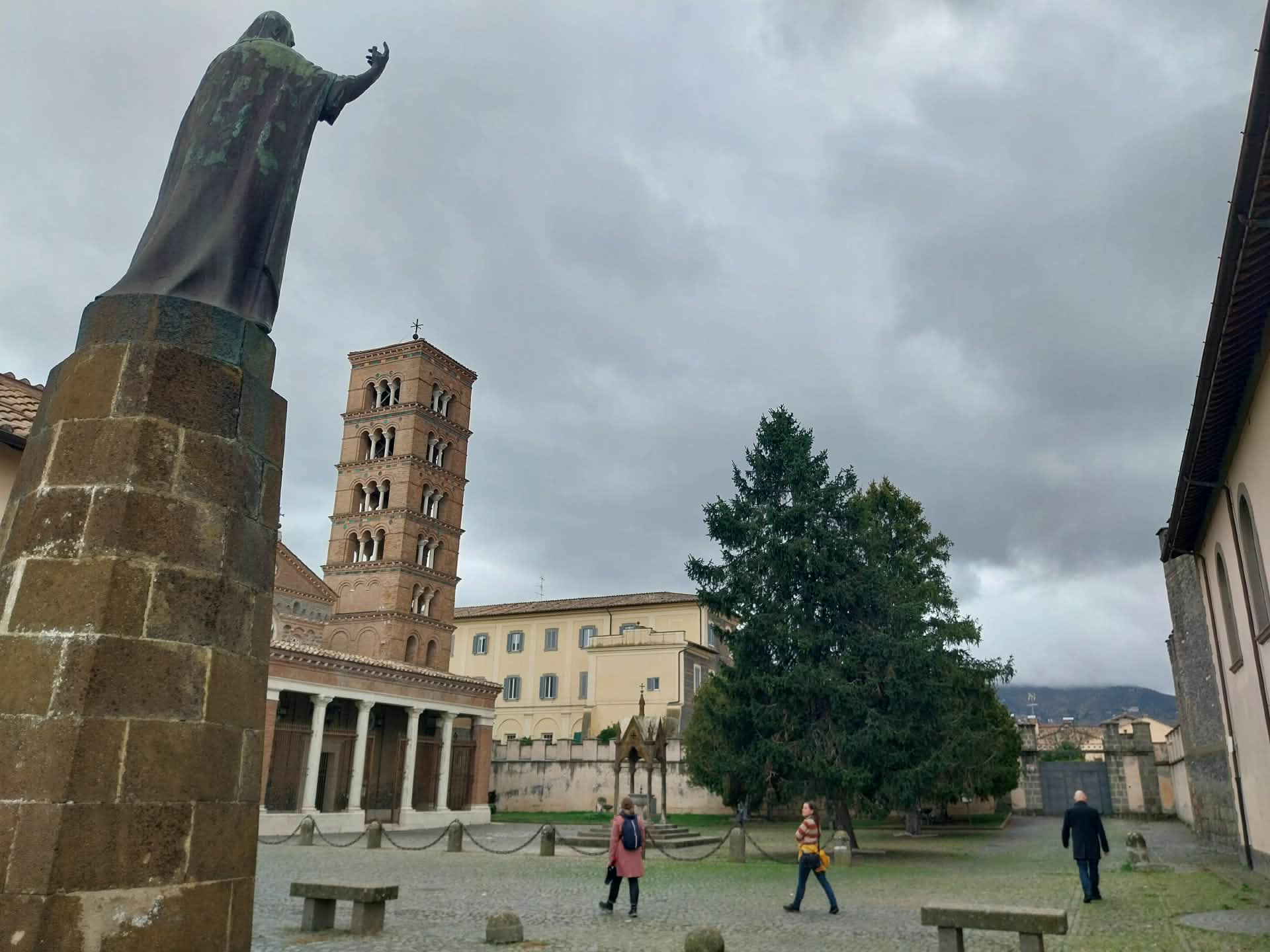
On the last day we drove to Grottaferrata to pick up Anni and to tour the monastery: luckily also the monastery’s splendid museum was open! The monastery of Grottaferrata is still operating and is the only surviving example of Southern Italian byzantine monastic tradition. It is exceptional, because it has been under direct papal supervision since the Middle Ages, and has thus managed to hold on to the Byzantine rite, which has also been influenced by western traditions over the centuries.
In Grottaferrata Anni worked in the monastery’s library with Greek manuscripts and studied how the presence of nature and forests is built within them. Additionally, she also examined sources which share light on the monastery’s land ownership and thus on its relationship with the surrounding landscape and land use.
In the afternoon we drove back to Fiumicino and flew back to Finland. Our study trip was a great success: the seminar fortified our international co-operation network, the field trips deepened our understanding of the monastic landscape of Southern Italy, and the archival work offered new central data for further research. The trip thus formed a strong foundation for the next phases in our project.