
Why Doing Less Harm Is No Longer Enough?
Businesses today are more and more expected to be green, sustainable, and responsible. But in a world facing biodiversity loss, social inequalities, and accelerating ecological change, doing less harm may no longer be enough. Drawing on my PhD research and experiences at the intersection of business, biodiversity, and societal well-being, this blog explores why regenerative business goes beyond green practices and why this shift matters for the green transition.
From Green Intentions to More In-depth Questions
Over the past decade, sustainability has moved from the margins of business to the mainstream. Many companies now measure carbon emissions, invest in renewable energy, and communicate their sustainability efforts more transparently than ever before. As someone working on sustainability and regenerative business research, I see this as an important and necessary development. At the same time, my research journey has pushed me to ask more uncomfortable questions. If businesses are becoming greener, why do biodiversity loss, ecosystem degradation, and social inequalities continue to intensify? Why do many sustainability strategies feel incremental when the challenges we face are systemic? Regenerative business represents something more fundamental than another green strategy. It pushes us to reconsider the purpose of business and its potential in a world going through significant ecological and digital transformations.
Green Business: Vital but Insufficient
Conventional green business practices largely focus on reducing negative impacts. This includes improving energy efficiency, lowering emissions, minimizing waste, and complying with environmental regulations. These efforts matter because without them, environmental pressures would be even greater than they already are. However, green business is often rooted in a logic of efficiency and optimization. The aim is to do the same things, but with fewer resources and less harm. From my perspective as a sustainability researcher, this approach has clear limits. Efficiency gains can slow down environmental damage, but they rarely address the deeper causes of ecological and social problems. In the context of the green transition, this distinction is crucial. If sustainability only means reducing harm relative to current practices, then we risk locking ourselves into systems that remain fundamentally extractive. Green business asks: How can we reduce our footprint? While this is a crucial question, there are others that must be asked as well. Regenerative business asks a more demanding question: How can we actively improve the systems we depend on?
Living Systems and Regenerative Business
The way that green and regenerative methods view the interrelationships between business, society, and nature is a major distinction between them. Systems thinking is the foundation of regenerative business. This viewpoint has had a significant impact in my research. It acknowledges that economic activity is not distinct from social and natural systems, but rather is a part of them. From this perspective, businesses depend on healthy ecosystems for resources, stability, and resilience. They also depend on functioning communities, trust, and social well-being. Business risks rise as these systems deteriorate, ranging from interruptions in supply chain operations to social unrest and unclear regulations.
In my research on regenerative business strategies, I have come to see regeneration as a shift from extraction towards involvement. Rather than viewing nature and society as external inputs, regenerative strategies emphasize reciprocity, care, and long-term system health. This might involve restoring ecosystems, supporting local livelihoods, or redesigning value chains to strengthen ecological and social resilience.
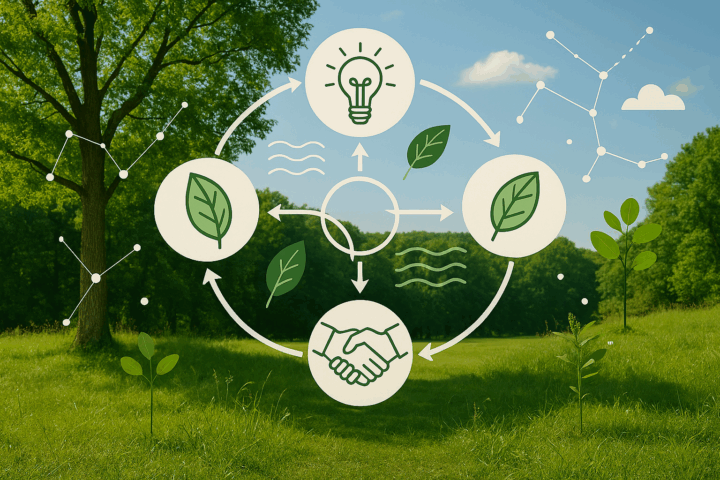
Visual presentation of Systems Thinking. Image created using Microsoft Copilot.
A Shift in the Mindset Rather Than a Checklist
One common misperception I come across is that regenerative business is just a new certification or a more sophisticated sustainability framework. Based on my experience and journey as a PhD researcher, this view seems to miss the mark. Regeneration is not a checklist but rather a mindset shift about altering how organizations perceive value, success, and responsibility. The change in perspectives entails accepting uncertainty and embracing learning. Regenerative solutions may emerge through experimentation, collaboration, and long-term engagement with stakeholders including those who are not traditionally considered part of business decision-making, such as local communities or ecological specialists.
This may cause discomfort for companies accustomed to achieving well-defined metrics and short-term goals. However, it also strongly relates to more general conversations about responsible innovation and flexible governance in the context of digital and green transitions. Businesses are encouraged by regeneration to view themselves as stewards within interconnected systems rather than merely as economic actors.
The Importance of Biodiversity to Regenerative Business
Despite being a key component of regenerative thinking, biodiversity is frequently disregarded in corporate sustainability plans. The loss of biodiversity is equally important for long-term resilience and well-being, even if climate change has received significant attention. Ecosystem services including pollination, soil fertility, water control, and climate stability are supported by biodiversity. These services facilitate economic activity in a variety of industries, including manufacturing, tourism, forestry, and agriculture. Ecological and economic systems become increasingly vulnerable when biodiversity diminishes. In my research, I’ve discovered that regenerative business offers a useful perspective for reestablishing the connection between business choices and biodiversity results. Regenerative approaches see healthy ecosystems as the basis for long-term value development, as opposed to perceiving biodiversity as a risk to be controlled or a cost to be reduced.

Image credit: Hanna Oksanen
Beyond Doing Less Harm
Now coming back to the question of the blog, during my time at UTU, I’ve come to realize that many sustainability issues are systemic rather than technological. They are related to the definition of value, the development of economic systems, and the prioritization of certain interests. I’ve frequently noticed how similar patterns emerge in a variety of domains, from energy systems to digitalization and biodiversity governance, in seminars, workshops, and casual discussions with other PhD scholars. While increasing the efficiency of current systems can be beneficial, the underlying logic is frequently left unaltered.
This is where the topic of regenerative business comes in. Regenerative business challenges the notion that sustainability is only about minimizing negative impacts. Rather, it encourages businesses to actively contribute to the health of the systems they rely on. Transitioning from green to regenerative is a challenging process. It requires changing perspectives, interacting with complexity, and taking on long-term responsibility. However, this change might be crucial in a world where social and ecological challenges are interconnected. As the green transition continues to unfold, regenerative business offers a powerful lens for imagining more resilient, inclusive, and life-supporting forms of economic activity.
A Personal Reflection from my UTU-GreDiT Journey
Being a part of UTU-GreDiT has influenced how I understand my role as a researcher. The program brings together individuals working on aspects of transition from a variety of disciplines, countries, and viewpoints. My perspective on the function of business in society has evolved as a result of my PhD study on regenerative business.
I’ve been reminded by this environment that sustainability is a continuous process of compromise and learning rather than a fixed destination. This understanding is reflected in regenerative business. Even though regenerative business does not guarantee simple solutions, it gives a more sincere and optimistic approach to dealing with complexity.
Living and working in Finland has also changed my perspective on regeneration because of the country’s high emphasis on education and social trust, as well as its profound connection to nature. It has emphasized how crucial context, culture, and location are in determining what sustainable and regenerative activities can entail.
I hope this blog will increase awareness about the importance of regenerative business. As such, I am looking forward to my research making a significant impact from the shift of doing less harm to actively engaging in regenerative business strategies. The PhD journey is not an easy one and it might get tougher moving forward. However, I look forward to this journey being a fulfilling and an impactful one.
Follow Bertha on LinkedIn!
Main photo image credits to Hanna Oksanen.
 Co-funded by the European Union. Views and opinions expressed are however those of the author(s) only and do not necessarily reflect those of the European Union or European Research Executive Agency (REA). Neither the European Union nor REA can be held responsible for them.