Bridging the Divide: How Robotics and Nature-Inspired Intelligence Shape a Sustainable Future
The future of sustainability may not be invented from scratch – it may already be written in nature, waiting to be translated into intelligent machines and meaningful action. We are currently witnessing a “Green and Digital Transition,” a global effort to rethink how we live by combining environmental care with smart technology.
The Power of Two: Green meets Digital
To understand where we are going, we must understand the two important concepts that are rapidly becoming the blueprint for development. The green transition focuses on reducing environmental impact through renewable energy, energy efficiency, circular economies, and sustainable infrastructure. The digital transition complements this by leveraging data, artificial intelligence, automation, and connectivity to optimize processes and decision-making. When combined, these create systems that are not only cleaner, but also intelligent, adaptive, and resilient.
Climate change, resource constraints, and rapid urbanization demand smarter, cleaner, and more adaptive technologies. One of the key drivers in this transformation is nature-inspired robotics. The convergence of sustainability, digitalization, and robotics is reshaping how we monitor ecosystems, manage resources, build resilient infrastructure, and respond to environmental challenges. This requires more than just a technological shift but rather a deliberate move from digital domain into real-world impact.
What is the role of Robotics?
Robots today are not only confined to the predictable environments of factory floors: they have “broken out” into the wild. We now see them in the sky, on the ground, and under water, operating in farms, forests and cities – often performing tasks that are dangerous, inefficient, or impractical for humans. Use cases include; monitoring radiation, counting thousands of trees in a reforestation target, prolonged underwater monitoring of aquatic life, tasks that would take extra caution and longer durations if a human were required. In perspective – aerial, ground, and underwater robots are actively being deployed to collect high-resolution data on biodiversity and climate dynamics. Through active sensing, actuation (taking action) and autonomy, robots act as environmental stewards. They no longer just record data; they interact with the environment. For instance, an aerial robot equipped with a sensor might change its flight path because it senses a chemical plume, following the trail to its source. This demonstrates a transition from passive to active observation.
One of the promising developments in modern robotics is biomimicry – the practice of drawing inspiration from biological systems that exhibit evolved efficiency, reliance, and adaptability over millions of years. Nature has already solved the problems of energy efficiency, resilience, and adaptability. Robots are beginning to mirror these solutions. By studying how birds fly, science has developed algorithms to reduce aerodynamic drag. Even further, by studying their flocking behavior, we understand how birds prevent mid-air collision and energy-efficient formations. Also, to be able to navigate dynamic scenes like dense forests or collapsed buildings characterized by cluttered or confined spaces, we look at how flying insect such as bees use “optical flow” (judging distance by how fast objects move across the eye) to avoid obstacles without needing massive, heavy sensors. In the heart of swarm robotics lies the concept of collective intelligence – how thousands of individuals can solve a problem that one complex individual could not, drawing inspiration from ant colonies and bee swarms. These biologically inspired designs are particularly valuable for environmental surveying, search-and-rescue, and infrastructure inspection.
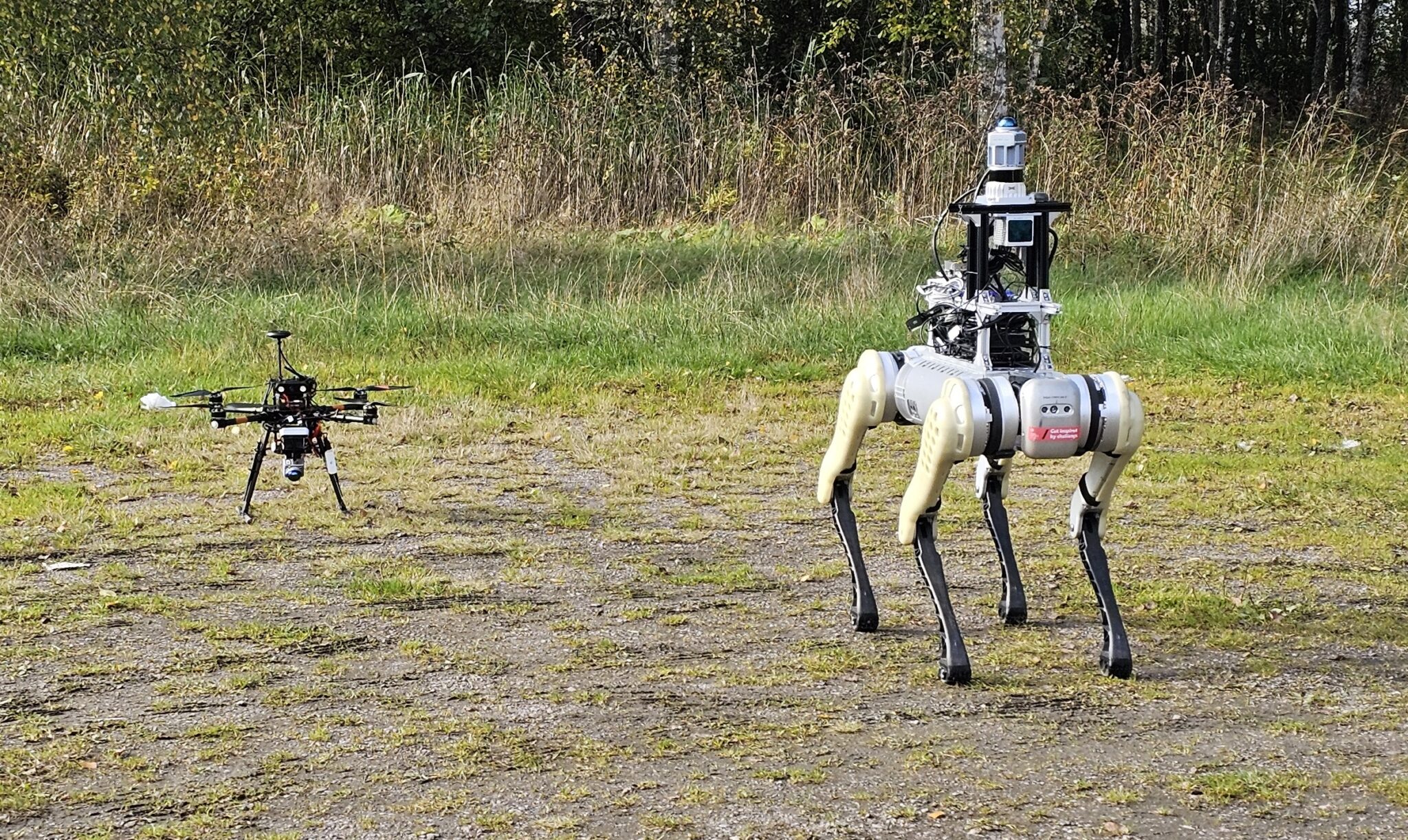
Field excursion with the Digital Water (DIWA) team, MAAGEO and FGI
Are robots alone enough?
What is your say? Are robots more than just tools and could they be more? That’s a discussion that continuously unfolds with every new robotics breakthrough today. However, back to our discussion, the real transition emerges when robots are embedded within Digital Ecosystems. Key drivers to this transition include: artificial intelligence, edge computing and digital twins. Artificial Intelligence enables robots to learn from the data they collect and adapt when the environment changes (e.g., a drone adjusting its flight pattern in strong wind conditions). Unlike the traditional way of robots sending data to the cloud to be processed, a task that would slow down environmental monitoring, Edge Computing allows the robot to think or process data locally, in real-time. With Digital Twins, we are able to create virtual replica of cities, forests and robots can be used to feed real-time data into these “twins.” This then enables us to run simulations of environment and infrastructure as a test ground before real-world intervention.
My Journey: From “How it Works” to “Why it Matters”
Growing up I was often captivated by electronics and the science behind their operation and how it could impact society and development. The question of ‘How?’ directed my choice to pursue an engineering career. During the undergraduate days, I always knew I would pursue a masters to enable me broaden my knowledge. Mechanical engineering gave me the foundation, but I felt I was only seeing half the picture; at least for the career path I had envisioned, while another person might say they had it complete. My choice to pursue a Master’s in Mechatronics and Robotics was intended to enable me extend the skills I had gained from mechanical engineering (physical) toward electronics and control (digital). There I was telling myself, after this I will have fulfilled that passion. While I thought that would be “a wrap up” of my academic journey – that I would have fulfilled the passion, there was more! The need to utilize the knowledge I had gained in the real-world became the missing link that fueled my search for a more intentional opportunity. At this point it was either industry or academia (again!) – a traditional tug-of-war. The common wisdom suggests that after years of study, one should stop “heaping up books” and finally gain “field experience.” Choosing between the two felt like a difficult compromise. While industry offers a direct venue for applying skills, I realized that modern research is the heartbeat of innovation. Even the “big tech giants” of today rely on research labs either of their own or in collaboration with institutions. Was this therefore the answer that I needed?
The UTU-GreDiT research track for me is more than just the next step in my education; it is a holistic ecosystem for professional evolution. As a unique doctoral training programme, its mission is ambitious and timely. The programme aims to train the experts needed to steer societies towards transformative change and sustainability, with skills and knowledge to operate across sectors, at regional, national and international level. UTU-GreDiT is co-funded by European Union’s Horizon Europe (Marie Skłodowska-Curie Action). My time working in Finland and at the University of Turku has enabled me to understand the academia-industry perspective a little better. Here, the distinction between research and the real world is blurred by a powerful culture of industry-academia collaboration.
My interest in Field Robotics inspired my choice of the ongoing PhD work on Drone fleet-based active data perception in uncertain and dynamic environments. Aerial robotic systems are emerging as pivotal platforms in enabling environmental monitoring herein contributing to a sustainable future. Aerial robots mounted with sensors like cameras and LiDAR present an opportunity for continuous and quick access to environmental data. These are able to operate under harsh and cloudy conditions and even cover more area once deployed as a fleet. My research work involves intelligent systems, autonomous robotics, and multi-agent coordination – working at the intersection of control, perception, and learning.
Being part of the UTU-GreDiT (University of Turku Green and Digital Transition) interdisciplinary research group highlights a critical insight: to understand the real-world value and the ethical implications of the tech we build.
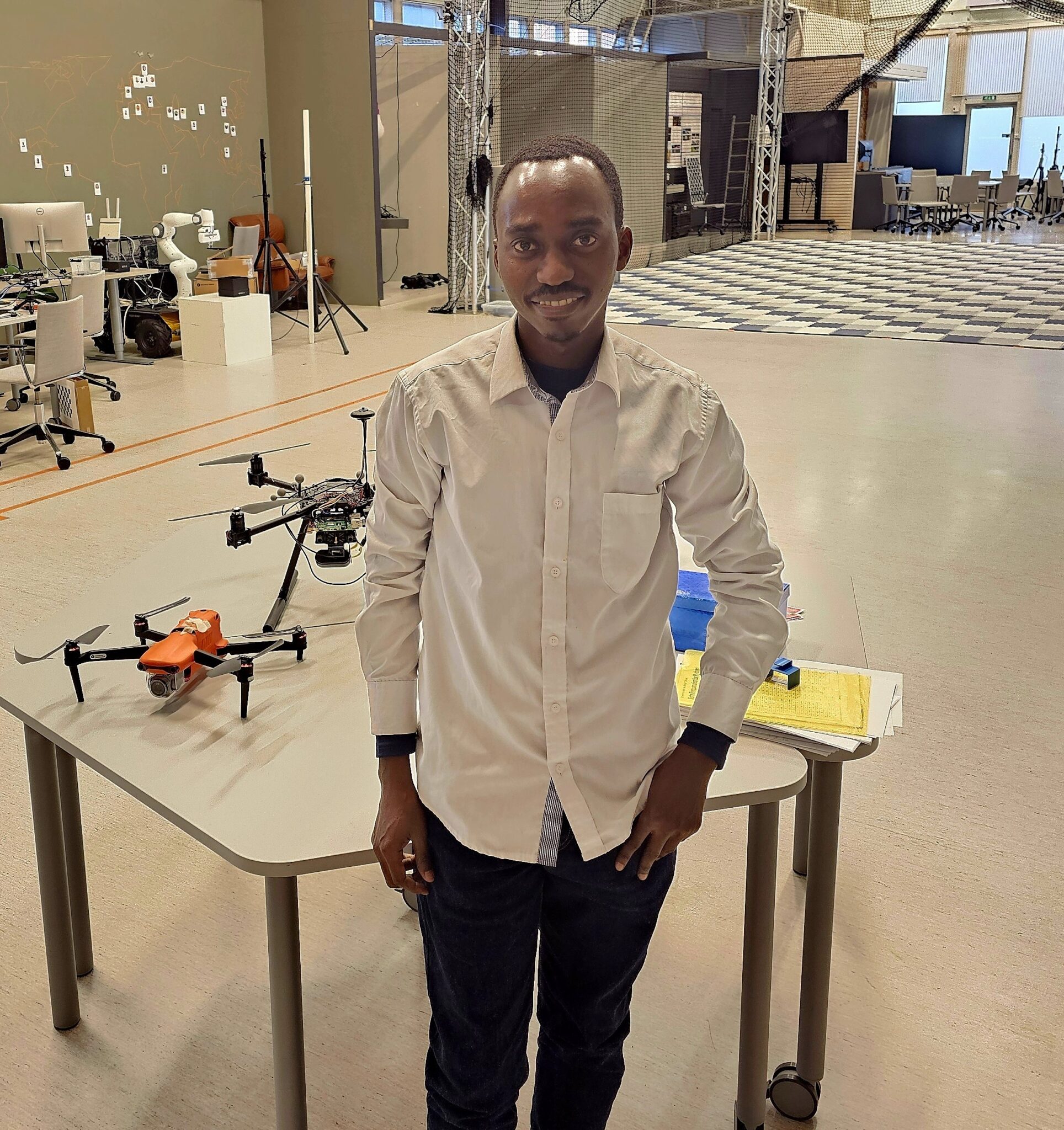
Photo taken at the lab. (Photo credit: Kimmo)
Personal perspective: Intelligent Systems with Sustainable impact
Environmental systems are inherently complex, uncertain, and ever changing – characteristics shared by many robotic systems. This makes them a natural application domain for autonomy, sensor fusion, adaptive control, and learning-based decision making. What makes this field even the more compelling is its strong alignment with biomimicry. Nature provides proven solutions for efficiency, robustness, and scalability – qualities that modern sustainable technologies require. Drawing inspiration from flocking birds, foraging ants or schooling fish is not only elegant, but also practical and impactful. Robots should exhibit swarm intelligence through principles such as: decentralized control, local communication, and self-organization. This enable scalability and fault-tolerance – ideal requirements for environmental monitoring applications where uncertainty and system failure are expected. Robotics-driven environmental monitoring enables: continuous monitoring and early-warning systems; capacity building in digital and green technologies; stronger links between advanced research and societal needs.
Why Swarm Intelligence? Look at it this way, the robots are in the middle of a forest or deep in the sea and something goes wrong, a robot breakdown, dead battery, or lost signal. Swarm intelligence exhibits three main directions: decentralized control, self-organization, and scalability. In decentralized control, if one robot fails, the others continue. In such a scenario, self-organization and re-organization of the swarm is required to cover more ground and gap left by a lost robot. With Scalability, you can add ten or numerous robots with little or no need to rewrite the software. So, is it an over ambitious goal or are we really getting there? Are the advancements in artificial intelligence and robotics fast enough to deliver the solutions required to meet the 2030 and 2050 climate goals?
Looking Ahead: A Nature-Aligned Digital Future
As we look toward the future, the goal of the green and digital transition is not about replacing the old technologies with the new – it is about rethinking system design through intelligence, adaptability, and harmony with the natural world: a future where technology does not dominate nature – but learns from it.
The bridge between robotics and nature is being unveiled every other tech day. It is a bridge of data, inspired by evolution, and fueled by the urgent need for a sustainable world. I end this blog with a point of reflection – Should the next generation engineers be just as “fluent” or “somewhat knowledgeable” in ecology as they are in coding!
Follow Amos Alwala on LinkedIn!
 Co-funded by the European Union. Views and opinions expressed are however those of the author(s) only and do not necessarily reflect those of the European Union or European Research Executive Agency (REA). Neither the European Union nor REA can be held responsible for them.