Chasing Invasion: Alien predators in the Baltic Sea
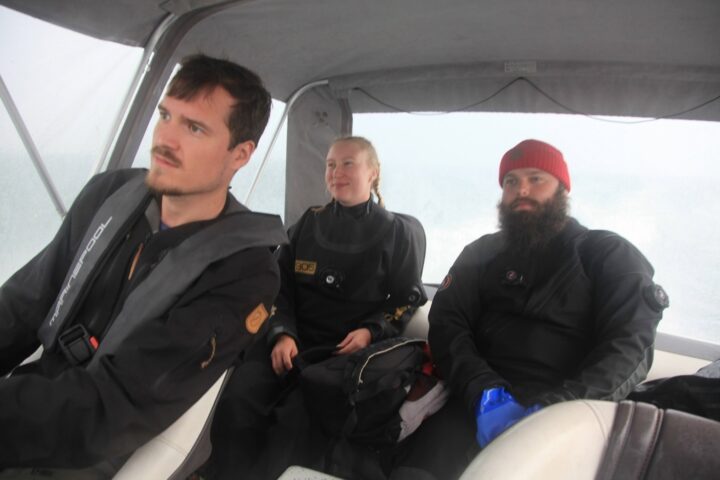
Main image: Some of my students (in the background) and I (front left) on the way from our fieldwork. Here, we were caught in a sudden summer storm and visibility was bad. But we got our samples and ourselves home safely. It’s part of life as a marine researcher and we don’t mind some rain and wind.
Welcome dear reader! Yes, my PhD topic is indeed assessing the effect of alien invaders on ecosystems of the Finnish Archipelago Sea. Before you roll your eyes and go back to whatever you did before clicking on this blog post, or get really excited expecting cool space stuff, let me clarify: Yes, this blog post will indeed talk about aliens – just not as you might think. When I say aliens, I talk about the biological concept of alien species, i.e., species that have been introduced to ecosystems outside their native habitats by human activities. Anyhow, I hope you feel somewhat intrigued to learn more about this kind of aliens and decide to read the rest of this blog post.
1. Biological invasions
Right off the bat, let me point out, that there are many terms for “species that have expanded beyond their natural range”. There are non-indigenous species, alien species, invasive species, neobiota, and a few more. Often, they are used interchangeably in everyday speech, but actually, they are referring to somewhat different things. But let me elaborate on this a little later.
Let’s start with what invasive species are and how biotic invasions work:
Species can expand beyond their native range by various natural and man-made ways. For example, there are many species of plants which were brought to new habitats as decorative garden plants and later spread into the wild (Seriously people, stop doing that! It’s a massive problem!). In marine environments, species can spread for example via drifting with currents or as part of the ballast water of big ships, crossing oceans and then being dumped when the ships prepare to enter harbors. If the circumstances at their place of arrival are right, they can become established there. At that point, we talk of non-indigenous species (NIS).
But is this a bad thing? It has been found throughout ecological research, that biodiversity – including a higher number of species in an ecosystem – is making the ecosystems more resilient to other stressors, like climate change. So why are non-indigenous species a problem? Well, these species now find themselves in new ecosystems with their own native organism communities, which exist and interact in a balance that has developed through behavioral and evolutionary adaptations over long timespans of coexistence. The non-indigenous species arriving in these ecosystems present a completely novel organism, that native species have no co-evolutionary history with and thus have no way of competing with or defending against yet. Hence, non-indigenous species can disrupt the delicate balance of their new ecosystems and cause strong declines or even local extinctions of the native species. In such cases we talk of (harmful) invasive species. This can be true for both, species which have spread through natural means and those that have spread via human activities (i.e., alien species).
The field of science that researches invasive species, the pathways of invasions, and their consequences on their new ecosystems – which also includes my PhD research – is invasion biology or invasion ecology.
Many ecosystems around the globe – but especially coastal and marine ecosystems – are increasingly deteriorating as a result of man-made climate change, pollution and exploitation, among others. Parallel to this decline of ecosystems, introductions of NIS have become increasingly frequent, and are expected to increase significantly as a result of e.g., growing maritime traffic and rising mean temperatures. Therefore, studying and understanding the mechanisms, causes and effects of biotic invasions and how we can potentially mitigate negative effects and prevent or manage future invasion events, is becoming more and more important.
Invasion biology theory recognizes 5 general phases of biotic invasions: Transport, Introduction, Establishment/Naturalization, Dispersal and Impact. All of these stages are being thoroughly researched, and understanding each of them is paramount to grasping the bigger picture of biotic invasions. My PhD project specifically focuses on the last of the phases: impact.
2. Archipelago under Attack
I guess, by now, you are all exited to finally read about what fearsome predator it is that I have alluded to with my attention-grabbing headline. What mighty organism can be so disruptive? So, let me introduce you, dear reader, to Rhithropanopeus harrisii, the Harris mud crab! I know, I know “A crab!? Really?!” And the answer is: Yes, a crab. Really. And not even a particularly big one at that.
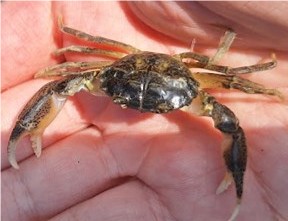
The Harris mud crab (Rhithropanopeus harrisii). A small crab with a big disruptive potential.
The Harris mud crab is native to the Atlantic coast of the United States and reaches its maximum carapace width with between 24 to (rarely) 26 mm. It has been sighted in the Baltic Sea first around 1933, in the German Bight. It likely arrived via ship ballast water and has first been observed in Finland in 2009. Since then, it started dispersing throughout the Archipelago Sea. Here, it represents not just a new species, but actually a novel group of organisms, as it is the only Brachyura – or True Crab – in Finland. Therefore, for the native species of the Archipelago Sea, R. harrisii presents not only a new organism, but a whole new group of organisms, which they have no co-evolutionary history with. On top of that, the ecosystems of the Archipelago Sea are characterized by low biodiversity and low functional redundancy. Let me quickly translate this: In the ecosystems of the Archipelago Sea there are a low number of species and there is little overlap in the functional roles that these species fulfill in the ecosystems. This in turn means that in the ecosystems of the Finnish archipelago, disturbances affecting one species can potentially trigger a cascade of negative effects which then affects other species and can even alter ecosystem effects and services. If the native communities can develop defensive responses and effectively integrate the mud crab in the food web, the invasion could transition from the current disruptive state, into a stable state. If this process takes too long, the disruption can cause the current status to tip and eventually reach a new equilibrium with different community structures than before.
In our case, the disturbance is the new invasive predator – the Harris mud crab – which significantly decreases the population of native key herbivores, like the isopod Idotea balthica and the snail Theodoxus fluviatilis due to their lack of avoidance strategies or defense adaptations. It can even cause local extinctions of these herbivores. With the decrease in herbivory, the next affected species are the primary producers, i.e., algae and plants. The coastal habitats of the Archipelago Sea are rocky and usually dominated by stands of bladder-wrack, Fucus vesiculosus. With the loss of herbivory caused by the invasion of R. harrisii, fast growing filamentous algae, epiphytes and periphyton are released from grazing pressure and will likely outcompete slower growing macrophytes, like Fucus, or vascular plants over time. This in turn, will lead to changes in primary production rates, ecosystem structure, ecosystems services, sedimentation rates and carbon sequestration. This is what my research is focused on. The cascading effects of the invasion on the entire ecosystem.
As you can imagine, with this potential to cause cascading negative effects, the invasion of R. harrisii is a serious threat to the ecosystems of the Finnish archipelago. This in and of itself is already enough to justify the importance of my research. If we learn more about the invasion, we can develop better strategies to manage and mitigate this threat and that of potential future invasions and thus better protect the Archipelago Sea and its native ecosystems. However, because of the characteristically low biodiversity and functional redundancy, and the fact the invasion is still going on, we are also in a unique position to observe the concept of cascading negative effects, as well as observing potential signs of adaptations and behavioral responses in native communities, which will present valuable novel insights in invasion biology. I hope, in turn, that this could also help to inform future management decisions and help conservation efforts in the face of rising global temperatures and increasing number of biotic invasions.
3. How to study biological invasions under the sea?
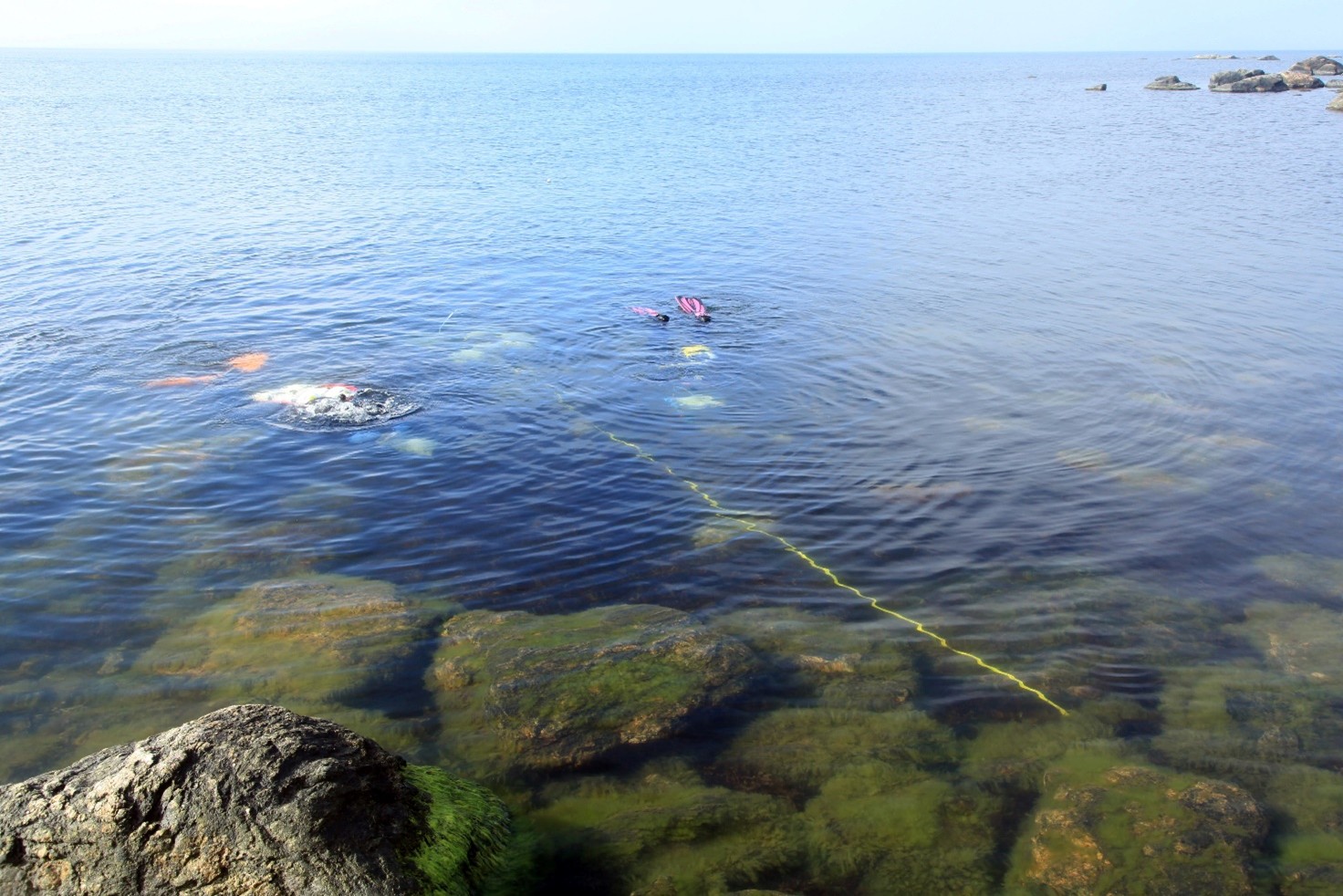
Two of my students doing the diving transects at one of our field stations. We have put down a 30 m long line using the weighted yellow measuring tape you can see in the picture.
So now that we have talked about what biological invasions are and the invasion of R. harrisii in the Finnish Archipelago Sea as my topic of study, I think I should introduce you to how I actually carry out my work to collect data for my PhD.
I am very lucky, because since starting my PhD in August of 2024, I have had 3 seasons of fieldwork. That means I got to go around the Finnish archipelago for 3 summers for my work. Seeing as I am trying to answer a variety of questions, I have to run multiple different experiments at different locations throughout the archipelago. Therefore, I think explaining everything I have done so far will be too much. So, I was thinking I would just describe “a typical day” of my PhD fieldwork life. Sounds good? I hope you said yes, because I will do it anyway.
6 am – The alarm goes. I wake up, brush my teeth, put on sunscreen, get dressed and head out the door.
6.30 am – I rush into the grocery store and get some croissants for breakfast on the way, some sandwich or salad for lunch and a 2L bottle of water to drink. I pay and put it all in my backpack. Then I walk through the sunny (or rainy) Turku mornings, cross the Aura and pass the cathedral to the university.
7 am – I start packing the things we need for the day: scales, falcon tubes and ethanol, markers and pencils, wet notes, mesh net bags, buckets, cut-off oversized syringes, our 1 m2 DIY-frame and weighted measurement tapes for diving transects and of course our SCUBA gear. One after another, the student research assistants of my work group arrive and help me gather things. One of us goes to fetch the boat keys and car keys and pulls up with the car, so we can load our stuff into the trunk.
7.30 am – We head out to the harbor.
8 am – We arrive and load our gear onto the university’s boat and head off into the archipelago. Birds are singing and the sun is reflected off the water. I finally have time to eat my breakfast. We talk about work and exchange some banter. About 3 hours and 30 minutes’ drive ahead of us, we enjoy the beauty of the archipelago, as we pass between hundreds of islands with beautiful cliffs and forests. Eagles are a common sight, as well as the ever-present seagulls. If we are lucky, we can see a grey seal poke its head above the water.
11:30 am – We arrive at one of our research stations. We have multiple of them throughout the archipelago, as we want to compare data between sites which have been invaded more than four years ago, recently invaded sites and sites that have not been invaded yet. This island is Sundskär, one of my favorites. It’s situated pretty far out in the archipelago and is one of our pristine sites. The water is clear and out here a gentle breeze is providing some much-needed respite from the summer heat. One of the research assistants and I put our SCUBA gear on, while the others set up the rest of the stuff. We dive into the water and set up the 30 m transects with the measurement tape, going straight from the shore to deeper water. We see a shallow bay enclosed by rocky cliffs on both sides, bladder-wrack dominating the shoreline from about 40 cm depth to 3 m depth. Sand covers the rocky bottom and there is life everywhere. Flounders, perch and sticklebacks can be seen swimming around the bay, thousands of snails’ crawl over the algae and water plants and shrimps and isopods flit around, ducking in and out of the cover of the vegetation. To this day, Sundskär is one of my favorite dive sites, it’s beauty on par with even such places as the reefs of Curacao.
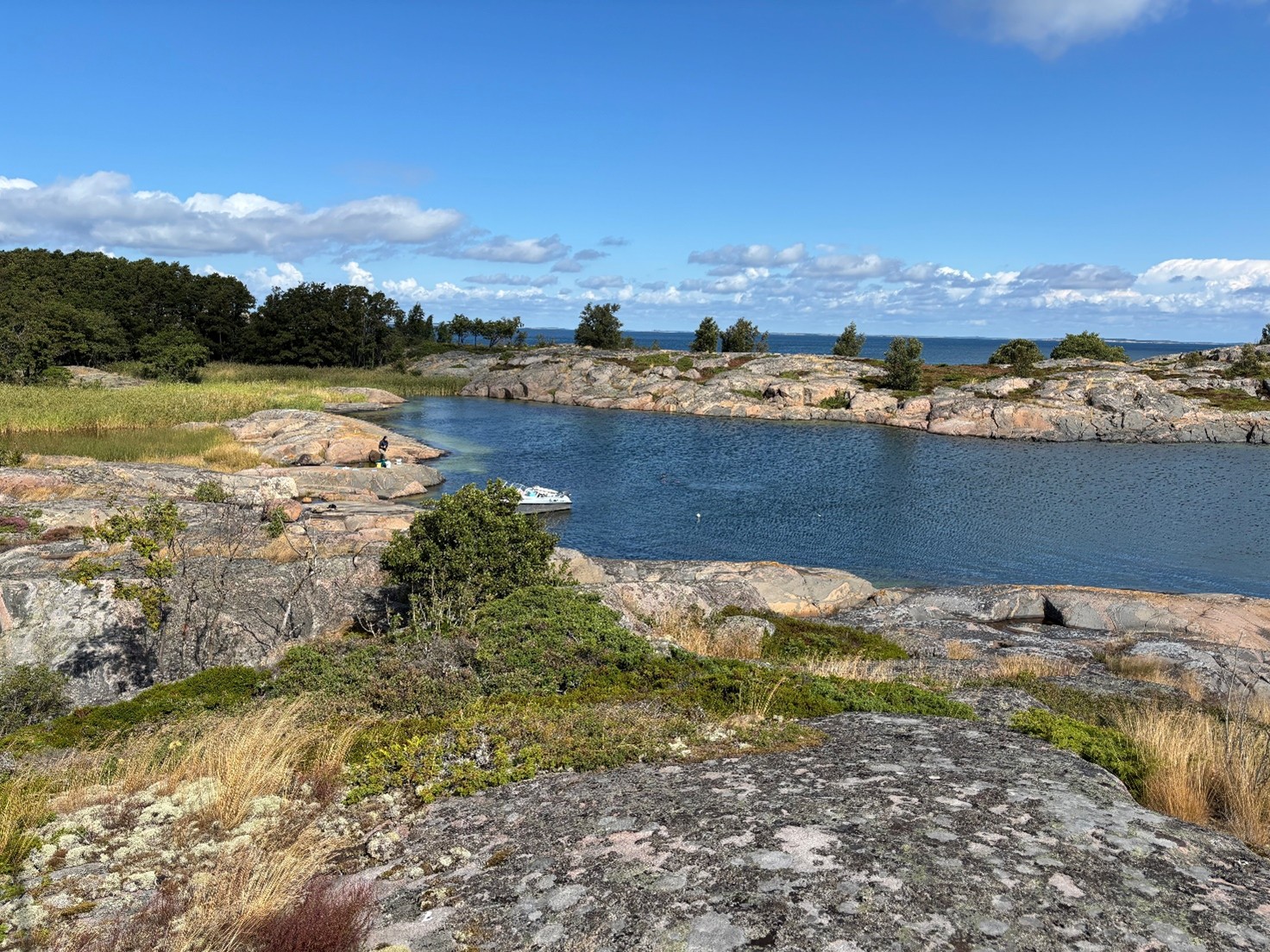
View of Sundskär island in the Finnish archipelago. This particular bay of the island is our field station on Sundskär and one of our “noninvaded” sites. Past this bay lie a few more islands and then the open sea of the Finnish Bosom.
While one person does the transect, setting down the frame randomly and recording algae cover, taking algae samples and counting Fucus vesiculosus bushes, the other one collects 15 random bushes of Fucus with the mesh-net bags. The mesh-net bags are then passed to the people on shore, who shake the bushes in buckets to collect all the animals inhabiting them and preserving them in falcon tubes filled with ethanol. Then the second diver uses the syringes to collect six sediment cores from random spots, which are then stored in a cool box. After the divers finish the two transects, which can take us between 1h30 to 2h, we all take a lunch break. Then we finish up going through the bushes of bladder-wrack to collect the animals. We store the bushes in water-filled buckets and load everything onto the boat.
3:30 pm – We leave the island, exhausted but happily chatting away as we head back to Turku.
7 pm – We arrive in Turku harbor. We tie up the boat and load our stuff into the car.
7:30 pm – We arrive at university and unload our gear. We store the samples in the cold room or freezer, depending on the sample. Then we clean up our SCUBA gear and put it to dry.
8 pm – We leave to go home and rest for another day of fieldwork tomorrow.
This only represents a fraction of the experiments I have done for my PhD so far. Our groups’ field season usually last from April to October and we perform multiple experiments, many of which we need to do at 12 different sites around the archipelago. But it still represents a typical day during field season. Of course, the work doesn’t end there: The samples need to be analyzed, the data entered into files, which in turn will be statistically analyzed and then I need to write the research articles. This keeps me busy the rest of the year, between field seasons. But I think, dear reader, by now you have a good idea of my work and I have been going on for a while. Sorry, I tend to do that sometimes. But hopefully you enjoyed this – more or less – short introduction to my PhD work and life. If you are interested in finding out more, look out for my articles! Thank you!
Follow Kjell on LinkedIn!
 Co-funded by the European Union. Views and opinions expressed are however those of the author(s) only and do not necessarily reflect those of the European Union or European Research Executive Agency (REA). Neither the European Union nor REA can be held responsible for them.