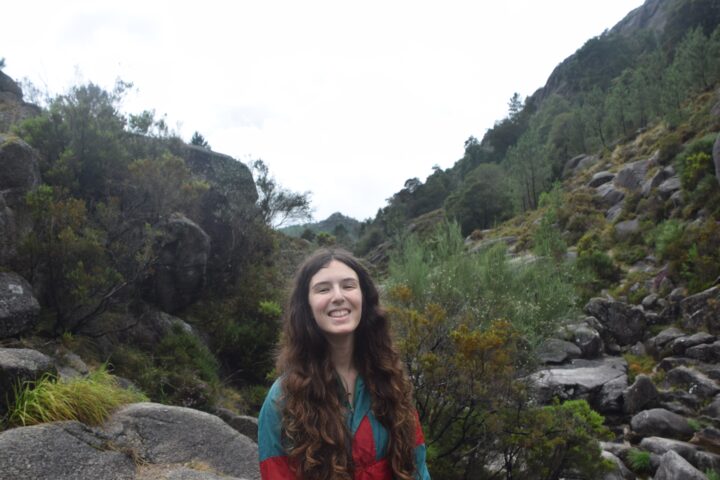
Put Yourself in Their Paws
Imagine being a wolf. Your territory is your home. You move through forests, follow prey, raise pups, and navigate the boundaries of neighbouring packs. Now imagine that, year after year, new roads appear, forests are cleared, infrastructure is built, vehicles move through your territory and human activity becomes increasingly difficult to avoid. You are one of the world’s top predators, but you have no control over your own landscape.
We often think of wolves as the ultimate predators, but in today’s world they are also trying to navigate a landscape shaped by a much more powerful predator: us. Predation, of course, occurs when an animal kills other animals, but that is not the only way predators can influence other animals. In the same way, humans don’t need to kill a wolf to change its behaviour, our presence alone can alter how animals move, where they settle and which parts of the landscape they use. This is where my PhD comes in.
Why do wolves matter?
Wolves are what we call top predators, or apex predators. They sit at the top of the food chain and play an important role in shaping the behaviour and population of the animals below them. This means that when top predators disappear, the effects rarely stop with them. There are cascading effects that trickle down through the food web, affecting other species and ecosystem processes.
A well-known example of this comes from Yellowstone National Park. In the late 1800s and early 1900s wolves were persecuted as a way to protect the herds of herbivore species, such as elk and deer. As wolf numbers declined, almost to extinction, the balance of the ecosystem was shifted, and herbivore species thrived, which in turn affected the plant community. Wolves were reintroduced to Yellowstone in 1995, and since then, the park has seen changes in vegetation, wetlands, and biodiversity. But the story is not as simple as “wolves came back and fixed everything”. Nature is a much more complex system, with many different forces shaping the ecosystems, including human activities. But, to me, the Yellowstone example shows us how wolves can help shape the ecosystem, and what happens when they are absent.
Now, how does this connect with my research?
When we think about threats to wolves, we might immediately think about hunting. Lethal activities, of course, have direct effects on wolf populations and behaviour. But non-lethal activities have a large influence as well. For instance, research has consistently shown that wolves avoid areas with high levels of human activity, including roads, settlements, and tourism. In other words, human activity can change how wolves use their own territory, even incidentally.
Specifically linked to my topic, a study conducted in Portugal, for example, found that the construction of wind farms led to den site relocation, consequently affecting short-term reproductive rates. But we still know relatively little about the long-term effects and at a larger scale. This is what I want to understand with my PhD – how wolf territory space use changes as renewable energy infrastructure expands. And, more importantly, how it changes when renewable energy infrastructure becomes part of an already human-dominated landscape.
So, why Finland?
Finland is an interesting place to study these processes, because both wolves and wind farms have been expanding at the same time across the country, and especially in the western coast.
The Finnish wolf population suffered a steep decline during the late 19th century, due to excessive poaching, reaching a point close to extinction. But after wolves came under the strict protection of the EU’s Habitats Directive in 1995, their numbers started to recover and the population began expanding again from east to west. Between 2017 and 2024, the population grew by approximately 10% per year, and in 2025 it had a remarkable 46% increase, reaching around 430 individuals.
Around the time that wolves began to recover, the construction of wind farms began in Finland during the 1990s. The construction of these infrastructures started at a smaller scale until the 2010s, after which development began to rise, particularly in the western coast. By 2025, Finland had more than 2,000 wind turbines, producing around 26% of Finland’s electricity consumption.
At the national level, this number of turbines might not look like much, and in fact, wolves keep expanding to the western side, where wind farm development is growing. But this is where looking at the territory level becomes important. Just because wolves are still present in an area does not necessarily mean that they are using the landscape in the same way as they would without these infrastructures. This is why I would like to understand if their territories change as more infrastructure appears around them.
But is this not a fight between good and good?
As we all know, we are facing a number of issues linked to our use of fossil fuels, and renewable energy is an important part of the solution to climate change. So, if renewable energy is helping us move away from fossil fuels, why am I studying its potential negative effects on wildlife? Because sometimes, even when we are trying to solve one environmental problem, we can create another if we don’t consider the wider impacts of our actions. But the most important message here is, we don’t have to choose between renewable energy and biodiversity. The challenge is learning how to build renewable energy infrastructures in places and in ways that minimize its ecological costs. Interestingly, a study conducted in Croatia found that by optimizing where wind farms were placed, only 31% of the planned wind farms would be necessary to meet energy targets, reducing disturbance to wolves by 91%. So, to me, the question is not about whether we should build renewable energy infrastructure or not, but rather where we build it, how much we build, and how we plan it.
Now, you might still be wondering what kind of negative effects can a few of these vertical structures have on a wolf. Aren’t wind turbines mainly a problem for birds and bats? When looking at a wind farm, we also have to think about everything that comes with it – forests being cleared, roads being opened, construction machinery and vehicles moving through the area, the resulting noise, and increased human activity. All this happening throughout multiple years. But wind farms are not the sole infrastructure in these landscapes, there may already be roads, settlements, and other sources of disturbance surrounding it.
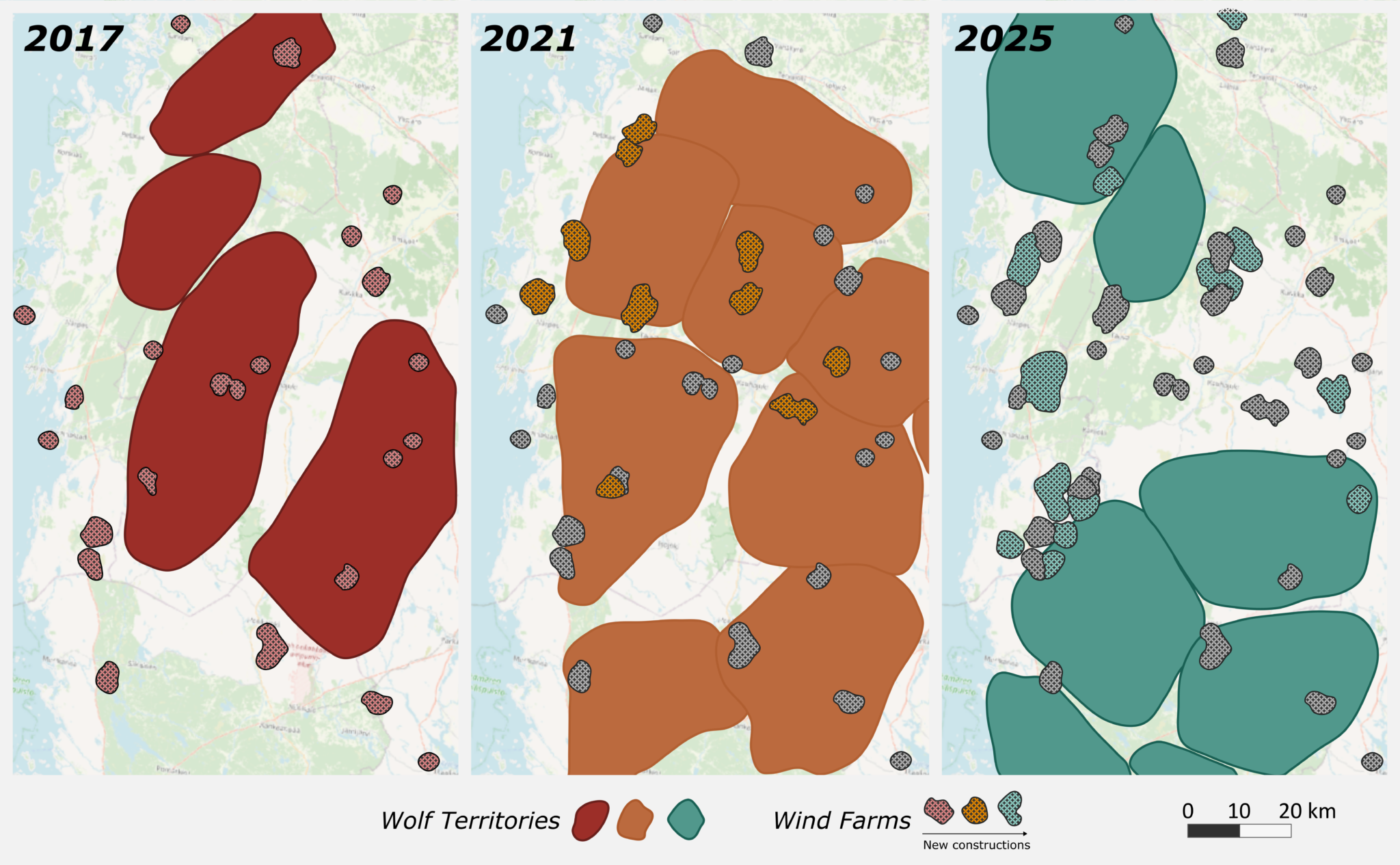
Representation of how wolf territories and wind farms changed between 2017 and 2025. Over these nine years, both wolves and wind farms expanded across the landscape. The sequence of events illustrates how some newly established territories later disappeared or relocated, avoiding wind farms at the centre of their territories.
This is a representation of a real example from my data. But one example alone does not tell us the whole story, as there might have been other forces in play which resulted in the disappearance of these specific territories. It does not show cause and effect, and it does not tell us what is happening across the whole wolf population at the national level.
Studying wolves in a divided society
And this brings me to the uncomfortable part of studying wolves. Whether you are conducting scientific research on wolves, or simply advocating for their conservation, you should probably be prepared for criticism and differences of opinions. When it comes to top predators, and especially wolves, everyone is listening. There is the sheep herder whose sheep are being depredated, the activist who wants to protect the wolves, the politician trying to balance different interests, the company wanting to build a wind farm in a wolf territory, and the common person that is simply afraid of the wolves that appear in their backyard. There are many stakeholders and members of the general public who are interested and care about what happens to wolves. That is why I think it is so important to share trustworthy information backed by robust research.
I don’t expect everyone to agree with my opinions, but I do think decisions should be based on the best evidence we have. And that is what I will always aim for, to contribute to research that can help us make informed decisions, which ultimately will aid the conservation of this iconic species.
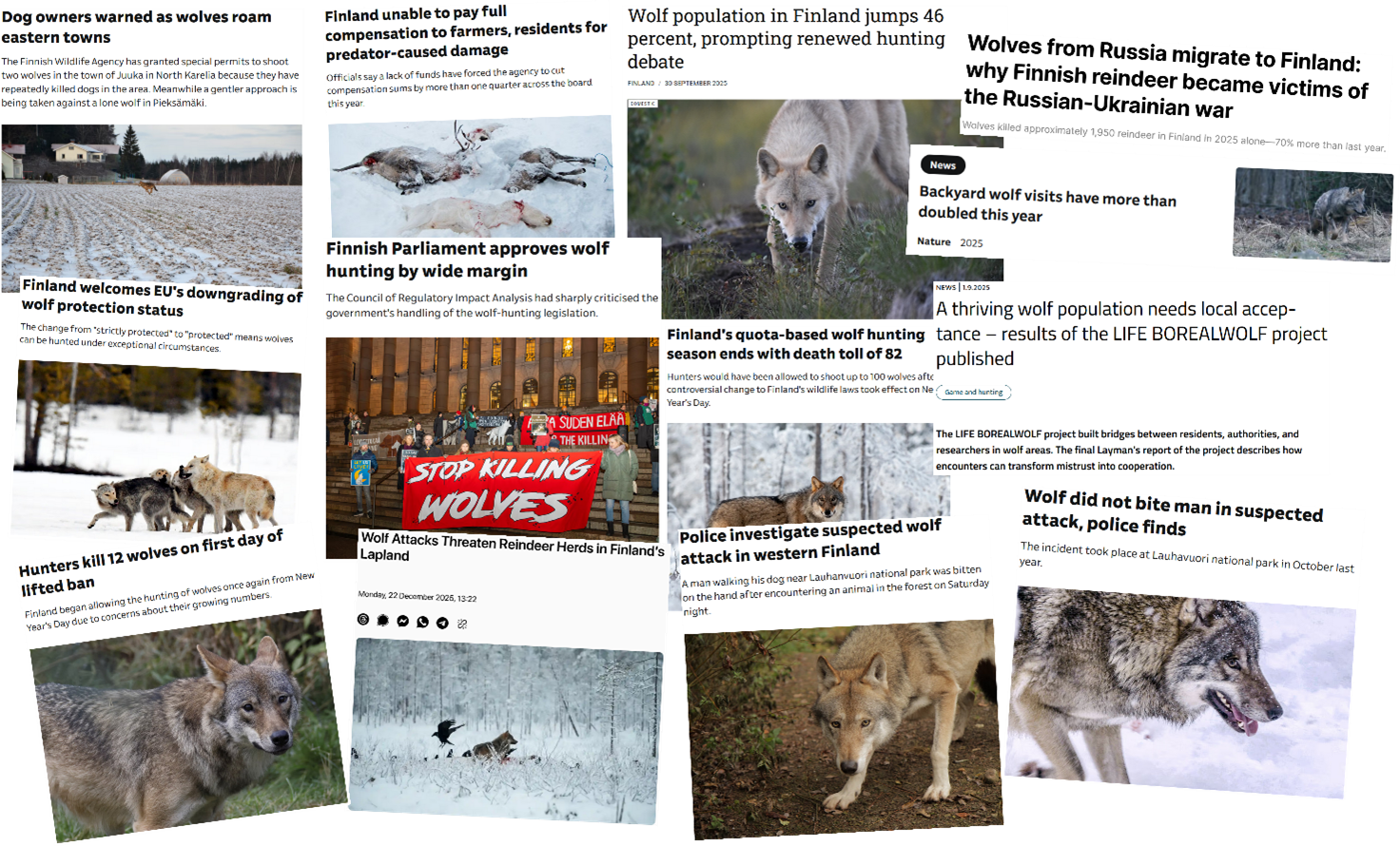
Wolves in the Finnish headlines: as wolf numbers and their distribution have increased in Finland, so too has media attention surrounding human-wolf conflicts, hunting, and coexistence.
What do I hope to achieve with my PhD?
Before starting my PhD, I was already studying wolves in Portugal, within an Impact Assessment study, with the aim to gather knowledge on the wolf packs surrounding a planned lithium mine. When I started my PhD, I was excited to continue studying wolves, this time in Finland, with much of the same general intent of understanding how human constructions affect wolves. What started as a project focusing specifically on wind turbines has gradually turned my interest into something broader. The more I learn, the more I realize that wind farms are only one part of the picture. Roads, settlements, tourism and other forms of passive human activity can all add up and change the way wolves use the landscape.
At the end of the day, I hope my research can help improve wolf management in Finland, and support future decisions on sustainable placement of wind power infrastructure.
We are the species with the greatest power to change the landscape, which also means we are the species with the greatest responsibility to decide how we change it.
Follow Leticia on LinkedIn!
 Co-funded by the European Union. Views and opinions expressed are however those of the author(s) only and do not necessarily reflect those of the European Union or European Research Executive Agency (REA). Neither the European Union nor REA can be held responsible for them.