Webinar 24.2. 14-15:00: Constantina Georgiade & Mark Spa
Join us for the February UTU-GreDiT webinar where we get to hear about the research of two UTU-GreDiT fellows Constantina Georgiade and Mark Spa. The webinar is held on 24 February 2026 from 14:00-15:00 (local time in Finland)! You can join the webinar using this link.
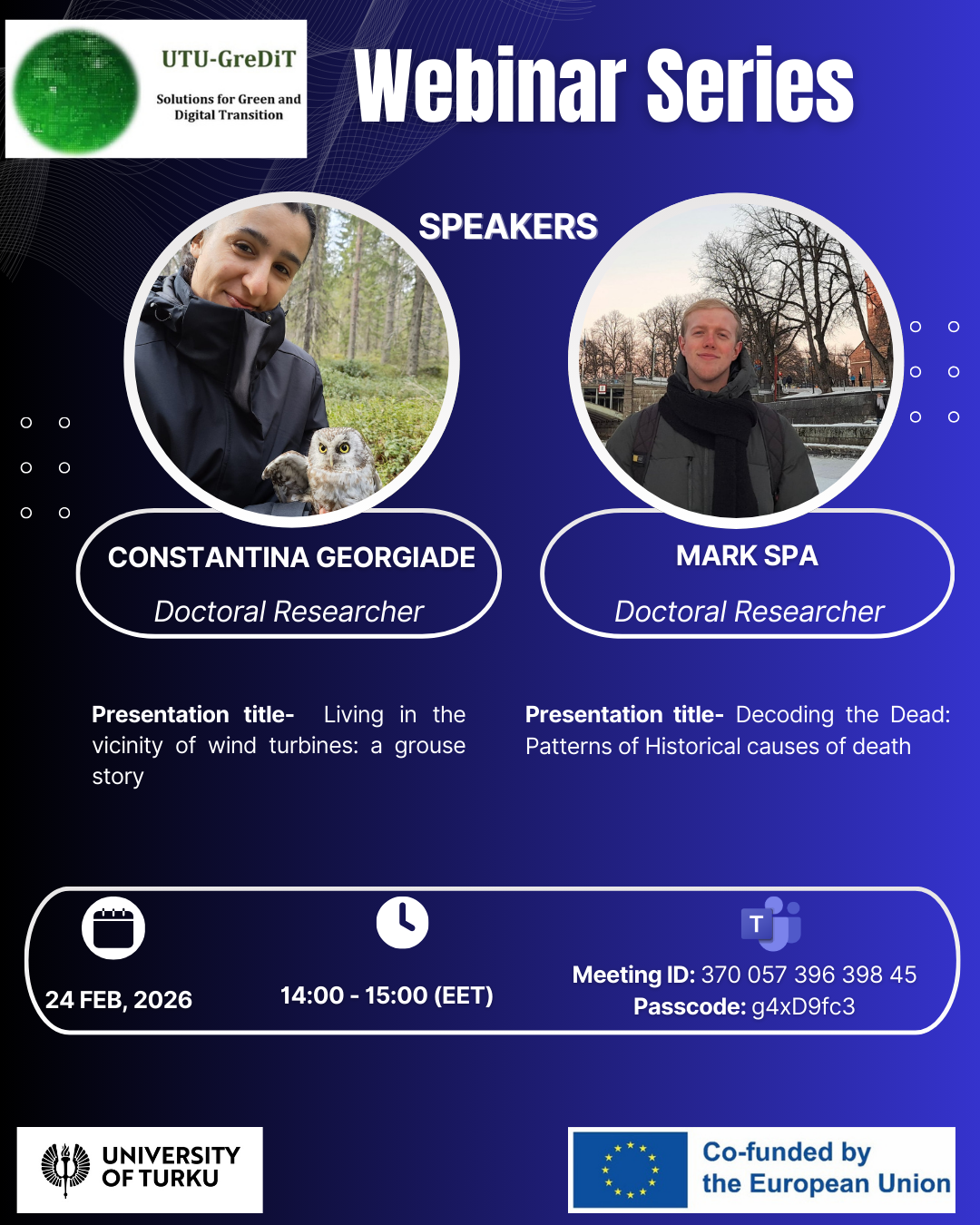
Doctoral Researcher, University of Turku, Department of Biology
Title: Living in the vicinity of wind turbines: a grouse story
As the world shifts toward renewable energy to combat climate change, the rapid expansion of wind power raises important questions about its ecological consequences. In Finland, where wind energy development is accelerating in forested landscapes, we know surprisingly little about its impact on sensitive wildlife – like the forest grouse, species highly sensitive to human disturbance. Using long-term data, we investigated how wind energy development in Finland impacted the population of four different grouse species, over the years. In this webinar, I will talk about the work of this project and present some of the latest findings of my recent analysis.
Doctoral researcher, University of Turku, Department of Biology
Title: Decoding the Dead: Patterns of Historical causes of death
Historical mortality is important for our understanding of the evolution of human health. What causes of death were a large burden on society and which age groups were affected the most. Here I focus more also on spatial patterns and explore how cause of death data of over 1.3 million individuals was distributed across Finland from 1800-1850. We find that there is a lot of clustering of these death causes which I’ll explore in future research!
 Co-funded by the European Union. Views and opinions expressed are however those of the author(s) only and do not necessarily reflect those of the European Union or European Research Executive Agency (REA). Neither the European Union nor REA can be held responsible for them.