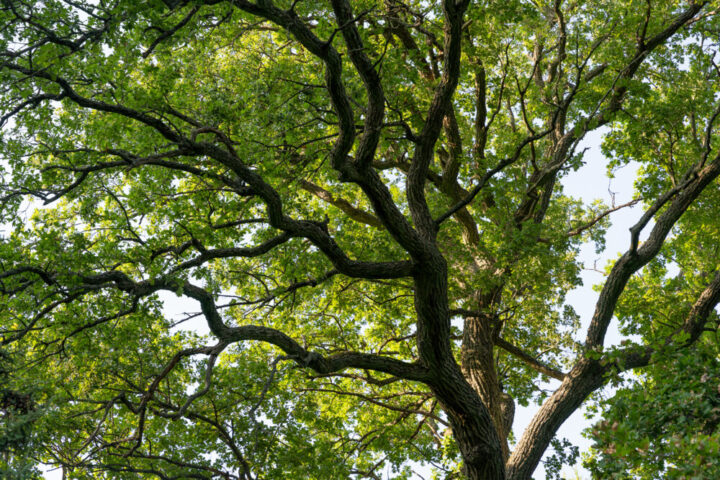
Webinar 26.5.2026 14:00-15:00: Alycia Valvandrin & Temitope Akinyemi
Join us for the May UTU-GreDiT webinar where we get to hear about the research of two MSCA COFUND UTU-GreDiT fellows Alycia Valvandrin and Temitope Akinyemi. The webinar is held on 26 May 2026 at 14:00-15:00 (local time in Finland, UTC +3, EEST).
You can join the webinar using this link.
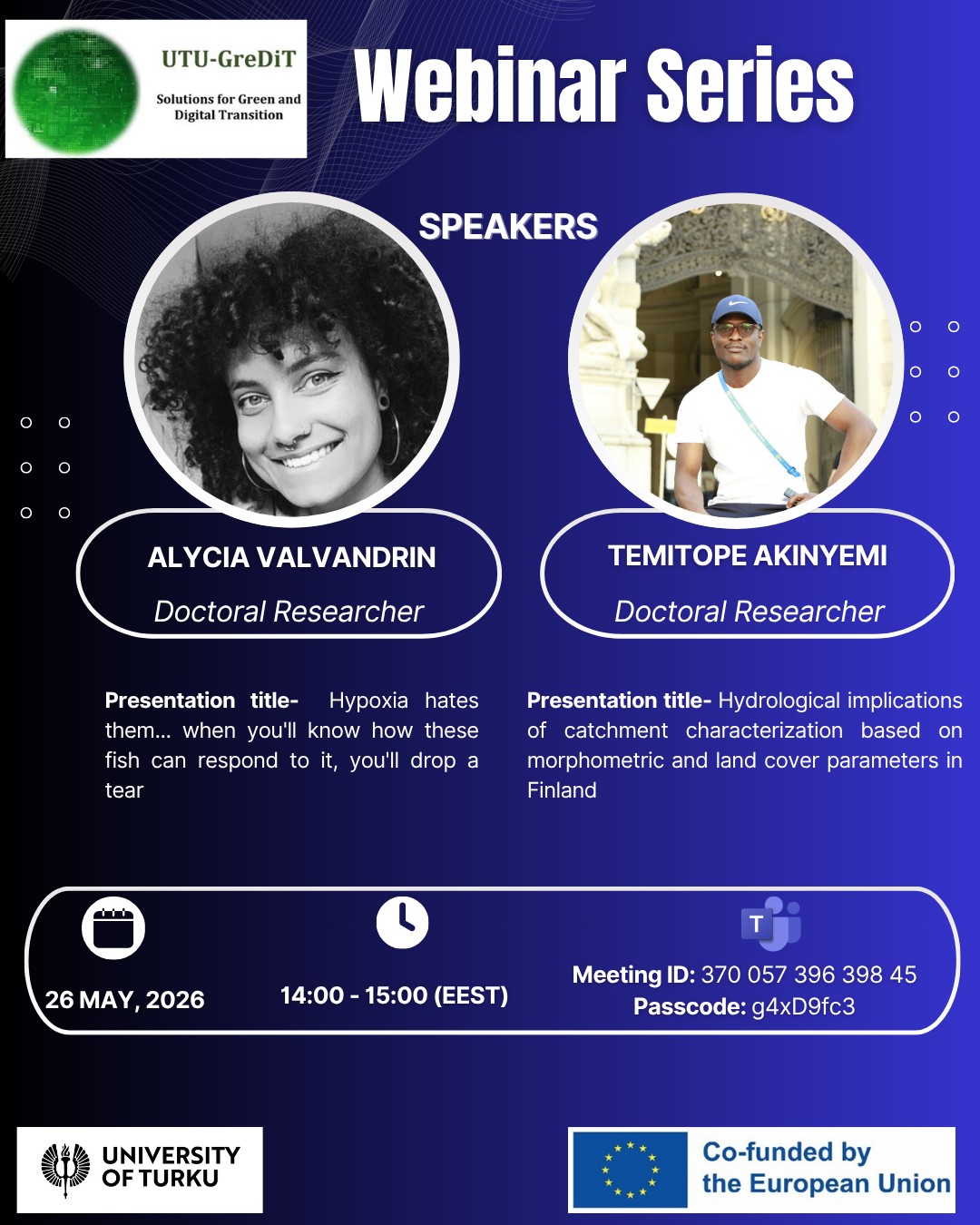
Alycia Valvandrin
Doctoral Researcher, University of Turku, Department of Biology
Title: Hypoxia hates them… when you’ll know how these fish can respond to it, you’ll drop a tear
Ongoing global change will increase hypoxic events, low oxygen in water, posing severe challenges for aquatic life. Organisms, especially fish, must respond to these changes through different time scales. This response is crucial to study for sustainable environmental management, response which can be studied through behaviour, cognition, and neurology. This talk will focus on the impact of hypoxia within and across generations on these three components in the three-spined stickleback (Gasterosteus aculeatus), in particular on their risk-taking behaviour and underlying evolutionary potential; their cognitive abilities in problem-solving and learning-memory; as well as on their brain volume and neurogenesis, which remains the subject of ongoing research.
Doctoral researcher, University of Turku, Department of Geography and Geology
Title: Hydrological implications of catchment characterization based on morphometric and land cover parameters in Finland
This study aims to take advantage of open datasets to improve our understanding of how morphometric and land cover variables relevant to hydrological response variability are distributed across Finland. Data of 19 morphometric and 13 land cover variables were explored for 19,366 sub-catchments across the country. Principal Component Analysis (PCA) was used to identify original independent variables with high influence in the dataset. Sub-catchments were clustered using the k-means algorithm and analysed for similarities in morphometric, and land cover attributes. The results, visualised through maps and boxplots, revealed distinct sub-catchment classes.
 Co-funded by the European Union. Views and opinions expressed are however those of the author(s) only and do not necessarily reflect those of the European Union or European Research Executive Agency (REA). Neither the European Union nor REA can be held responsible for them.