Webinar 27.1. 14-15:00: Ali Salmasi & Sewwandi Alwis
Join us for the first UTU-GreDiT webinar of 2026 where we get to hear about the research of two UTU-GreDiT fellows Ali Salmasi and Sewwandi Alwis. The webinar is held on 27 January 2026 from 14:00-15:00 (local time in Finland)! You can join the webinar using this link.
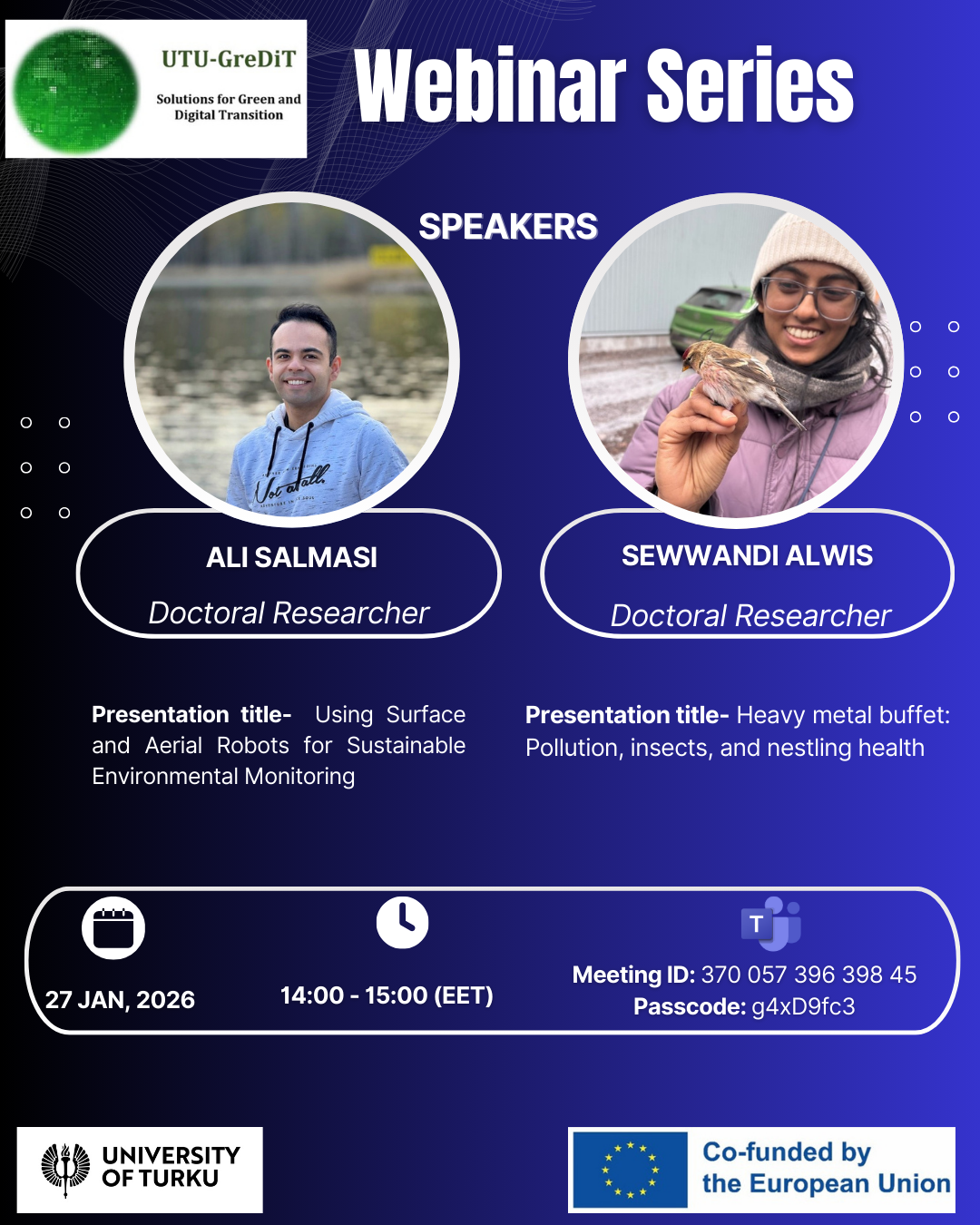
The UTU-GreDiT webinars are organised for the UTU-GreDiT doctoral researchers of University of Turku to share with each other, and with everyone, their in-progress research or finalized outputs in a friendly and supportive atmosphere.
We continue our webinar series with:
Department of Information Technology, University of Turku
Title: Using Surface and Aerial Robots for Sustainable Environmental Monitoring
My PhD research aims to enable collaborative surface–aerial robotic systems for sustainable environmental monitoring, and so far my work has focused on perception for a single autonomous robot. In particular, I study how vision–language models and local large language models can be used to interpret visual scenes and connect them with high-level semantic concepts. This forms a digital foundation for more scalable, data-efficient autonomy in natural environments. In this talk, I will present what I have implemented so far and how it fits into the longer-term goal of multi-robot collaboration within the green and digital transition.
Sewwandi Alwis
Department of Biology, University of Turku
Title: Heavy metal buffet: Pollution, insects, and nestling health
Air pollution can have direct and indirect effects on birds. Although the direct effects are widely known indirect effects such as exposure via the food webs is comparatively unknown. I will present findings from diet metabarcoding of nestlings exposed to heavy metal along a pollution gradient.
 Co-funded by the European Union. Views and opinions expressed are however those of the author(s) only and do not necessarily reflect those of the European Union or European Research Executive Agency (REA). Neither the European Union nor REA can be held responsible for them.