Out of sight, out of mind: The problem with invisible pollution
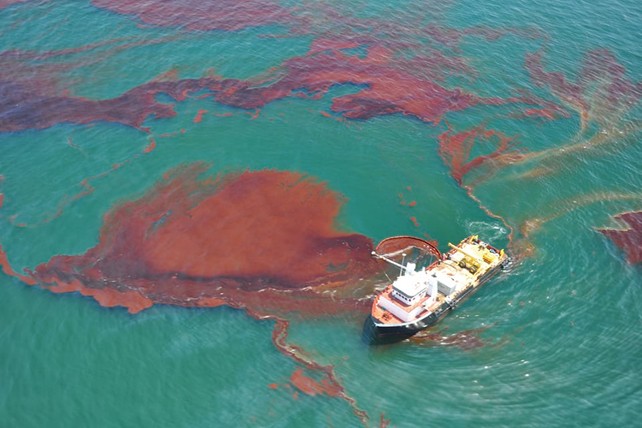
Main picture: Oil skimming after the Deepwater Horizon oil spill in 2010 (Credit: NOAA)
You might read this blog at the end of a typical day – maybe you went out to get some takeaway, just put your wet raincoat into the closet and fried an egg to accompany your curry. You read some news about a recent oil spill and think “all this pollution sure is concerning, but at least I’m far away”.
But are you really?
Your raincoat’s water proofing? Probably made using PFAS. The non-stick pan you used for your egg? Teflon, also PFAS. The coating on your polystyrene foam takeaway box? You probably guessed it by now – also PFAS. But what are these PFAS even? PFAS, or per- and polyfluoroalkyl substances, are a group of persistent organic pollutants, in which the hydrogen atoms on a hydrocarbon chain are replaced with fluoride atoms. In non-chemistry terms: It’s a group of substances which are great to use for all kinds of applications whenever something needs to be durable, water or fat repellent or heat resistant. Sounds good, right? And it is! However, there’s an issue: known as “forever chemicals”, PFAS are also very long lasting in the environment, and many have been linked to cancer, hormonal disruption and other health concerns.
When we think of pollution, most of us have an image of oil covered seabirds or giant mountains of plastic waste in their heads, or maybe smokestacks billowing black clouds into the sky. And while these are important parts in environmental pollution, there is way more going on which is invisible to the eye, and we humans are strangely good at ignoring what we cannot see.
Progress brings pollution
Let us start at the beginning. Pollution is not a purely human-made phenomenon; natural pollution always existed. Volcanos produce carbon dioxide and other gases, some of which contribute to climate change, while others damage the ozone layer or cause acid rain, or are simply highly toxic even at low concentrations. In addition, particle emissions can include all kinds of toxic substances such as arsenic or mercury. Wildfires can have a similar effect on air pollution, if they get large enough. Phenomena like El Niño can cause algal blooms, which in turn can produce massive amounts of toxins. But most of these events are temporarily and spatially restricted – which is not at all the case for anthropogenic pollution.
Up to the 18th century, human impact on pollution remained fairly limited, until the gamechanger called “industrial revolution”. Smoke from burning coal, heavy metals from mining washout and manufacturing and toxic chemicals from processes like paper production or leather processing increased dramatically with industrialisation. When looking at CO2 levels, both the surge and the absolute concentration have increased exponentially from 1950 onwards. Rivers like River Irwell in Manchester became heavily polluted and void of life, and biodiversity greatly decreased in many parts of the world. While people began to notice the negative impact of industry on the environment and human health even then, it was seen as collateral damage of economic progress. We still see this issue today in developing countries – and I certainly can’t blame them for it, as they just want to adjust their lifestyle to ours.
This brings me to another leading contributor, although it can be seen as more of an indirect influence on pollution. While the population in most European countries and North America is slowly declining now after a strong increase over the last centuries, it is on the rise in the aforementioned developing countries. All of this can be credited to the production of nitrogen on an industrial scale, implemented by Haber and Bosch in the early 20th century. This process made large scale production of fertilisers possible and so enabled the increase in world population from under 2 billion in 1900 to more than 8 billion in 2026. However, with greater populations come greater needs, and as we have learned by now: more production generates more pollution.
The Age of Plastics
While steel drove the industrial revolution, nowadays we rely on a second material for more applications than ever before: plastics. With their wide range of physical and chemical properties plastics can be found in almost every part of our lives, from building materials over packaging to specialised medical equipment. However, despite all their usefulness plastics have some serious downsides. Production is energy intensive, and they are long lasting in the environment, for example in the Great Pacific Garbage Patch, which by itself already contains around one hundred thousand tons of plastic waste. Plastic bags and nets are especially dangerous for marine animals (like the sea turtles in the following picture), and when plastics begin to degrade, they become microplastics, which accumulates through the food chain. Microplastics have even been found in human brains and placentas! And while the accumulation of plastic particles alone can already lead to health problems like inflammation, many plastics are created using so called additives (for example plasticisers to make PVC supple), which can be toxic by themselves as well.
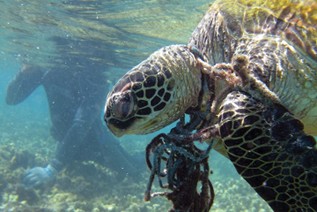
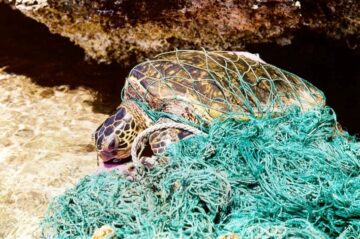
Sea turtle caught in old fishing nets. Left: Hawksbill sea turtle. Right: Green sea turtle (Credit: NOAA)
But whenever we talk about plastics and pollution, we should also take a look on the resource they are made from. Crude oil is the main component of plastics, and its extraction brings its own environmental problems. I still remember the Deepwater Horizon oil spill in 2010, where more than half a million tons of crude oil blasted into the Gulf of Mexico with a devastating effect on marine live – one of the first times I began to understand the damage we do to the environment.
That being said, even without accidents happening the heavy use of oil takes a toll for the environment. You’ve read terms like “coal smoke”, “CO2 levels” or “energy intensive production” several times in this text now, and oil belongs right in the same category. The problem is that modern society depends on fossil fuels as a power source to sustain our lifestyle. Around 80% of the global energy supply comes from fossil fuels like oil or coal, the main consumers being industry and transportation with one third of global energy consumption each. This leads to an enormous emission of greenhouse gases, which are major drivers for anthropogenic climate change. These changes affect Earth’s climate system in multiple ways, resulting for example in more common extreme weather events like heat waves or floods. So, we see, pollution is a complex topic, and now that we had some examples of visible pollution and some of their not so visible effects, we can talk about an even more invisible issue.
Problems Of Persistence
After talking so long about pollution, maybe we should discuss what a pollutant even is. If I were to give you a simple explanation, I’d say in this context pollutants are mostly substances that have a negative effect when released in the environment. Now that we have established that, we can differentiate them further. Focusing purely on a few carbon-based compounds, some substances like the plasticisers in PVC are harmful, but they degrade in a relatively short amount of time. Sadly, this is not always the case. Actually, there are not just a few, but millions of chemicals which break down extremely slowly, and therefore named persistent organic pollutants (POPs) – here we get back to your dinner from the beginning, because it involves a lot more POPs than you might think.
If you’re an 80s child, you might remember the depletion of the ozone layer, largely due to the use of chlorofluorocarbons. At the time, these compounds were used to cool down refrigerators, until scientists realised that the release of these gases greatly decreased the ozone layer, which led to higher exposure to UV light. To avoid higher risks of cancer due to UV light, the Montreal Protocol was created, a treaty to ban production of ozone depleting substances. While probably none of us still has a refrigerator using these coolants, don’t worry, there’s plenty other opportunities for exposure in your kitchen! Let’s look at your pans: You might use stainless steel or cast iron if you’re fancy, but I know from experience that most people enjoy the comfort of a non-stick coated pan for quick cooking sessions. Many of these are made using different PFAS compounds, mostly Teflon with some other “production assistants”. As mentioned in the beginning, they are linked to major health concerns, and they can persist in the environment for decades.
And there are so many more examples for substances which are used everywhere but rarely thought of, until we find ourselves in a situation, in which we suddenly realise that they are harmful, and we have to start thinking how to get rid of them. PCBs, used in electronics, which are carcinogenic. DDT, a pesticide, which isn’t just toxic to insects but other crawlers and even birds as well. All these compounds share the same problem: often they take a long time to be recognised as harmful. They are simply less flashy than oil spills or waste covered rivers and are convenient for us to overlook.
The Trojan Horse
So far, we have learned that there are substances which are invisible, harmful and persistent, and that these properties let them slowly accumulate in plants, animals and humans. Now you might be wondering: what if there are ways which could change the speed of this accumulation? Well, you’re not the only one! I’ve started working on harmful effects of POPs and heavy metals on fish in 2020 and was fascinated by the changes depending on environmental scenarios. This is also where my PhD topic comes in – I’m investigating the influence of transport particles, so called vectors, on PFAS contaminants. Imagine yourself walking around in your hometown in heavy rain. Without transportation you wouldn’t move around much and stay close to home. But if you take a bus, you suddenly become more mobile and can move around the town much easier. Many pollutants can behave similarly when attached to transport particles like plastic particles. The complexity of this topic means that currently little research has been done on it, but in my opinion, it is a very important thing to understand – after all, how can we decide on which chemicals are harmful if we don’t even know how they can actually accumulate in nature?
Into a cleaner future
This brings us to the last point: After the research is done, how can we make sure that we really decrease emissions and create a cleaner world for us and the generations after? I have already mentioned the Montreal Protocol, which showed that society can pull together if needed. Since then, several treaties have been signed to reduce contaminants, for example the Kyoto protocol to decrease CO2 emissions or the Stockholm convention against POPs. But procedures in all of them are slow, and I think all of us should give more attention to these invisible pollutants and show that we are interested in long term solutions instead of the current way of replacing one contaminant with another. I’ve listened to a conference talk on PFAS not long ago that raised a point: Do we really need all of these chemicals? Were we not able to solve the same problems without issues before, maybe just by using slightly more expensive but less harmful methods? The question stuck with me, and I hope this blog was able to give you a bit of insight on the problem of pollution. Especially invisible pollution is easy to ignore as we do not see it directly, but understanding how these persistent pollutants move, accumulate and harm us might be one of the greatest environmental challenges we currently face.
Follow Alexander on LinkedIn!
 Co-funded by the European Union. Views and opinions expressed are however those of the author(s) only and do not necessarily reflect those of the European Union or European Research Executive Agency (REA). Neither the European Union nor REA can be held responsible for them.