Infrastructure
E-Mobility & Automation Lab (EMAL), Sähköliikkuvuuden ja automaation laboratorio, UTU Automation, Department of Mechanical and Materials Engineering
EMAL is part of Roadmap for research infrastructures of the University of Turku https://www.utu.fi/en/research/research-infrastructure
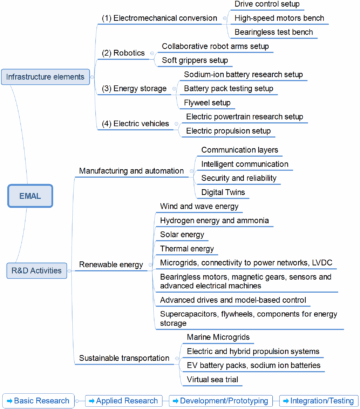
The E-Mobility & Automation Lab (EMAL) is a multidisciplinary innovation and research hub dedicated to advancing the future of electric mobility, intelligent automation, and sustainable energy systems. EMAL brings together expertise in robotics, advanced electrical machines, energy storage, electric powertrains, renewable energy integration, and smart power systems to develop next-generation solutions for transportation, industry, and infrastructure.
EMAL’s mission is to accelerate the transition to clean, connected, and intelligent systems by integrating cutting-edge research with real-world applications. The lab focuses on developing new machine topologies, control methods, application of new materials, novel manufacturing technologies, and high-efficiency energy and automation systems to support innovations that drive both environmental sustainability and industrial competitiveness.
From modular electric drive systems, bearingless motors, and adaptive soft robotic manipulators to renewable-powered microgrids and intelligent control architectures, EMAL serves as a collaborative platform for academia, industry, and public stakeholders to co-create the technologies that will define tomorrow’s mobility, energy, and automation landscape.
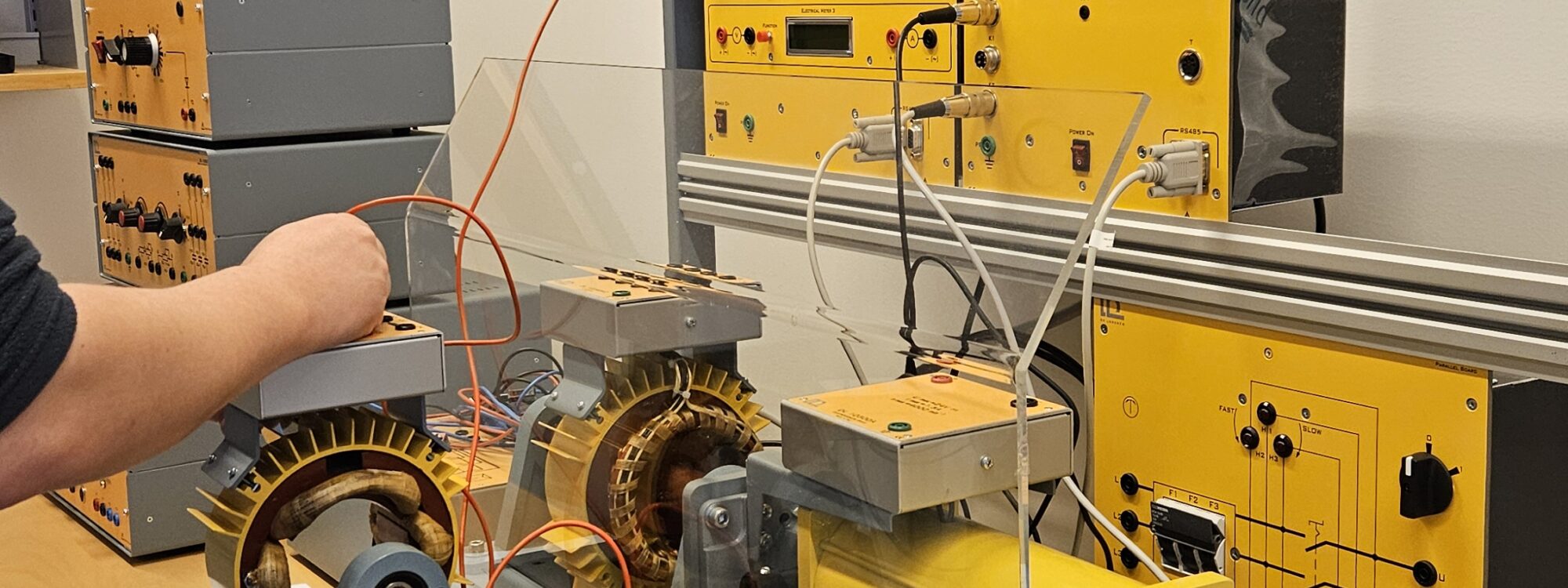
The operation has started in 2025 with opening Automation micro labs in the Joukahaisenkatu 3, 20520 Turku, Finland, ICT-City, Stair B, 5th floor spaces: B5080 – Automation lab 1 and B5029 – Automation lab 2. Presently, the small mostly educational bits for about 20 (running and under development) automation and electrical engineering courses (https://sites.utu.fi/automation/teaching/) are being used and prepared for teaching. The educational/research small bits include: permeameter, educational HIL, several electrical machine educational kits, Siemens automation PLC warehouses and smart factory kits, motion control kits, drive train custom research platform based on real hybrid track and e-lifter (incoming), and others.
The newly opened curricula and program at the University of Turku offers automation engineering that includes teaching and research in control and automation, model-based/optimal control, industrial systems engineering, electric powertrain systems, and other relevant areas. The research and teaching strategic aims are closely related to the regional industrial stakeholders’ needs in the broadly understood region of Southwest and Western Finland and beyond. The curricula have been designed in response to the Ministry of Education and Culture’s decision that granted the University of Turku educational responsibility in automation and electrical engineering.
Discipline(s) of the research infrastructure (see. Statistics Finland’s fields of science)
213 Electronic, automation and communications engineering, electronics
214 Mechanical engineering
216 Materials engineering
Keywords (Finnish and English)
Automaatioala, sähkökoneet, robotiikka, uusiutuvat sähköjärjestelmät, sähköiset voimalinjaratkaisut, sähköajoneuvot, laakerittomat moottorit, teho- ja ohjauselektroniikka, säätöjärjestelmät, mallipohjainen ohjaus, optimaalinen ohjaus, tekoälypohjainen ohjaus, teollisten järjestelmien suunnittelu, älykkäät järjestelmät, digitaaliset kaksoset, virtuaaliset testausympäristöt, sulautetut järjestelmät, koneoppiminen, kyberfyysiset järjestelmät, energiatehokkaat järjestelmät, älyanturit, teollisuus 4.0, energiavarastointi, mikroverkot.
Automation engineering, Electrical machines, Robotics, Renewable power systems, Electric powertrain systems, Electrical vehicles, Bearingless motors, Power and control electronics, Control systems, Model-based control, Optimal control, AI-driven control, Industrial systems engineering, Intelligent systems, Digital twins, Virtual testing environments, Embedded systems, Machine learning, Cyber-physical systems, Energy-efficient systems, Smart sensors, Industry 4.0, Energy storage, Microgrids.
Responsible person and description of the management model
Rafal Piotr Jastrzebski, Associate Professor, UTU Automation, +358408337618, rafal.jastrzebski@utu.fi
The completely new research initiatives in the region encompass innovative technologies that align with the green transition and sustainable development goals. Examples include
- Sandvik Mining and Construction Oy would provide two vehicles: BEV loader and diesel-electric truck demonstrator, which are becoming a backbone experimental system in powertrain research setup for efficient electrification and electric driveline components development for mobile machinery at UTU.
- Sandvik, IONCOR, and Valmet Automotive connect their activities to the planned battery pack testing setup and climate-controlled cell cycler that will enable comprehensive testing and validation of new battery concepts at UTU. Precision data acquisition, monitoring, and analysis of multiple battery cell channels will simplify lab operation and consolidate battery research, including sodium-ion development and testing systems compliant with industrial standards.
- Wärtsilä has been looking for advanced decarbonization technologies, such as quieter and lower maintenance superchargers for marine gensets, highly efficient turbines, heat recuperation generators, integration of renewables and energy storage on ships and in harbors, as well as cleaner novel propulsion. The efficient electromechanical conversion platform provides a needed development environment.
- Meyer Turku collaborates with Wärtsilä (e.g., through the Zero Emission Marine ecosystem), and Finnish and international cruise lines (e.g., Royal Caribbean). Meyer is deeply involved in marine decarbonization through several ambitious initiatives and partnerships in the NEcOLEAP Ecosystem. The ecosystem is supported by the Green Transition Lab, and the initiative aligns with Finland’s national green goals and the EU’s climate targets. The sodium battery research setup, among others, supports this development. EMAL connects through energy-efficient HVAC systems and the integration of ship design and energy systems.
- Kongsberg Maritime and ABB are actively involved in marine decarbonization, and they have a presence or partnerships relevant to the Turku region. Advanced electric propulsion, drives, and electrical machine initiatives are planned based on the RI platforms. Rauma Marine Constructions led the Decatrip project, which created one of the world’s first carbon-neutral maritime corridors between Turku and Stockholm. New projects and initiatives involving retrofitting ships with hybrid and battery systems are being examined. Similarly, Danfoss provides HVAC and other energy-efficient solutions specifically tailored for marine applications. Development and laboratory prototyping of HVAC components to improve energy efficiency, reduce emissions, and enhance onboard comfort and safety across various vessel types is planned. Yaskawa also operates in the Turku region; and is actively involved in technologies that support decarbonization, particularly in the fields of renewable energy and electrification.
Examples of innovative technologies being developed using planned infrastructure that align with the green transition and sustainable development goals –
- EVs operated on land, sea, and in the air eliminate direct air pollution. They require compact and efficient batteries. Sodium-ion batteries use sodium ions instead of lithium ions to store and deliver power. They are cheaper, safer, and more abundant than lithium-ion batteries, but they have lower voltage, slower charge/discharge rate, and limited cycle life. Sodium-ion batteries are being developed as a potential alternative to lithium-ion batteries for EVs. Battery Management Systems (BMS) for sodium-ion technology and control and composition of the battery pack, which is an assembly of battery cells electrically organized in a row and column matrix configuration, will be developed under the project. The development and deployment of EV technologies contribute to SDG 7, 9, 11, and 13.
- Hydrogen energy, particularly in the form of green hydrogen produced via water electrolysis using renewable electricity, is increasingly seen as a cornerstone of the global green transition. It offers a clean, versatile, and high-energy alternative to fossil fuels. Hydrogen enables large-scale energy storage and grid balancing, especially when integrated with intermittent renewable sources like wind and solar. Research is focused on improving the efficiency and sustainability of water-splitting technologies through advanced electrocatalysts, eco-friendly electrolytes, and low-energy input systems, which reduce the environmental footprint of hydrogen production while enhancing its scalability and economic viability. Green hydrogen supports SDG 7 (Affordable and Clean Energy), SDG 9 (Industry, Innovation and Infrastructure), and SDG 13 (Climate Action), positioning it as a transformative energy carrier for decarbonizing sectors such as transportation, industry, and power generation.
- Bearingless technology, characterized by non-contact operation, compact structure, and without the need for lubrication, aligns with the themes of environmental protection, efficiency, and energy conservation. 60% of the electrical energy consumed by various motors is consumed by industrial, mostly high-speed, high-power pumps, compressors, and fans. Developing affordable bearingless technology has potential to significantly drive global industrial emissions and pollution down directly (by increased efficiency, reduced maintenance, elimination of oil lubricants in existing electrical machine applications) and indirectly by unlocking clean, environmentally-friendly, efficient applications, such as high-temperature heat pumps (SDG 13) to replace oil and coal burning to generate industrial heat. Those advantages are particularly well received by medium and higher power applications, which are the main industrial energy consumers (SDG 7, 9, 11, and 12). The first impacted applications include generators, compressors, blowers, hydrogen energy electromechanical converters, heat pumps, and water purification municipal plants.
- Supercapacitors are increasingly recognized as a key technology in the green transition, offering sustainable, high-performance energy storage. Electrically, they provide rapid charge and discharge capabilities, high power density, and long cycle life, making them ideal for stabilizing renewable energy systems and supporting smart grids and electric vehicles. Chemically, research is focused on eco-friendly materials such as biomass-derived carbons, conductive polymers, and waste-to-carbon technologies, which reduce reliance on toxic or rare substances and promote circular economy practices. These innovations contribute to cleaner energy systems, responsible resource use, and climate action, positioning supercapacitors as a vital component of sustainable energy infrastructure (SDG 7 and 9).