ICCAP 2026 Kraków: Day 1
Our rewarding conference trip has given us plenty to write about. Enough for several blog posts! In this post, we recap the first day of the ICCAP 2026 conference in Kraków. Alongside academic content, we’ll also share some of our food and cultural adventures, as conference trips are a great opportunity to explore the world.
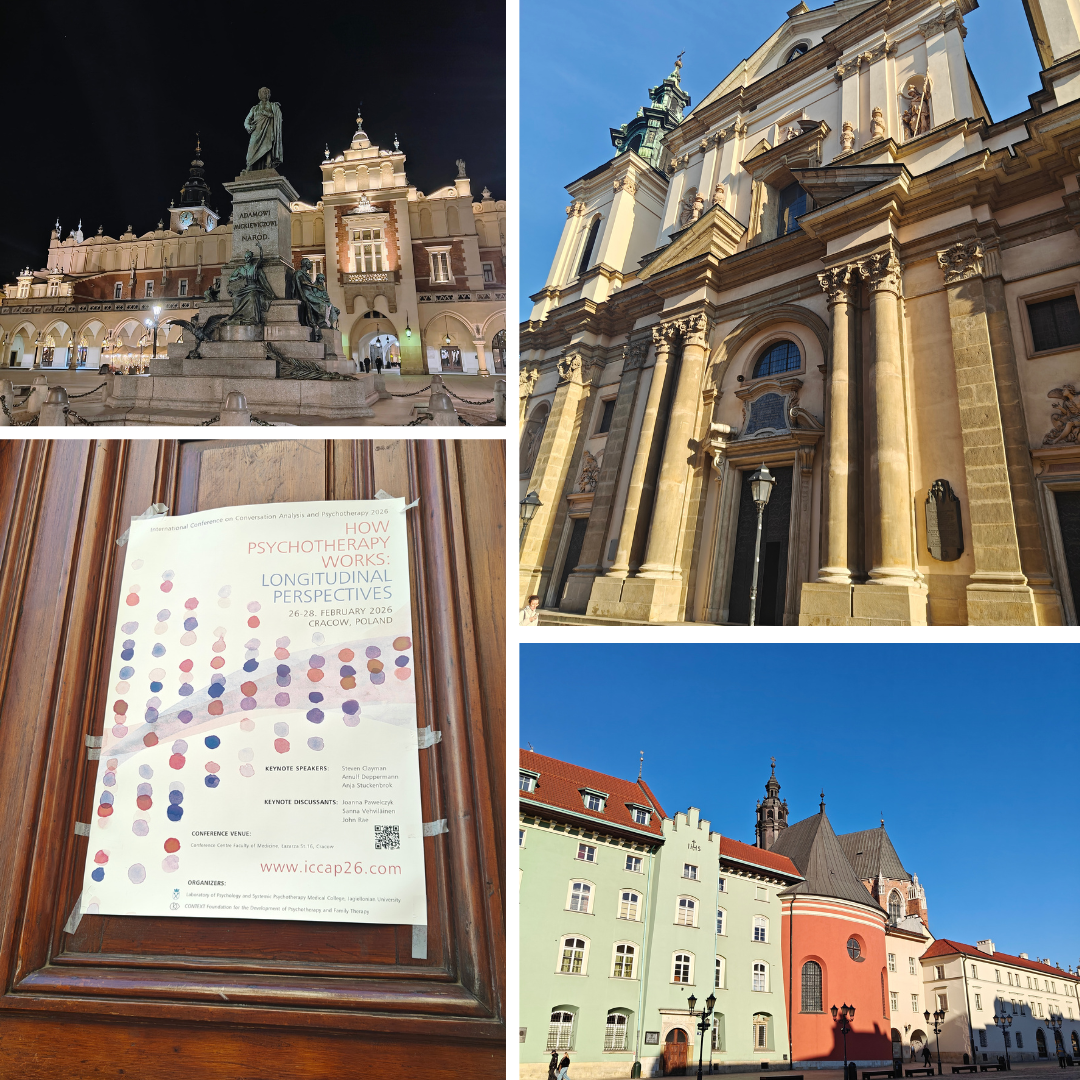
Jenny recommends paying attention to accommodation location when planning conference travel. Is it possible to conveniently reach both the conference venue and the city’s main sights? If walking is inevitable, could the route include something enjoyable to see along the way? On this trip, we managed both: the short walk from our hotel to the university took us right through Kraków’s Old Town.
Inspiration for Longitudinal Psychotherapy Research
In the Borderlines of Self project, we are working with data from a full year-long group therapy process, which we aim to analyze qualitatively, including from the perspective of change. For this reason, the theme of ICCAP 2026, How Psychotherapy Works: Longitudinal Perspectives, was especially appealing to us. While we may have secretly hoped to leave the conference with clear answers for our future work, we instead came away with a stronger sense of the complexity of the task. Therapeutic change can to some extent be traced in interactional data, but it remains unclear which phenomena and details should be the primary focus of such analysis.
The conference opened with a plenary by Professor of Sociology Steven E. Clayman (University of California), who discussed the methodology of longitudinal conversation analysis, or more precisely, applied research grounded in conversation analysis. Clayman suggested that interaction has a “production infrastructure”, including basic structural features, recipient design, and context-sensitivity. Interactional projects may develop in particular ways over time. As an example, he examined U.S. presidential press conferences from 1955 to 2000 (see Clayman & Heritage 2002; 2009), showing how journalists’ questions have become increasingly assertive and aggressive over the years. In the second part of his plenary, Clayman addressed talk about loss in couples therapy, though without a longitudinal perspective.
Later presentations also explored change over time. Professor Emeritus of Clinical Psychology Jarl Wahlström (University of Jyväskylä) presented a case study in which a psychotherapy client’s agency increased and their ability to recognize emotions became more refined. Assistant Professor of Theoretical Psychoanalysis Christian Sell (International Psychoanalytic University Berlin) analyzed a four-year individual therapy process, focusing on changes in resonance between therapist and client. As indicators, Sell examined, among other things, jointly produced turns and the client’s participation in guiding the interaction.
Personality Disorders in Therapeutic Interaction
We had lunch at a nearby restaurant, after which we attended presentations focusing on personality disorders in therapeutic interaction, which is central to the Borderlines of Self project. Psychotherapist and researcher Bartłomiej Taurogiński (Jagiellonian University) presented on self-blame and self-defense in couples therapy involving clients with features of personality disorders. He showed that self-blame tends to occur in safe situations, whereas accusations from a partner trigger defensive responses. Taurogiński and colleagues (2023) have also previously studied complaining about and blaming one’s partner in the same dataset, showing that individuals with narcissistic traits may be more likely to behave in ways that hurt their partner in therapy interactions.
Assistant Professor of Psychiatry Mariusz Furgał (Jagiellonian University) presented research on the therapeutic alliance in couples therapy, also involving clients with features of borderline personality disorder. His analysis illustrated how therapists manage disagreements without explicitly siding with either party.
In our Borderlines of Self presentation, we examined displays of identification in VideoFacilitation group therapy. We analyzed excerpts in which patients commented on each other’s video-recorded accounts of childhood trauma. Our focus was on comments where one participant responds to another’s experience by sharing a similar personal experience. In our data, such comments typically begin with a claim of similarity (e.g., “I’ve had exactly the same”). This is followed by evidence, such as a personal narrative (a second story, see Sacks 1992; Arminen 2004; Ruusuvuori 2005; Siromaa 2012) or a looser listing of similar elements.
What is particularly interesting in these expressions of identification is how they shift toward constructing a shared, collective experience. We will discuss this in more detail in our upcoming publication, which Jenny has been working on intensively since the conference. The feedback we received on our presentation was very encouraging, making it a pleasure to continue the research.
The Charm of the Old Town
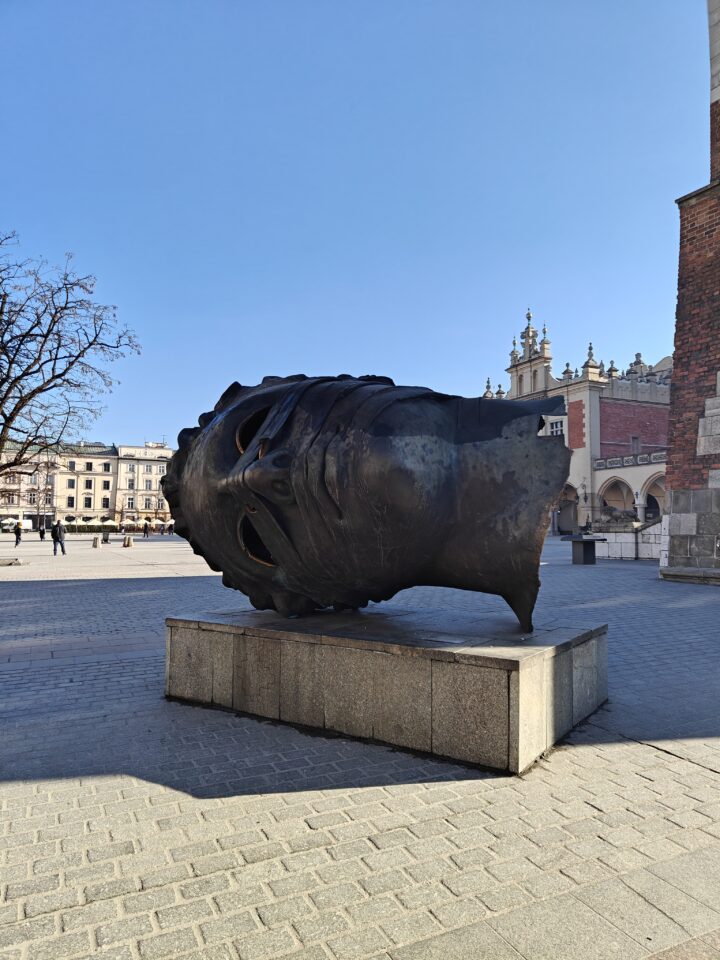
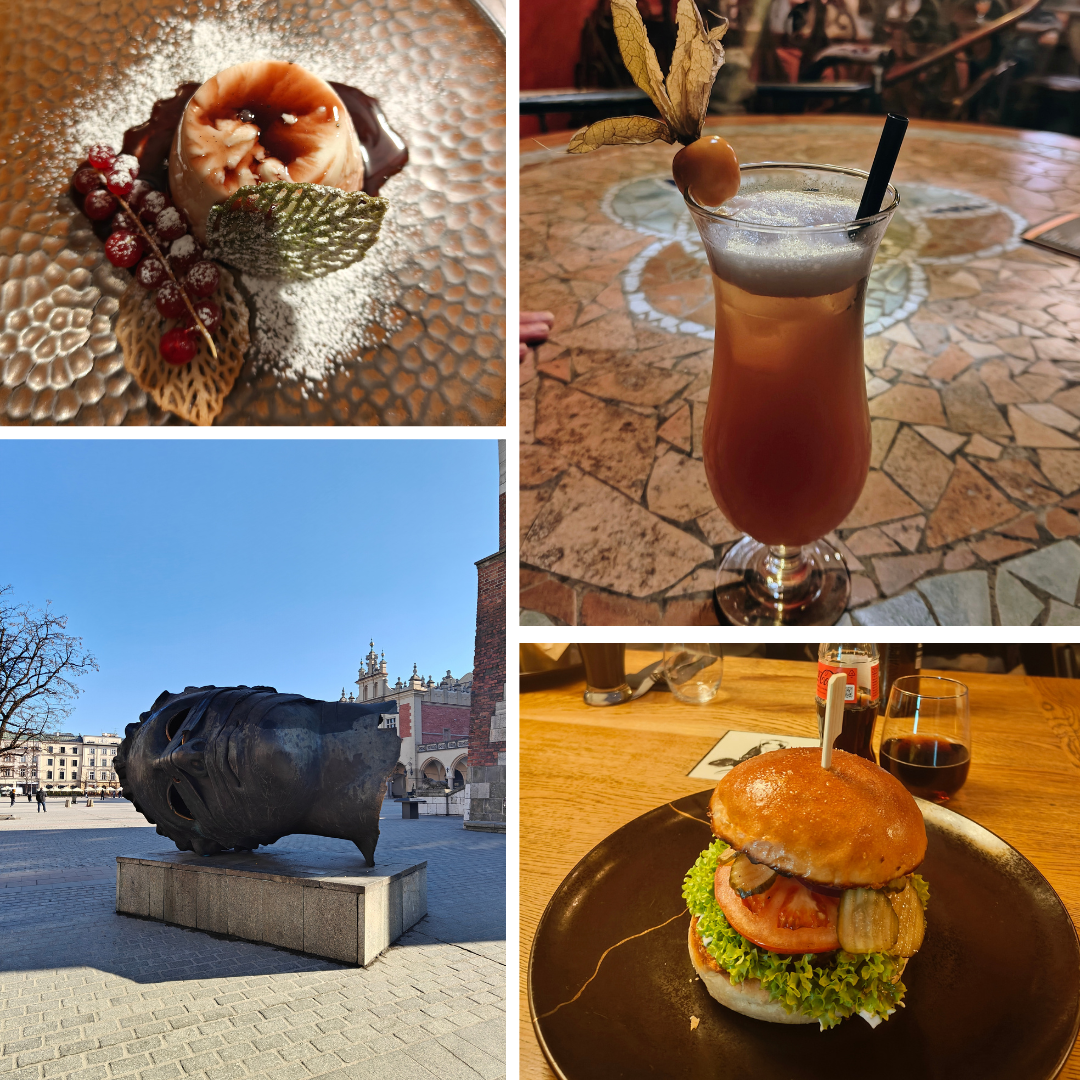
Already on our way to the conference venue in the morning, we had time to admire the Old Town square and happened to pass St. Mary’s Basilica right on the hour, just in time to hear the trumpet call played from its tower. A bit further along, we also came across the Eros Bendato sculpture, more commonly known simply as “The Head.” The Old Town square was a beautiful and lively place, offering glimpses of the city’s history as well as numerous shops and restaurants.
On our first evening, we enjoyed a delicious Italian meal at a restaurant called Sorrento. After the first conference day, we discovered a slightly hidden, Buddha-themed bar in the Old Town, where we tasted some drinks inspired by the theme. After a long conference day, it was refreshing to enjoy the atmosphere and reflect on the ideas sparked during the sessions. Afterwards, we ended up at a nearby place called Moo Moo for hearty cheeseburgers. While not recommended for vegetarians, or those who care about the visuality (the restaurant was decorated with meat displays…), it offers very juicy portions for burger lovers. The food was both tasty and affordable, making Kraków an excellent destination for culinary exploration as well.
Jenny and Kati
References
Arminen, I. (2004). Second stories: the salience of interpersonal communication for mutual help in Alcoholics Anonymous. Journal of Pragmatics, 36(2), 319–347. https://doi.org/10.1016/j.pragma.2003.07.001
Clayman, S., & Heritage, J. (2002b). Questioning presidents: journalistic deference and
adversarialness in the press conferences of Eisenhower and Reagan. Journal of Communication, 52(4),749-77.
Clayman, S., & Heritage, J. (2009). Question design as a comparative and historical window into president-press relations.” In M. Haakana, M. Laakso, & J. Lindström (Eds.), Talk in
interaction: comparative dimensions (pp. 299-315). Helsinki: Finnish Literature Society
(SKS).
Ruusuvuori, J. (2005). ”Empathy” and ”sympathy” in action: Attending to patients’ troubles in Finnish homeopathic and general practice consultations. Social Psychology Quarterly, 68(3), 204–222. https://www.jstor.org/stable/4148770
Sacks, H. (1992). Lectures on Conversation, vols. I & II. Blackwell.
Siromaa, M. (2012). Resonance in conversational second stories: a dialogic resource for stance taking. Text & Talk, 32(4), 525–545-. https://doi.org/10.1515/text-2012-0025
Taurogiński, B., Janusz, B., Bergmann, J. R. & Peräkylä, A. (2023). Spectrum of complaints: practices of complaining in therapeutic conversations as a window to spouses’ personalities and couples’ relationships. Frontiers in Psychology, 14:1232594. https://doi.org/10.3389/fpsyg.2023.1232594