
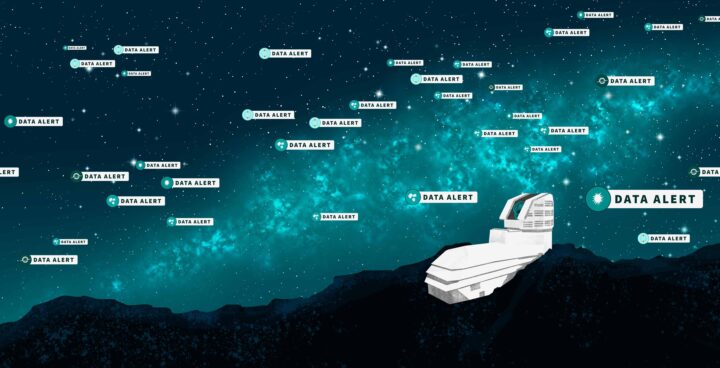
This artist’s illustration represents the start of the alert stream from NSF–DOE Vera C. Rubin Observatory. The summit facility is shown on a rocky ridge. The night sky features stars and the glittering band of the Milky Way Galaxy. The sky is populated with multiple alert “pings,” representing individual alerts from Rubin that something in the sky has changed in brightness or position. Different icons represent various types of alerts, including asteroids, supernovae, active galactic nuclei, and variable stars Credit: NSF–DOE Vera C. Rubin Observatory/NOIRLab/SLAC/AURA/P. Marenfeld/J. Pinto

Vera C. Rubin Observatory revolutionising time-domain astronomy: Start of the 10 year Legacy Survey of Space and Time

FINCA fellow Stefan Schuldt recently published a perspective on the the 10-year Legacy Survey of Space and Time (LSST), that has now officially started. Stefan is a FINCA fellow working as a part of the supernova group at the University of Turku. Within LSST, he is a member of the Strong Lensing Science Collaboration and the Dark Energy Science Collaboration through the Italian research institute INAF. Furthermore, he is a member of the SOXS consortium, highly involved in the supernova Winny characterization and follow-up work (including the NOT) within the HOLISMOKES collaboration. In Euclid he is leading the static lens search. His main research focus is mass modelling for time delay cosmography application.

You can read the full perspective on the UTU website.

Cover image:

This artist’s illustration represents the start of the alert stream from NSF–DOE Vera C. Rubin Observatory. The summit facility is shown on a rocky ridge. The night sky features stars and the glittering band of the Milky Way Galaxy. The sky is populated with multiple alert “pings,” representing individual alerts from Rubin that something in the sky has changed in brightness or position. Different icons represent various types of alerts, including asteroids, supernovae, active galactic nuclei, and variable stars
Credit: NSF–DOE Vera C. Rubin Observatory/NOIRLab/SLAC/AURA/P. Marenfeld/J. Pinto