5/2026 Matti Kuusi and Owambo proverbs
“All knowledge does not fit in one head alone”: Matti Kuusi and Owambo proverbs
Folklorist and paremiologist Matti Kuusi’s work on Owambo proverbs is often referred to in studies on Namibia (see, e.g., Mbenzi 2019, 116, 142), but usually without any mention of who Matti Kuusi actually was. At a conference organized in 2005 to celebrate 135 years of collaboration between Namibia and Finland, Professor of History and specialist in Namibian history Harri Siiskonen (2005) noted that Kuusi was the first to recognize the significance of Aawambo folklore and oral tradition collected in the early 1930s by Emil Liljeblad and his assistants. (Harju 2019; Mbenzi 2019). Later on, this same oral material has been used in several other studies (see, e.g., Koivunen & Merivirta 2024, 14).
Matti Kuusi (1914–1998) was Professor of Finnish and Comparative Folk Poetry Studies (Folkloristics) at the University of Helsinki from 1959 to 1977. However, Kuusi was not only a well-known academic, but also “a speaker, poet, critic, columnist, essayist, cultural politician, and university teacher,” as Professor Lauri Honko described Kuusi in his obituary. According to Honko, he was also a strong supporter of individual talent who cringed at stereotypical mediocrity (Honko 1998). In a seminar held in honor of Kuusi in 2014, his biographer Tellervo Krogerus (2014) stated that although Kuusi was “known to surprise, irritate, and stir up stagnant waters,” in his research he remained committed to the topics dearest to him.
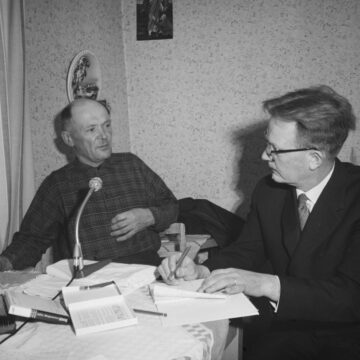
Matti Kuusi (left) interviews Iivana Potkonen (right). Photograph: Pertti Virtaranta (1965). Kansatieteen kuvakokoelma, Museovirasto. CC BY 4.0.
Kuusi was a vigorous researcher who studied oral poetry, epics, anecdotes, personal narratives, and popular culture. He introduced new terms like unwritten literature (kirjoittamaton kirjallisuus) and poplore. Already in 1959, he declared that popular songs and hits are the folk songs of today, which was at the time unheard of. (E.g., Ilomäki 1994.) But, among Kuusi’s many research interests, proverbs were closest to his heart. Vanhan kansan sananlaskuviisaus: suomalaisia elämänohjeita, kansanaforismeja, lentäviä lauseita ja kokkapuheita vuosilta 1544–1826 (1953) is a 500-page long anthology of Finnish proverbs, aphorisms, catchphrases, and common sayings spanning nearly 300 years. In 1988, Kuusi published another extensive collection, this time focusing on modern-day Finland: Rapatessa roiskuu: nykysuomen sananparsikirja. Furthermore, Kuusi was the founder and chief editor of the international paremiological journal Proverbium from 1965 to 1974. In 1988, he donated his extensive collection of proverb literature from Finland and elsewhere to the Finnish Literature Society. This collection, known as the M6 collection*, consists of 1,464 items.
Although Kuusi’s main interest lay in Finnish folklore and proverbs, he was also interested in proverbs from other cultures. In 1985, he published the anthology Proverbia septentrionalia, which contains 900 Baltic-Finnish proverbs with their Germanic and Russian equivalents. In 1993, Kuusi, together with his daughter, the well-known paremiologist Outi Lauhakangas, published a collection of proverbs from around the world, Maailman sananlaskuviisaus (The Wisdom of Proverbs Around the World). However, as early as 1970, he had already published the anthology Ovambo Proverbs with African Parallels, which includes 2,483 proverbs. In 1974, he published Ovambo Riddles with Comments and Vocabularies. In 1979, he published a book in Finnish, Mustan Afrikan viisautta (Black African Wisdom), which includes 533 proverbs, of which 30 are from Owambo (Oshindonga, Kwambi, and Oshikwanyama) (Kuortti 2024, 73).
Kuusi’s work on Owambo proverbs was not coincidental. In a radio interview from 1969**, Kuusi discusses his long-standing interest in Africa, and especially in the Owambo region. Already as a child, he was fascinated by Africa and, like many of his generation, became familiar with the continent and its people by reading Henry Rider Haggard’s adventure novels set there. Already then, he found it difficult to reconcile his own conceptions of Africa with those presented by Finnish missionaries. For Kuusi Africa was an adventure full of possibilities and not a “dark continent”. In a way, Kuusi appears to have been ahead of his time. In his interview he mentions that he finds it difficult to speak of “one specific Africa” and suggested that it would be worthwhile to study where these differing notions originate from. He also proposed that because of the long history of Finnish missionary work in Owambo, it would be worthwhile for Finnish scholars to do more research on Africa. (Yle 1.5.1969.)
In the interview, Kuusi also talks about his first encounters with Owambo proverbs. During a research visit to Germany a few years before, Kuusi had come across Martti Rautanen’s collection of Ovambo proverbs recorded by the missionary in 1884 and after this he found Emil Liljeblad’s extensive collection of proverbs collected in the 1930s. Although he appreciated the work of both missionaries, he considered it unfortunate that the proverbs had been collected according to Christian moral frameworks, which led to the exclusion of many topics. (Yle 1.5.1969.)
Although Kuusi’s work on proverbs has been widely praised, his extensive collections have also raised questions about their usefulness. In her review of Ovambo Proverbs, Ruth Finnegan (1973) pointed out similarities between Kuusi’s work and Richard F. Burton’s Wit and Wisdom from West Africa, first published in 1865. Both anthologies are compilations based on earlier collections. Furthermore, Finnegan criticizes Kuusi for treating proverbs primarily as texts and providing very little contextual information. It is well known that a lack of contextual knowledge can lead to misinterpretations, like in the case of how women have been portrayed in Finnish proverbs.
In a talk given by Kuusi in 1971, he compared proverbs about women in Owambo and Finland and argued that women are represented much more negatively in Finnish proverbs. Although Kuusi acknowledged that he lacked sufficient contextual information and had relied only on selected examples, his conclusion was generalized and contributed to long-lasting assumptions that women are belittled in all Finnish proverbs (Granbom-Herranen 2021). In his 1969 radio interview, however, he clearly demonstrates a deeper understanding of the meanings and contexts of Owambo proverbs than is evident in his published anthologies.
The proverb “All knowledge does not fit in one head alone,” or alternatively “Understanding does not fit in one head alone” (Kuusi, H3b 32), is known both in Namibia and in Finland (“Ei kaikki mieli yhden päässä”). Of the numerous proverbs listed in Kuusi’s International typology and database of proverbs, I chose this one for the title of this brief introduction to Matti Kuusi and his work with Owambo proverbs, because the proverb describes so well the importance of collaboration in the FinNamKnow-project, but also research collaboration in general.
Anne Heimo
* The name of collection is a word game. In Finnish the number 6 is “kuusi”.
** Note: The interview contains terms not found appropriate today.
References
Yle 1.5.1969 radio interview with Matti Kuusi about Ovambo proverbs (Ohjelma ambolaisesta kansanperinteestä). Republished on Yle Areena Ambolainen kansanviisaus – avain Afrikan sieluun 8.9.2006 https://areena.yle.fi/1-50416897 and 16.12.2014 https://yle.fi/a/20-81563 (Accessed 13.5.2026)
Apo, Satu 1997. Kuusi, Matti (1914– 1998). Kansallisbiografia-verkkojulkaisu. Studia Biographica 4. Helsinki: Suomalaisen Kirjallisuuden Seura. https://kansallisbiografia.fi/kansallisbiografia/henkilo/7059 (Accessed 13.5.2026)
Finnegan, Ruth 1973. Wit and Wisdom from West Africa by R. F. Burton Ovambo Proverbs & Ovambo Proverbs by Matti Kuusi. (Review) Research in African Literatures 4(1): 117–119. JSTOR, http://www.jstor.org/stable/3818625. (Accessed 13.5.2026)
Granbom-Herranen, Liisa 2021. Sananlaskujen tutkimus suomenkielisen folkloristiikan historiassa. In Paradigma: Näkökulmia tieteen periaatteisiin ja käsityksiin, edited by Niina Hämäläinen & Petja Kauppi, Kalevalaseuran vuosikirja 100, 202–220. Helsinki: Suomalaisen Kirjallisuuden Seura. Available at: https://doi.org/10.21435/ksvk.100.
Harju, Kaisa 2019. A Joint Effort: Owambo Agency in the Karl Emil Liljeblad Collection. In Intertwined histories. 150 years of Finnish-Namibian Relations, edited by Marjo Kaartinen, Leila Koivunen & Napandulwe Shiweda. Turku: University of Turku. https://sites.utu.fi/intertwined-histories/a-joint-effort-owambo-agency-in-the-karl-emil-liljeblad-collection/ (Accessed 13.5.2026)
Honko, Lauri 1998. Matti Kuusi 1914–1998. Folklore Fellows’ Network 15, April 1998: 8-9. https://folklorefellows.fi/matti-kuusi-1914-1998/ (Accessed 13.5.2026)
Ilomäki, Henni 1994. Notes for an introduction. In Matti Kuusi: Mind and Form in Folklore: Selected Articles, translated by Hildi Hawkins, edited by Henni Ilomäki. Writings published on the occasion of the 80th birthday of Matti Kuusi, 25 March 1994, 13-20. Studia Fennica, Folkloristica, 3. Helsinki: Finnish Literature Society.
Koivunen, Leila & Raita Merivirta 2024. From the Arrival of First Finnish Missionaries in Owambo to Collaborative History-Writing. Cultural Change, Endurance and Resistance, edited by Leila Koivunen and Raita Merivirta, Studia Fennica Historica 28, 7–22. Helsinki: Finnish Literature Society. https://doi. org/10.21435/sfh.28
Krogerus, Tellervo 2014. Esitelmä: Matti Kuusi – rajojen rikkoja? Elore, 21(2). https://doi.org/10.30666/elore.79157
Kuortti, Joel 2024. Oshigwana Hashi Lesha – A Bibliography of 150 Years of Writing on Namibia. In Colonial Aspects of Finnish–Namibian Relations, 1870–1990. Cultural Change, Endurance and Resistance, edited by Leila Koivunen and Raita Merivirta, Studia Fennica Historica 28. Helsinki: Finnish Literature Society. https://doi. org/10.21435/sfh.28 (Accessed 13.5.2026)
Mbenzi, Petrus Angula 2019. The Contribution of Finnish Missionaries Towards the Development of Oshiwambo Language and Culture. In Intertwined histories. 150 years of Finnish-Namibian Relations, edited by Marjo Kaartinen, Leila Koivunen & Napandulwe Shiweda. Turku: University of Turku. https://sites.utu.fi/intertwined-histories/the-contribution-of-finnish-missionaries-towards-the-development-of-oshiwambo-language-and-culture/ (Accessed 13.5.2026)
Siiskonen, Harri 2005. Kulttuuria, tutkimusta ja yhdessä opittua, Paper given at the meeting of
the Finnish-Namibian Society in Helsinki, 14 October 2005. http://www.suominamibiaseura.
fi/doc/seminaari_Siiskonen.pdf http://www.suominamibiaseura.fi/doc/seminaari_Siiskonen.pdf (Accessed 13.5.2026)
Selected bibliography of Matti Kuusi’s work on proverbs in English
The Matti Kuusi international type system and database of proverbs, List of Ovambo Proverbs with African Parallels: https://www.mattikuusiproverbtypology.fi/m6books/m6books-kuu2-186/
Kuusi, Matti 1969a. Southwest African Riddle-proverbs. Proverbium: Bulletin d’information sur les recherches parémiologiques 12: 305–11. Partly reprinted in the online journal De proverbio 4:1 (1998).
Kuusi, Matti 1969b. The Woodpecker That Helped People out of the Tree. Temenos: Studies in Comparative Religion 4: 67–75. https://doi.org/10.33356/temenos.6433
Kuusi, Matti 1970. Ovambo Proverbs with African Parallels. Translated by Anja Miller, Matt T. Salo & Eugene Holman. FF Communications 208. Helsinki. Suomalainen Tiedeakatemia Academia Scientiarum Fennica.
Kuusi, Matti 1974a. The Ovambo Myth Concerning the Origin of Death. Translated by Jane E. György. In Folklore Today: A Festschrift for Richard M. Dorson, edited by Lind Dégh, Henry Glassie & Felix J. Oinas, 319–324. Bloomington: Indiana University Press
Kuusi, Matti 1974b. Ovambo Riddles: With Comments and Vocabularies. Translated by Eugene Holman. FF Communications, 215. Helsinki: Suomalainen tiedeakatemia – Academia Scientiarum Fennica.
Kuusi, Matti 1990 [1971]. The Place of Women in the Proverbs of Finland and Ovamboland. In Matti Kuusi: Mind and Form in Folklore: Selected Articles, translated by Hildi Hawkins, edited by Henni Ilomäki, 148–58. Writings published on the occasion of the 80th birthday of Matti Kuusi, 25 March 1994. Studia Fennica, Folkloristica, 3. Helsinki: Suomalaisen Kirjallisuuden Seura.
Lauhakangas, Outi 2001. The Matti Kuusi international type system of proverbs. FF Communications 275. Helsinki: Suomalainen Tiedeakatemia – Academia Scientiarum Fennica.
Lauhakanags, Outi 2013. The Matti Kuusi International Database of Proverbs. Oral Tradition 28(2):217-222. https://journal.oraltradition.org/wp-content/uploads/files/articles/28ii/06_28.2.pdf