
LifeFactFuture at HICSS-59 and the University of Hawai‘i at Mānoa
Building Global Futures for Life Science, Health, and Sustainability
In January 2026, the LifeFactFuture (LFF) project funded by Business Finland reached a significant milestone through its participation in the 59th Hawaii International Conference on System Sciences (HICSS-59) and an extended scientific research mobility visit to the University of Hawai‘i at Mānoa (UHM). Together, these engagements formed a continuous knowledge journey, linking global scientific dialogue with place-based collaboration, and connecting strategic foresight, life sciences, digital health, sustainability, and socio-technical systems into a shared futures agenda.
HICSS-59: Convening Futures of Digital Health and Socio-Technical Systems
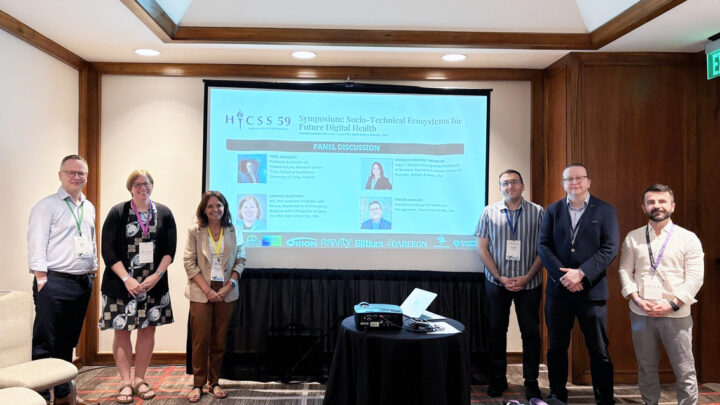
At HICSS-59, LFF research team Professor Toni Ahlqvist, Development Manager Tero Villman and Project Researcher Tolga Karayel organized the symposium “Socio-Technical Ecosystems for Future Digital Health”, creating a dedicated space for interdisciplinary dialogue on how health systems evolve at the intersection of technology, governance, data, and society.
The symposium brought together participants from different counties (USA, Netherlands, Australia, Finland, Canada, New Zealand) and featured distinguished speakers including Monica Chiarini Tremblay (William & Mary, USA), Carmen Quatman (The Ohio State University, USA), and Farzin Ahmadi (Towson University, USA).
Discussions emphasized that future health systems must be understood as interconnected ecosystems rather than isolated technologies, requiring long-term, systemic, and ethically grounded perspectives. Beyond the symposium, HICSS-59 served as a catalyst for collaboration and networking. Strategic discussions with Joshua Rubin, Founding President and CEO of the Learning Health Community and faculty member at the University of Michigan Medical School, reinforced joint ambitions around learning health systems, digital health, and health ecosystems.
Research Mobility at the University of Hawai‘i at Mānoa: A Connected Ecosystem of Collaboration
Following HICSS-59, the research team continued to Honolulu for a scientific research mobility program at the University of Hawai‘i at Mānoa, engaging with a wide range of departments, research centers, and units. At the Shidler College of Business, discussions with Professor Tung Bui and focused on future collaboration for HICSS-60 in 2027 in Hawai‘i and the Futures Conference 2026 in Turku.
Visit to the Family Business Center of Hawai‘i and PACE explored Hawaiian family businesses, succession, and community-embedded models. Engagements with the Institute for Sustainability and Resilience addressed climate adaptation, environmental policy, and long-term sustainability. At John A. Burns School of Medicine (JABSOM), meeting covered the LFF project, biomedical research in Hawai’i, rural health, and precision medical educations at JABSOM.
Research mobility also covered sustainability, culture, and community-based innovation, including Worm Ohana for circular economy practices and the Center for Hawaiian Studies on indigenous knowledge and agroecology. Additional dialogues at the Center for Japanese Studies focused on sustainability, robotics, aging, and higher education. Futures-oriented discussions with Professors Debora Halbert and Jenifer Sunrise Winter highlighted data governance, AI ethics, and communication policy.
From Dialogue to Action: LFF connects people, places, and perspectives to co-create futures that matter.
Together, HICSS-59 and the University of Hawai‘i at Mānoa research mobility program formed a coherent platform for advancing the international mission of LFF project. The engagements of researchers from Finland Futures Research Centre, University of Turku and Futures Distillery strengthened the value of strategic foresight as a connective methodology across health, life science, sustainability, business, technology, and culture, and generated concrete next steps including joint research initiatives, coordinated funding applications, researcher exchanges, joint publications, and co-created futures workshops. Most importantly, the Hawai‘i engagements reaffirmed a shared commitment to building sustainable, inclusive, and resilient futures for life sciences, health systems, and socio-technical ecosystems, grounded equally in global scientific excellence and local knowledge.
We warmly thank all the LFF consortium members, our colleagues and hosts at HICSS-59 and the University of Hawai‘i at Mānoa for their openness, generosity, and intellectual partnership. The collaborations initiated in Hawai‘i will continue to shape the LFF project and its global network in the years ahead.
Tolga Karayel
Project Researcher, Doctoral Researcher
Finland Futures Research Centre, University of Turku
LFF at HICSS 2026 (video by Tolga Karayel).
– –
Cover photo with: Toni Ahlqvist (FFRC), Carmen Quatman (The Ohio State University, USA), Monica Chiarini Tremblay (William & Mary, USA), Farzin Ahmadi (Towson University, USA), Tero Villman (FFRC) and Tolga Karayel (FFRC).
Call For Papers: ’Technology and Strategic Foresight for Decision-Making’ minitrack at HICSS-60
60th Hawai‘i International Conference on System Sciences (HICSS-60) will be organised on 5–8 January 2027. Our research team is organizing a minitrack focusing on the two-way relationship between technology and strategic foresight in the context of decision-making. It examines how new technologies influence and enable foresight in decision-making contexts, and how foresight, in turn, shapes the development, governance, and adoption of technological innovations. Read the full Call for Papers.