Management System Supporting Digital Transformation
LifeFactFuture project’s work package 2 on manufacturing excellence includes a task concerning digital innovation users’ readiness and agency in the digital transformation of manufacturing. Involving people is considered a success factor in advancing the digital changes required for the future factory. But what kinds of support can management systems offer, to involve people and enhance their agency? Researchers at University of Turku’s Industrial Engineering and Management unit conducted a literature review, interviewed Darekon’s managers, and organized a result workshop, to identify the core dimensions of management system support for manufacturing firms’ digital transformation.
Management systems – what are they?
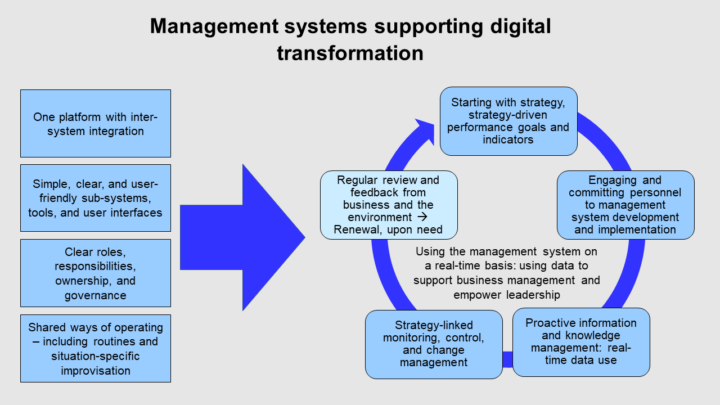
Any organizations have some kind of a management system that defines how the organization’s operations are governed. Sometimes the system is viewed narrowly, merely as strategy and structure of the organization. We, however, see management systems broadly. Besides strategies, goals, and organizational structures, the system contains mechanisms for performance management and leadership of people. Performance management requires processes and routines for planning, resourcing, deciding, organizing, monitoring, and control of the organization’s main operations and various related practices in managers’ work. Many of these aspects can be supported with management information systems, such as ERP (Enterprise Resource Planning), BI (Business Intelligence), and CRM (Customer Relationship Management) systems. Leadership of people, in turn, concerns roles and responsibilities, culture and values, capabilities and skills, and information and knowledge. Some of these aspects, too, may be supported through modern information systems and tools. The various dimensions of management systems are central in supporting the manufacturing firms’ operational efficiency, innovations, and business performance.
Successful management systems combine efficiency and renewal. They support the organization’s adaptiveness, evolution in light of changes in the business environment, and ability to serve customers’ needs also under uncertainly. They take into account employees, by supporting psychological safety, wellbeing, and learning. Each organization has its specific needs, in terms of the types of operations and business, the types of customers, and personnel and skill-base, so management systems always need to be designed to match the unique profile of the organization. Management system should not be viewed merely as a mechanism for control and monitoring, nor as a static quality manual stored on an intranet server. Instead, it should function as a living framework that translates strategic objectives into daily leadership and operational practices. By moving beyond document-centric compliance and embedding organizational goals into everyday routines, management systems become active tools that support effective, situation-specific decision-making while balancing the diverse needs of customers, employees, and the business. A common interest in different manufacturing organizations is to develop such management systems that enable efficiency, quality, and flexibility (agility) at the same time.
Possible challenges in the era of digital transformation
Currently, digitalization is transforming also management systems. There is an increasing interest toward automating and digitalizing the processes associated with performance management and people-related information and knowledge management. Common challenges relate to the disconnects between management domains. For example, operations management, human resources management, quality management, and customer relationship management each may require their own systems which are not necessarily connected with each other. There are several different user interfaces for managers handling such information. Also data quality and reliability may become key concerns, when data is used for planning and decision making. Poor quality data or unreliable data will yield erroneous decisions. Many organizations are already experimenting with artificial intelligence, so the source data quality and reliability issues will need to be solved. A common pitfall is assuming that the IT department owns all digital systems and data streams. In a mature management system, business-side ownership must be clearly defined across different domains.
Further challenges may deal with people’s ways of operating. A lot of information resides in personal emails, may be exchanged in event-specific corridor discussions, and remain in the possession of individuals. Particularly when businesses grow, there will be a need to consider what information needs to become more generally available and be stored in information systems. Harmonizing the ways of operating and the related information management practices become important. Even with the various information systems, people in different parts of the processes or even in different manufacturing sites need to communicate with each other, to ensure accuracy of information and decisions. Learning from past events and actions does not necessarily cumulate anywhere, if there is no communication, documentation, and shared routines of information management.
Developing management systems with digitalization
The interviews with Darekon managers revealed an active orientation toward developing management systems in such a way that will benefit from the simultaneously ongoing digital transformation. Considering digital systems and management systems in parallel may offer new mechanisms to design a comprehensive, integrated system that promotes shared practices and routines, stores relevant information on a seamlessly functioning platform, and helps clarify ownership and roles in using the data. The move from document-centricity and several separate systems toward an integrated, comprehensive, and data-enhanced management system is a long-term endeavor that requires new steps and actions every year.
The digital information systems, indeed, represent merely part of the story. Management systems are about people and ways to implement strategy that connects the organization with its broader business environment. Turning strategic goals into actionable processes and projects requires intensive discussion among personnel. Identifying and sharing good practices requires constant attention at all levels of the organization, and good information sharing forums to activate continuous learning. Uncertainties and changes in the business environment call for sensitivity to detect weak signals and more powerful forces that might create a need to revise the strategy. While digitalization may help in some of these steps, decision making and daily management concerns people and their active choices. Some things can never be automated and digitized.
Maarit Päällysaho, Project Researcher
Miia Martinsuo, Professor
University of Turku, Industrial Engineering and Management
