
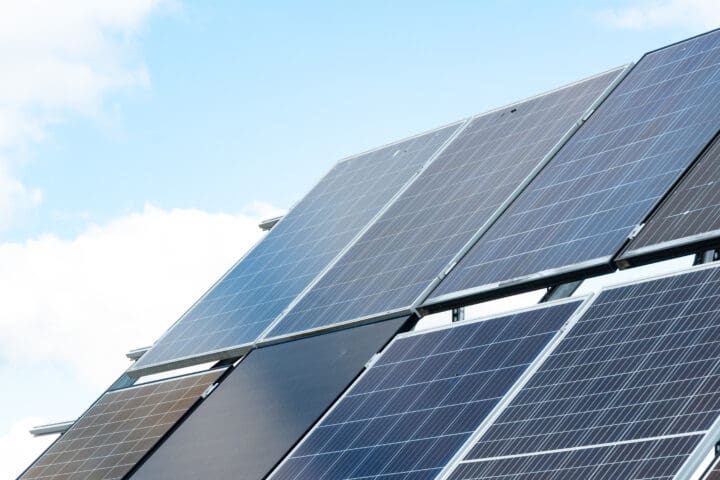
Thinking about buying solar panels? Evaluate profitability with a solar electricity calculator
Producing your own solar electricity provides protection against spikes in electricity prices, says materials engineering Professor Kati Miettunen.
The cost of solar panels has fallen significantly in recent years, making solar power generation profitable even for households. Over the past 15 years, the price of solar panels has dropped by about 90 percent which a dramatic decline for energy technology.
“If you assessed the profitability of solar power production even five years ago, it’s worth taking another look at the situation,” says Professor Kati Miettunen from the University of Turku, who leads the RealSolar project investigating solar energy production in Nordic conditions.
Although solar power alone cannot make you energy self-sufficient in Finland due to the dark winter, your own panels can still bring significant savings on electricity bills from spring to autumn.
“With current solar energy system and electricity prices, solar energy can be produced profitably. The key is to aim to use most of the electricity you produce yourself,” Miettunen says.
Evaluate profitability with a calculator
According to Miettunen, system sizing plays a crucial role in profitability. This means that solar energy production should match a household’s consumption so that as much of the generated electricity as possible is used on-site.
When you use the solar energy yourself, you save not only on energy costs but also on transmission fees and taxes, ensuring financial benefits. Electricity sold to the grid, on the other hand, follows spot prices, so revenues can be low during cheaper hours.
“Unfortunately, we still hear about and see reports of cases where people have been sold unnecessarily large solar energy systems,” Miettunen says.
If you can assess a suitable system for your household before contacting a vendor, you’ll be in a better position when making purchasing decisions.
The RealSolar research project has developed an open tool for comparing and evaluating the profitability of solar energy systems.
“The size of a solar energy system should not be determined based on annual consumption. Instead, it’s important to examine consumption on a monthly or even hourly basis and match production to that,” says Miettunen.
In the Solar Calculator application developed by Turku University of Applied Sciences, users can enter their home location and specify key roof characteristics, including roof type, orientation, inclination, and the available surface area. These factors are essential for accurately estimating the amount of electricity a solar energy system can generate.
Users can also select a Finnish household electricity consumption profile from a range of ready-made examples or upload their own consumption data, enabling a more accurate assessment of how much of the electricity generated by the solar panels can actually be used within the household throughout the year.
“Based on this information, users can estimate how much electricity different solar system configurations and sizes would produce,” explains Hugo Huerta Medina, Senior Advisor at Turku University of Applied Sciences and developer of the calculator. “The application can also help determine whether a proposed system is well matched to a household’s electricity consumption or whether it is likely to generate too little or too much electricity.”
Finally, the calculator estimates the long-term financial benefits of investing in a solar energy system. The calculations are based on average electricity prices, the relationship between household consumption and solar production, and the investment costs of the solar system.
“However, the calculator cannot simulate shading on the roof,” Huerta Medina says. “It’s important to assess potential shading from trees and nearby buildings before installation, as it is one of the factors that can significantly reduce the output of solar panels.”
Long delivery times during crisis situations
Although electricity prices in Finland are currently low, studies show that solar energy generation in households is still profitable. It becomes even more advantageous when there are disruptions in energy production or distribution.
“During the 2022 energy crisis, demand for solar panels surged dramatically. However, many people didn’t manage to benefit from their own panels during the worst price spikes, as delivery times for systems were several months,” Miettunen notes.
According to the professor, the investment can also be viewed from the perspective of securing a household’s energy supply in case of delivery problems or price spikes. In recent years, for example, there have been disruptions in nuclear power production, and damage to the Estlink 2 power cable between Finland and Estonia has affected electricity prices.
“In addition to financial benefits, I would also like to highlight household resilience. Investments are often considered only in terms of current electricity prices, but owning a solar system also provides stability during price spikes,” Miettunen says.
Try the Solar PV Evaluation app: https://nerc.turkuamk.fi/aurinkosahkolaskuri/
The calculator was developed by Turku University of Applied Sciences as part of the RealSolar and Taloyhtiöiden energiamurros projects. The tool and its features will continue to be developed further in the future.
Additional information
Kati Miettunen
Professor at University of Turku
kati.miettunen@utu.fi
Hugo Huerta Medina
Senior Advisor at Turku University of Applied Sciences
hugo.huertamedina@turkuamk.fi