
Understanding geoeconomic developments and their implications
The era of stable growth and deepening globalisation has reached a turning point. The international business environment is shifting towards fragmentation, polarisation, and strategic uncertainty — an unfamiliar world where established assumptions no longer hold, and historical data offers limited guidance for what comes next. Through various externally funded projects, our research explores how geopolitics, geoeconomics and security threats are reshaping societal and business dynamics.
As states and firms become increasingly entangled, economic activity is no longer separate from security concerns but deeply embedded in them. In business, this shows in innovation, competition, and internationalisation, for instance.
Focusing on areas such as critical resources, dual-use technologies, hybrid influencing, and shifting global value chains, our research examines how firms navigate political risk, strategic dependencies, and new forms of influence. It highlights how uncertainty is not an exception, but a defining condition of the global economy.
By connecting firm-level strategies with broader geopolitical dynamics, our research offers continuously new insights into how innovation and resilience are built in an era of fragmentation, contestation, and systemic change.
Ongoing research projects
Disruptive hybrid influence in NATO & the possibilities of OSINT
In this two‑year research project (2026–2027), funded by the Scientific Advisory Board for Defence (MATINE), we examine changes in relations between Russia and key NATO countries during Donald Trump’s second presidential term, as well as the role of hybrid influence and new influence opportunities within this development.
This phenomenon‑driven study combines three complementary perspectives—hybrid influence research, intelligence studies with a special focus on OSINT methods, and societal resilience research. Using various methods (content analysis of media material, expert interviews, and a workshop), the project aims to determine how hybrid influencing affects NATO cohesion, as well as different countries’ willingness and determination to defend one another, particularly in the European context.
The objectives of the research are:
- To identify changes in perceptions of the opposing side in Russia and NATO countries as they appear in national public discussion.
- To analyse the role of hybrid influence in shaping these perceptions and, conversely, the new influence channels and manifestations that the changed situation creates in Finland’s key NATO allies.
- To assess whether hybrid influencing shows recurring patterns and temporal cycles that could be detected through OSINT in the future, thereby enabling automation of influence monitoring.
The research project expands our understanding of how relations between Russia and NATO countries have developed during Trump’s second presidential term, how NATO’s unity has evolved in this situation, and what role hybrid influence may play in these changes. Additionally, the project produces new knowledge about ways to detect and monitor hybrid influence using OSINT methods. In this way, the research strengthens analysis of Finland’s operating environment and provides critical insights for Finland’s preparedness regarding hostile influence efforts aimed at undermining NATO cohesion, as well as Finland’s opportunities to strengthen its security and resilience in a rapidly changing environment.
Contacts:
(GEONIUS) Rethinking sustainability through geopolitical security: How to navigate international business in turbulent Europe
Funded by the Research Council of Finland, the GEONIUS project reconceptualises sustainability beyond its traditional three pillars – people, profit, planet – by integrating security as the fourth dimension: peace. The dynamics of these dimensions will be examined in Finland, a European microcosm with bolder climate policy than the EU and heightened security pressures on the Russian border.
The project’s objectives are to uncover the mechanisms through which sustainability and security enhancement (1) merge in business network interactions, (2) evolve through firms’ agency and engagement with policy and civil-society actors, and (3) are shaped by managerial sensemaking over temporal horizons.
Empirically, the project focuses on three contexts: mining and natural resources, industrial manufacturing, and high technology industries. A qualitative research design links interviews, policy document and media analyses, and foresight workshops across business, policy, and civil society actors. Outputs include a mechanism-rich theory, insights relevant across the EU, a framework for further research, and guidance for firms and policymakers.
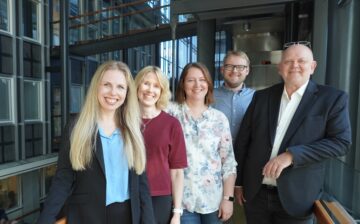
The project is led by Academy Research Fellow Eini Haaja (Principal Investigator) and funded by the Research Council of Finland and University of Turku with a total budget of 984 834 €. The research group comprises M.Sc. (Econ) Matti Karinen, M.A. Hanna Mäkinen, M.Sc. (Econ) Kari Pylkkönen, and D.Sc. (Econ) Anna Karhu. The four-year research project runs from 2026 to 2030.
Contact:
(MANU) Managing sustainability amidst geopolitical turbulence
The MANU research project, funded by the Foundation for Economic Education, explores Finnish firms’ sustainability management amidst geopolitical turbulence. The key research questions are:
(1) How is sustainability management characterised and challenged in geopolitical turbulence?
(2) How resilient are firms in different operational time spans in the face of such turbulence?
(3) How can firms advance their sustainability through resilience against possibly increasing geopolitical turbulence?
The empirical research will be conducted through three case studies exploring different time spans towards sustainability in international business. The short-term case focuses on Finnish firms’ resilience to hybrid threats, which may affect different dimensions of sustainability. The medium-term case examines Finnish firms’ de-internationalisation and re-internationalisation activities, illustrating resilience in action as well as complex sustainability trade-offs. The long-term case analyses the resilience and sustainability dynamics associated with intensifying natural resource extraction in Finland.
The Principal Investigator of the project is Research Manager, D.Sc. (Econ) Eini Haaja. The research group comprises M.Sc. (Econ) Matti Karinen, M.A. Hanna Mäkinen, M.Sc. (Econ) Kari Pylkkönen, and D.Sc. (Econ) Anna Karhu. Haaja’s research group has received 200 000 EUR from the Foundation for Economic Education for conducting the three-year MANU project in 2026–2028.
The MANU project seeks to renew the understanding of sustainability and resilience in business studies by updating existing concepts to fit today’s turbulent international business environment. The project will produce high-level academic articles as well as practical recommendations for business managers and policymakers.
Contact:
(STARA) Strategic Rural Areas: Economic Structures and Finland's Comprehensive Security 2040
STARA produces up-to-date knowledge on how recent changes in the international business environment affect rural livelihoods and economic structures in Finland, and what consequences these developments may have for Finland’s comprehensive security.
The project examines rural areas as a key component of societal resilience and makes visible the mechanisms through which local economic structures are connected to global economic and geopolitical changes as well as to national security. In addition, the project assesses future scenarios related to rural development and comprehensive security up to the year 2040.
The two-year project is being carried out in 2026–2028 in collaboration between the University of Eastern Finland and the University of Turku. The Principal Investigator of the project is Professor Teemu Makkonen from the University of Eastern Finland, and Academy Research Fellow Eini Haaja leads the research conducted at the University of Turku.
The project is funded by the Ministry of Agriculture and Forestry, based on a proposal from the Rural Policy Council’s project group, from national funds allocated to rural research and development projects under Makera.
For more information, please visit the STARA website.
Contact:
Latest publications
Academic
Haaja, E., & Karhu, A. (2026). Resilience, Business-Policy Interaction, and Collective Agency: Advancing Sustainability and Security in Europe. Springer Nature. (access)
Haaja, E. & Mäkinen, H. (2026) The geopolitical implications of Russia’s Arctic natural resources development since the war in Ukraine. In: Inevitable Instability in Russia: Strategic Information, Intelligence and Foresight on Russia (Ed. Kari Liuhto & Joonas Sipilä). Cham: Palgrave Macmillan. (access)
Mäkinen, H. & Liuhto, K. (2025) Russia’s shadow war: The media coverage of Russia’s hybrid war against the EU in the 21st century. In: Russia’s war against Ukraine (Ed. Pentti Forsström). Series 2: Research Reports. The Department of Warfare. Helsinki: National Defence University. (access)
Mäkinen, H. & Liuhto, K. (2024) Foreign investments and national security: Finland’s approach. In: The Political Economy of National Security, Critical Infrastructure and Securitization of Foreign Investments (Ed. Jakub M. Godzimirski & Morten Skumsrud Andersen). Cham: Palgrave Macmillan, 123–154. (access)
Mäkinen, H., Kuikka, S. & Balasubramanian, P. (2024) Someympäristö ja yhteiskunnallinen vakaus poikkeusolosuhteissa. Maanpuolustuksen tieteellisen neuvottelukunnan julkaisuja 2024:8. (access)
Kuikka, S. & Mäkinen, H. (2024) Telegramin hyödyntäminen sodanvastaisuuden mobilisoinnissa Venäjällä. Idäntutkimus, 31 (2), 4-20. (access)
Klemetti, L. & Mäkinen, H. (2021) New Sources of Natural Gas for Finland: The Balticconnector Pipeline and LNG Imports. In: The Future of Energy Consumption, Security and Natural Gas (Ed. Kari Liuhto). Cham: Palgrave Macmillan, 275–307. (access)
For general public
Mäkinen, H. (2026) Pursuing technological supremacy and geopolitical power – Chinese and Russian espionage in Europe. BSR Policy Briefing 1/2026. (access)
Haaja, E. (2026) Mitä tarkoittaa kestävyys geopoliittisen myllerryksen keskellä? Geotalouden ja kauppapolitiikan ilmiöitä blog of Turku School of Economics on the 9th of February 2026. (access)
Mäkinen, H. (2026) Russia’s hybrid warfare in Europe. Baltic Rim Economies, 1/2026. (access)
Haaja, E. (2026) Managing sustainability amidst geopolitical turbulence – meet the MANU project. Blog of Liikesivistysrahasto on the 6th of February 2026. (access)
Mäkinen, H. (2025). Venäjän varjosotaa Euroopassa – hybridivaikuttamisen monet muodot. Tieteessä Tapahtuu, 43(5). (access)
Haaja, E. (2025) Onko vihreä osaaminen laivanrakennusteollisuudelle kilpailuvaltti? Turun Sanomat on 25th April 2025. (access)
Karhu, A., Haaja, E. & Mäkinen, H. (2024) The competitiveness of Finnish firms in the changing business landscape. BSR Policy Briefing 5/2024. (access)
Mäkinen, H. (2022) The efficacy of sanctions – case Russia. Baltic Rim Economies, 4/2022. (access)
Mäkinen, H. (2022) Sanctions against Russia, their effectiveness and impacts on Finland. BSR Policy Briefing 11/2022. (access)
Podcast
Access here!
Contact
Eini Haaja
Academy Research Fellow
Anna Karhu
Research Manager
Matti Karinen
Doctoral Researcher
Kari Liuhto
Professor
Hanna Mäkinen
Senior Researcher
Kari Pylkkönen
Doctoral Researcher
For questions and collaboration ideas, feel free to get in touch!