Researcher in media spotlight – great opportunity or uncomfortable necessity?
Joha Järekari, Kaisa Vainio, Nora Fagerholm, Salla Eilola, Felix Hallikainen, Department of Geography and Geology, University of Turku
As our research team members have been doing their research, the topics and results have gained interest in the media. Lately, the doctoral research of MSc Joha Järekari about nature’s eudaimonic wellbeing benefits, doctoral research of MSc Felix Hallikainen on sustainable mobility lifestyles, Dr. Kaisa Vainio’s research on meaningful relationships with trees, as well as JustTrees project led by prof. Nora Fagerholm about multispecies wellbeing have featured in several media outlets. These include news and magazine articles, podcasts, and blog posts. In this post, we reflect on what is behind this publicity and what does it mean to a researcher.
First, what explains the current amount of coverage of these topics? We see that the emotional connection to nature and wellbeing it supports are timely in our urbanizing and hectic living environments. Topics which people can relate to are interesting to wide audiences and media outlets. For example, Kaisa’s PhD research on people’s relationships with trees in Trees Near Us project got media spotlight right from the start and continues after her defense. People’s curiosity about self-help and non-medical health interventions – and the numerous online sources on these topics – may also in part explain interest in scientific research on nature’s impact on our wellbeing.
Furthermore, many people share concerns about the threats to their nearby nature and loss of biodiversity. Thus, endeavors, such as JustTrees project, that bring concerns of residents and needs of non-human species into practical planning discourse resonate with the audience. JustTrees has, for example, featured in the local newspaper in Turku.
Requests and opportunities for media coverage logically come when something happens in the research project; may it be publication, event, workshop or opening of a survey. For Kaisa, interview requests peaked around the time she defended her PhD, and Joha felt more comfortable showcasing their research after their first scientific article was published – although journalists contacted them already earlier. This highlights the different working paces of research and journalism. One can build momentum for their research topic before publishing any results. However, publishing in the media results that have first gone through rigorous peer-review is important in our time, which is characterized by misinformation.
Researchers can also proactively contact journalists, write press releases, or opinion pieces. Researchers in JustTrees project wrote an opinion piece for local newspaper to encourage discussion on land use planning and greenery. University communications are there to help publish and advertise press releases. In Joha’s case, the press release issued by the university’s communications team helped their research reach media outlets outside Finland. Sometimes research funding bodies have resources to support dissemination of results, like in the case of our European Union funded Transformative Cities project where Felix was interviewed in a video produced by a professional media company. This video has been featuring on Finnish TV as a part of science communication campaign.
Efforts to promote one’s research pay off
One practice that keeps researchers up to date and inspired about societally relevant aspects of their research, is to actively follow relevant non-academic outlets. There are many sources and discussions out there though that one may get overwhelmed. A good start is social platforms such as LinkedIn and Bluesky, which have become popular outlets for sharing between academics and practitioners. University of Turku has a guide for researchers on social media impact.
Following and being part of non-academic public discussions can increase work motivation through the social impact, and the little accomplishments of getting published amid months-long academic publishing processes. And as Joha says, science communication increases the meaningfulness of one’s work, while one can see how the understanding that one’s research builds contributes to solving challenges of our time from climate resilience to sustainability transformations. Kaisa points out that in social scientific research, it is also an ethical practice to bring the knowledge back to communities.
Science communication also helps in networking and diversifying one’s career. The first time, Kaisa encountered professor emeritus Kalevi Korpela’s work on environmental psychology was in Minna Pyykön maailma nature podcast on YLE, the Finnish public broadcasting company. Later, Korpela became the pre-examiner of her dissertation. Joha was contacted by the Evangelical Lutheran Church of Finland after their work featured in a news article. This broadened their thinking outside the academic bubble, as the Church works on many of the same themes—such as meaningfulness and spirituality. At the end of the day, having one’s research featured in the media can lead to work opportunities, for instance invitations to collaborate on funding proposals.
Does one have to enjoy being in the spotlight to do so? Science communication takes some time and effort. One can see it as an important part of their work, but one can also enjoy it. Kaisa enjoys interviews as an interviewer and interviewee, because “understanding is created in discussion” as she says. For this reason, radio and podcast formats are the most enjoyable for her. Joha takes a subject-centered approach to popularizing research. They view themself as a spokesperson for the topic they are researching. In short: it isn’t about them, but the people they have been collecting data with, and other stakeholders. It feels important to echo their voices and stories forward. Felix learned a lot from the video shooting process, like how to clearly and concisely formulate arguments to lay audience. Science communication and popularizing one’s research are skills that researchers can learn, says Nora.
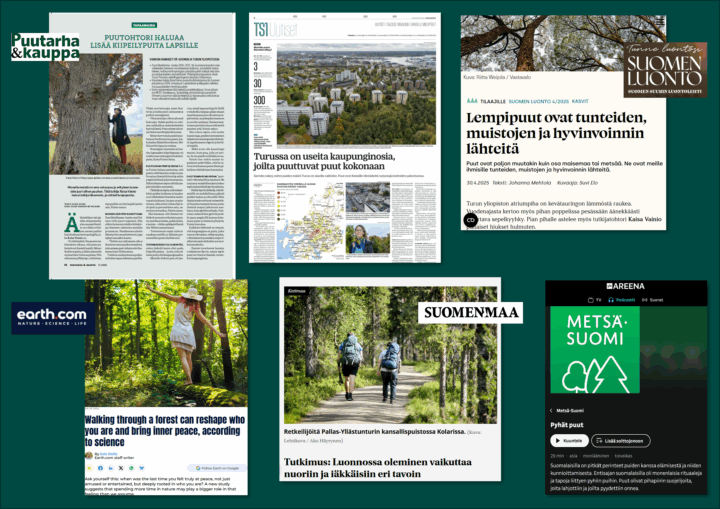
Here is a list of latest media sources covering research from our team members:
Newspaper and magazine articles:
- Turun Sanomat local newspaper: “Mistä on kyse, kun luontokokemus on lähes hengellinen ja vahvistaa elämän tarkoitusta?”
- Earth.com: “Walking through a forest can reshape who you are and bring inner peace, according to science”
- Suomenmaa local newspaper: “Tutkimus: Luonnossa oleminen vaikuttaa nuoriin ja iäkkäisiin eri tavoin”
- Aamuset local newspaper: “Tutkimus: Luonnossa oleminen tuo elämään syvyyttä ja merkitystä”
- Puutarha & Kauppa magazine: “Tapaamassa – Puutohtori haluaa lisää kiipeilypuita lapsille” (only on print)
- Suomen Luonto magazine: “Lempipuut ovat tunteiden, muistojen ja hyvinvoinnin lähteitä”
- Turun Sanomat local newspaper: “Turussa on kolme isoa aluetta, joilla on hälyttävän vähän puita” (only for subscribers, LinkedIn post of the same topic)
Podcasts and promotional videos:
- YLE Metsä-Suomi podcast: “Pyhät Puut”
Blog posts and opinion pieces:
- Antroblogi: “Lempipuu ei jätä eikä tuomitse”
- Turun Sanomat local newspaper: Kaupunkipuut tuottavat hyvinvointia ihmisille ja muille lajeille (only for subscribers)