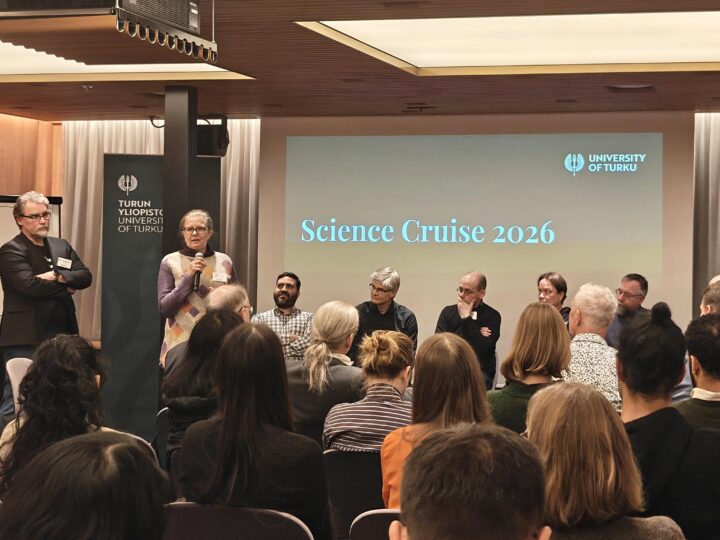
Science Cruise 2026
 The University of Turku’s Faculty of Science, founded in 1921, celebrated its 105th anniversary with a day-long cruise on the Baltic Sea on 19 October 2026. The event brought together faculty members to celebrate the milestone, learn about ongoing research and major projects across the faculty, and enjoy a day together outside the university.
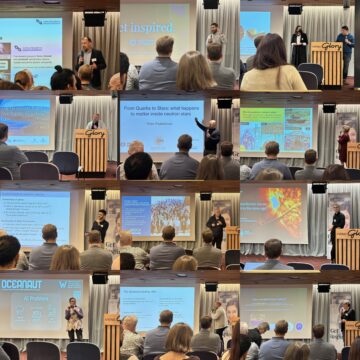
The morning programme began with welcoming words from Vice Dean Juha-Pekka Salminen, followed by a series of short presentations highlighting the diversity of research conducted at the faculty. The presentations introduced several major research initiatives, Research Council of Finland Centres of Excellence, and projects funded by the European Research Council (ERC).
The presentations covered a wide range of research topics. Sergey Tsygankov discussed strongly magnetised neutron stars, which are also studied within the new Centre of Excellence in Neutron-Star Physics. Risto Paatelainen explored the behaviour of matter under the extreme conditions inside neutron stars, the central research topic of his ERC-funded ExPertQCD project. Rami Vainio addressed extreme space storms and their potential impacts, a topic related to the research conducted at the Centre of Excellence in Space Resilience, in which he leads the University of Turku research group.
Ricardo Correia introduced his ERC-funded NATURETIME project, which investigates how natural environments influence human time perception, wellbeing, and environmentally sustainable behaviour. Jovana Milić and Mohammadreza Golobostanfard presented multifunctional hybrid materials and their applications, ranging from solar cells to neuromorphic computing. This research is connected to Milić’s ERC-funded SmartHyMat project. Petriina Paturi discussed neuromorphic solutions for artificial intelligence, an area central to the Business Finland-funded OCEANAut project, which develops energy-efficient, memristor-based neuromorphic computing systems.
We also heard about several other major research initiatives across the faculty. Petteri Alho introduced the Digital Waters (DIWA) Flagship, which develops digital solutions for studying water systems and managing water resources, and the UTU-GreDiT doctoral training programme, which focuses on solutions for the green and digital transition and is funded through the European Union’s Marie Skłodowska-Curie COFUND scheme. Päivi Onkamo presented the Centre of Excellence for Human Diversity through Contacts (HuDi-Con), where she serves as Vice-Director. The Centre investigates the development of human genetic, linguistic, and cultural diversity and the influence of contacts between populations. Jari Metsämuuronen introduced the Education for the Future (EDUCA) Flagship, which focuses on researching and developing learning, teaching, and assessment, including through artificial intelligence and learning analytics.
Tony Haddad demonstrated a mathematical approach to modelling prime factorisation through breaking sticks, while Juha-Pekka Salminen discussed chemical communication between trees. This topic is also connected to the new Centre of Excellence in Anthropocenic Chemical Ecology of Forests (ACE-Forest).
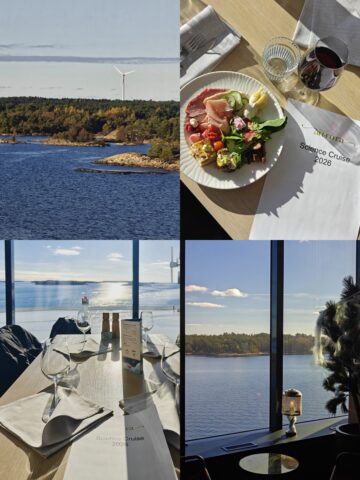
The scientific programme concluded with a Q&A session with the heads of departments. After changing ships in Mariehamn, the afternoon continued with a shared buffet lunch at Restaurant Aurora aboard Viking Grace. The return journey offered time to catch up with colleagues, enjoy the sea views, and reflect on the many different research activities taking place within the faculty.