
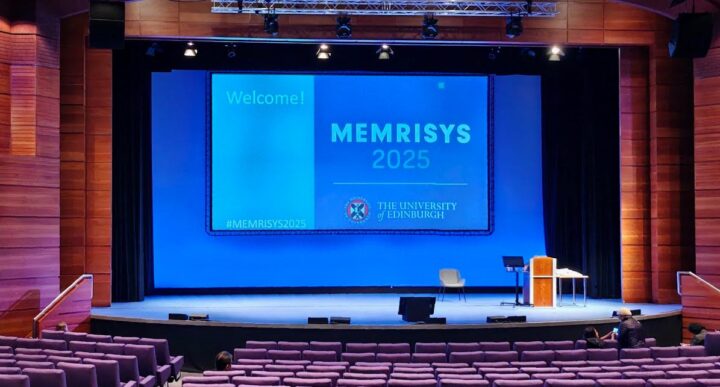
Highlights from MEMRISYS 2025
In October, our group participated in MEMRISYS 2025, held in Edinburgh, Scotland. The conference gathered researchers, scientific publishers, and industry representatives from around the world to share recent developments in memristive materials, devices, and neuromorphic systems. The event provided a broad overview of the current directions in the field, covering both fundamental studies and applications that connect materials science with emerging computing paradigms.
The conference opened with a plenary lecture by Leon Chua, who revisited the conceptual foundations of the memristor and its links to biological excitability and chaos theory. His talk set the tone for a week that bridged theory, materials research, and system-level implementations. Over the following days, the program included sessions on oxide-based resistive switching, 2D material heterostructures, ferroelectric and spintronic memristors, and neuromorphic circuits that aim to emulate synaptic and neuronal dynamics. Several talks also explored reservoir computing and edge-of-chaos computation, reflecting a growing interest in analog and in-material approaches to artificial intelligence.
Our group presented recent results on GCMO-based memristors, focusing on their interfacial behavior and switching characteristics. The work was featured in both poster and oral formats:
- “GCMO-based memristors for autonomous robots” – Anni Antola, Poster (Day 1)
- “Area-dependent resistive switching and interfacial dynamics in GCMO-based memristors” – Petriina Paturi, Talk (Day 3)
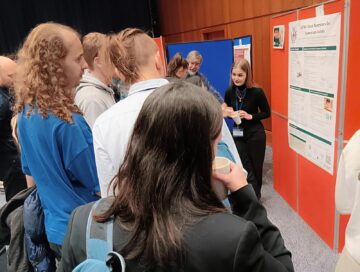
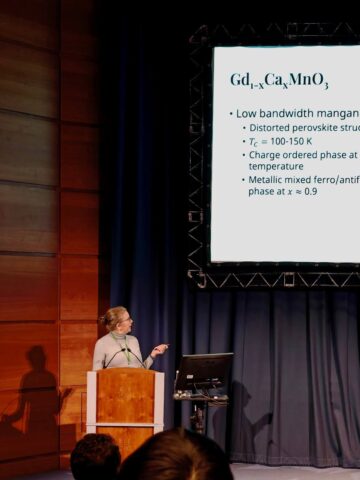
The presentations prompted detailed discussions with researchers working on oxide interfaces, ionic migration modeling, and neuromorphic device architectures. These exchanges provided useful perspectives on how perovskite manganites compare with more established oxide systems, and how their mixed electronic and ionic conduction might be harnessed for adaptive or leaky-integrate-type behavior.
Beyond the technical sessions, MEMRISYS offered opportunities for informal discussions that helped situate our work within the broader landscape of resistive switching research. Many groups presented results on interface-type mechanisms, oxygen vacancy control, and electroforming-free device concepts, which are closely related to our ongoing efforts at the Wihuri Physical Laboratory. The conference also highlighted increasing collaboration between materials research and circuit-level modeling communities, reflecting a gradual convergence toward system-oriented memristor studies.


Outside the scientific program, Edinburgh offered plenty to explore. The Waterstones bookshop on Princes Street had an impressive selection of popular science books in its basement, which quickly became a favorite stop. Petriina left with ten excellent finds. Nearby, the Greyfriars Bobby statue and grave added a heartwarming touch to the city’s historic atmosphere. The conference dinner, held at the National Museum of Scotland, was another highlight, providing a memorable setting for conversations surrounded by the museum’s remarkable architecture and exhibits.
Overall, MEMRISYS 2025 was a valuable opportunity to exchange ideas and observe how the field is evolving. The research community around memristive and neuromorphic systems continues to expand, yet remains collaborative and open. We returned with new insights into experimental techniques, simulation methods, and conceptual frameworks that will inform our ongoing studies on interface-controlled resistive switching in GCMO and related oxide materials.