
Face-to-face communication and the formation of temporary groups promote the acceptability of solar PV projects
In the RealSolar research project, we have examined the decision-making processes related to solar power investments in Finnish municipalities. Based on our interview data, the local authorisation procedure was perceived to be seamless in those municipalities where there was an open dialogue with the residents face-to-face. Shared discussion and understanding between residents and decision-makers did not develop the same way when communication about the project happened mainly or almost exclusively through electronic channels.
Face-to-face events are often attended by active local residents, who raise not only their own concerns but also more broadly questions of justice for the community as a whole. In fact, they act as a kind of community lightning conductors, supporting the presentation of many different perspectives. However, these events are not always easy from the participants’ point of view. The atmosphere can be tense, as the participants have different and sometimes conflicting views on what would be the best solution for the municipality and its residents.
It is these tensions in the community that make face-to-face encounters meaningful and important to the decision-making process. When people come together in the same space, different views, concerns, and desires become visible. Consensus is not the goal of such encounters, but it is important for a person to feel that they have been heard and that their views have been taken seriously.
Our research also highlights the importance of public places and buildings as arenas for these gatherings. Physical public spaces are still needed to support the acceptability of public decision-making. For example, a municipal building, library, school or village house can serve as a neutral low-threshold place where different people and interest groups meet.
In these spaces, a shared “we-frame”, a so-called temporary group, can be created momentarily. Participants will then not only look at the issue from their own perspective, but will be able to exchange relevant perspectives as part of the same local community as a group. Common goals can then be sought even if the participants’ initial views on the decision and its implications are different. The temporary and diverse groups that arise in these encounters also build the resilience of the municipality over a longer time span, for example, in relation to preparedness on a wider scale.
During an encounter, conflicts do not necessarily go away, nor do they need to go away. The important thing is that they are seen and heard. This can strengthen the resident’s experience of participation and their own opportunities for influence. When a person feels valued as a member of the community, it is also easier for them to listen to the views of others and understand how the decision has been reached.
Acceptability does not mean that everyone agrees with the decision or is satisfied with its outcome. Rather, it is a matter of experience that the decision-making process has been fair, open and understandable.
Based on our interview data, an undesirable decision can also be seen as more acceptable for a resident when it has been openly discussed face-to-face. Acceptability therefore does not mean that everyone agrees with the decision or is satisfied with its outcome. Rather, it is a matter of experience that the decision-making process has been fair, open and understandable.
Therefore, it would be a good idea to organise events on investment projects that have a wide impact on local residents in neutral and easily accessible public spaces. At best, the space supports people’s experience that they belong to the same local community and that their participation matters. Municipal residents continue the discussion related to decision-making in their own daily lives, in local networks and in their personal meeting places. The systemic effects of individual successful municipal encounters in the network can thus strengthen the acceptability of decision-making more broadly.
At the moment, a lot of communication relies on digital channels. These channels make it easier to share information, communicate about opportunities and invite people to join in. They are also important in organising joint action. However, digital information alone does not yet generate participation or experience in one’s own agency. People also need face-to-face encounters: situations where you can ask questions, share your own concerns, hear the views of others, and find that you are not alone with your concerns.
The ability of the local community to deal with changes and conflicts is largely built up in such encounters. A temporary group formed in a common space with its ‘we-frameworks’ and experience of a common issue helps to build an understanding of decision-making, even when there is ultimately no common view of the outcome. Similar dynamics can be seen not only in solar power projects but also in many other local issues, such as decision-making on the future of village schools or health stations. Face-to-face encounters and open public debate don’t make decisions uncontroversial. However, they can make decision-making more humane, understandable and acceptable. Face-to-face interaction is vital in building community action, vitality and agency.
Writers:


University lecturer Maria-Elisa Männistö, professor Saku Mäkinen, doctoral researcher Loviisa Hietanen, and summer intern Aino Mäki from the Industrial Engineering and Management Unit at the University of Turku.
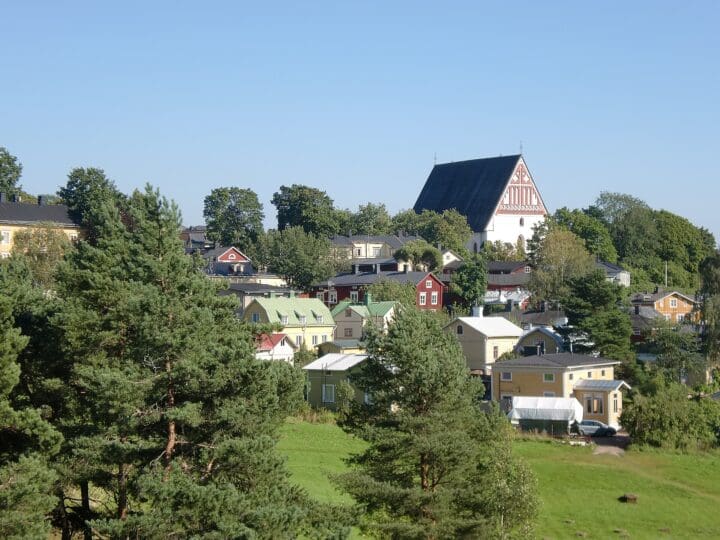
Picture: Mikkoau, Porvoo näkymä Linnamäeltä / Wikimedia Commons, CC BY-SA 4.0