
Introducing new SELMA visiting scholar Claudia Alea Parrondo
Claudia Alea Parrondo is a Spanish Ministry of Education predoctoral fellow at the Complutense University of Madrid (UCM). She is currently a PhD candidate at UCM, researching cognitive metaphors in contemporary US cancer memoirs written by women, under the supervision of Dr. Rebeca Gualberto (UCM) and Dr. Laura de la Parra (UCM). She is also a working member of the research project “Illness Narratives: Towards a Gendered Health(care) Awareness” (INGH), funded by the Spanish Ministry of Science and Innovation (2025-2028). She holds a Master’s degree in Literary Studies (UCM, 2024), with a Master’s thesis entitled: “‘In The Kingdom of The Ill’: análisis desde la poética cognitiva de las metáforas del cáncer y sus consecuencias en El desconcierto (2017) de Begoña Huertas y The Undying (2019) de Anne Boyer”.
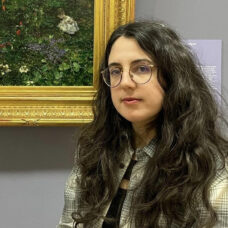
Her research interests include Medical Humanities, Gender Studies, and Cultural Studies, focusing on theoretical approaches related to Horror Films. She will be conducting a 4-month research stay at SELMA (2026) to work on her PhD.
You can contact Claudia at: calea[at]ucm.es
“My interest in Illness Narratives comes from a seminar organized by my supervisors’ research group (‘Gender Studies in English-Speaking Countries’) that I attended in my undergraduate years. That seminar was devoted to the concepts of ‘pathography’ and ‘autopathography’, following the ideas stated by Anne Hunsaker Hawkins in Reconstructing Illness: Studies in Pathography (1993). In this way, illness metaphors were highlighted, as depicted both in Hawkin’s work and in Susan Sontag’s Illness as Metaphor (1978) and AIDS and its Metaphors (1989). Being already familiar with the cultural role of tuberculosis in the Romantic period, I was intrigued by the cultural visions of cancer in our century, and how they may or may not have changed in retrospect to Sontag’s ideas. I was already interested in the depiction of illness in literature (of TB in Romantic poetry), and in the work by John Lakoff and Mark Johnson, Metaphors We Live By (1980), (in my case, applied to the evolution of the conceptualization of love in the Romantic vs. the 21st-century). In this way, I decided to merge both approaches in my Master’s thesis, researching cancer metaphors under a cognitive perspective to try to unveil the cultural conceptualization of cancer hidden in our language. Contemporary memoirs seemed the most interesting genre for my approach, especially the ones that aim to challenge the culturally accepted narratives surrounding cancer, as authors are usually aware of the use of metaphors in medical language. This awareness implies a problematization of metaphors and a vindication of the ill body as part of the self.”