
Legislative Pluritemporality
Whose time counts in the forest?
Whose time counts in the law-making?
What becomes visible, and what disappears, when law privileges some temporalities over others?
These are some of the key questions we will explore in Corporate Forest(s).

We conceptualize forests as a sites of conflicting temporal logics. At the same time, we understand regulatory processes as arenas for negotiating and reconciling these contradictions and as sites where plural temporalities intersect. In other words, law-making, regulation, and governance both shape and are shaped by interactions among multiple temporalities rather than a singular, linear timeline.
Regulatory dance
Our framing aligns with scholarship that views regulatory reform in developed capitalist economies as an ever-changing dialectical process that does not ‘proceed in linear fashion, from weakness to strength’ (Snider, 1991: 211). Periods of strict regulation and effective enforcement against harms produced at the state-corporate nexus are followed by periods of re-regulation and deregulation, emerging and declining in cyclical fashion (Glasbeek, 2013; Snider, 2020; Tombs, 2015).
Scholars have used artistic metaphors to capture this fluid character of regulatory processes. Stakeholders connected to the state, business, and civil society engage in what Snider (1991) calls a ‘regulatory dance’, Ken and Leon (2022) ‘regulatory theatre’ or ‘performative governance’ and Malik and Davies (2024) describe as ‘relational regulation’.
Such accounts emphasise the lack of consensus among stakeholders and competing interest groups both within and outside the state (Snider, 1991) as a driving force behind regulation, viewing law-making and regulation as inherently contradictory and ethically incoherent processes (Chambliss and Zatz, 1993).
Law and Time
The second building block of legislative pluritemporality draws on interdisciplinary scholarship on law and time. Inspired by this work, legislative pluritemporality shifts attention from historicized accounts of law in time to the multiple temporalities of law (Beynon-Jones & Grabham, 2019; Pecile, 2023). Traditional legal scholarship has often viewed time as linear, tracing the progression of law from past to present and future. Such understandings have been criticised for privileging particular experiences of time while marginalising others (Grabham, 2016; Greenhouse, 1989; Nousiainen, 1994; Mawani, 2014).
Building conceptualisations of time by, among others, or Serres and Latour (1995), Barad (2007), (Harraway, 2016) critical law-and-time scholarship instead emphasises temporal plurality, contingency, and non-linearity (Beynon-Jones & Grabham, 2019; Chowdhury, 2017). Rather than treating time as a neutral background against which legal processes unfold, this scholarship highlights its multi-directional (Braidotti, 2002), intra-actively produced (Barad, 2007) and experiential (Bergson, 1889, 2008) nature and the co-constitutive role of temporality in legal ordering itself.
Legislative pluritemporality
Legislative pluritemporality develops this insight by drawing attention to the coexistence of multiple temporal horizons, perceptions, expectations, experiences, and memories within regulatory processes. It embraces the nonlinear and fluctuating nature of regulation, highlighting the temporal dissonances (Wiber, 2014, Richardson, 2017) entanglement of legal temporalities with collective memory, lived experience and expectations (Svalvsberg & King, 2007; Howard, 2002). Law-making and regulation are therefore best understood as processes of continual (re)negotiation in which competing temporal claims intersect, conflict, and temporarily stabilise through changing governance arrangements and power relations.
This perspective is particularly relevant for questions of environmental governance and the Anthropocene, where legal and political decision-making must accommodate the competing temporalities of ecosystems, markets, communities, states, and future generations (Richardson, 2017; Grear, 2018; Pecile, 2023). Legislative pluritemporality therefore invites us to ask not only how regulation changes over time, but also which temporalities become recognised in law, which are marginalised, and whose futures are made governable through regulatory processes.
How do we observe these temporalities empirically?
Our aim is to move beyond the explicit temporal grammar of legal texts and examine how different temporalities are produced, negotiated, prioritised, and marginalised throughout law-making processes.
Ultimately, our goal is not simply to identify references to time in legal texts. It is to understand how legal institutions structure experiences of time, and which temporalities become prioritised or disappear during law-making processes.
In the first step, we read through laws, justifications for key legal reforms in broadly understood forest governance in Finland, to map and identify:
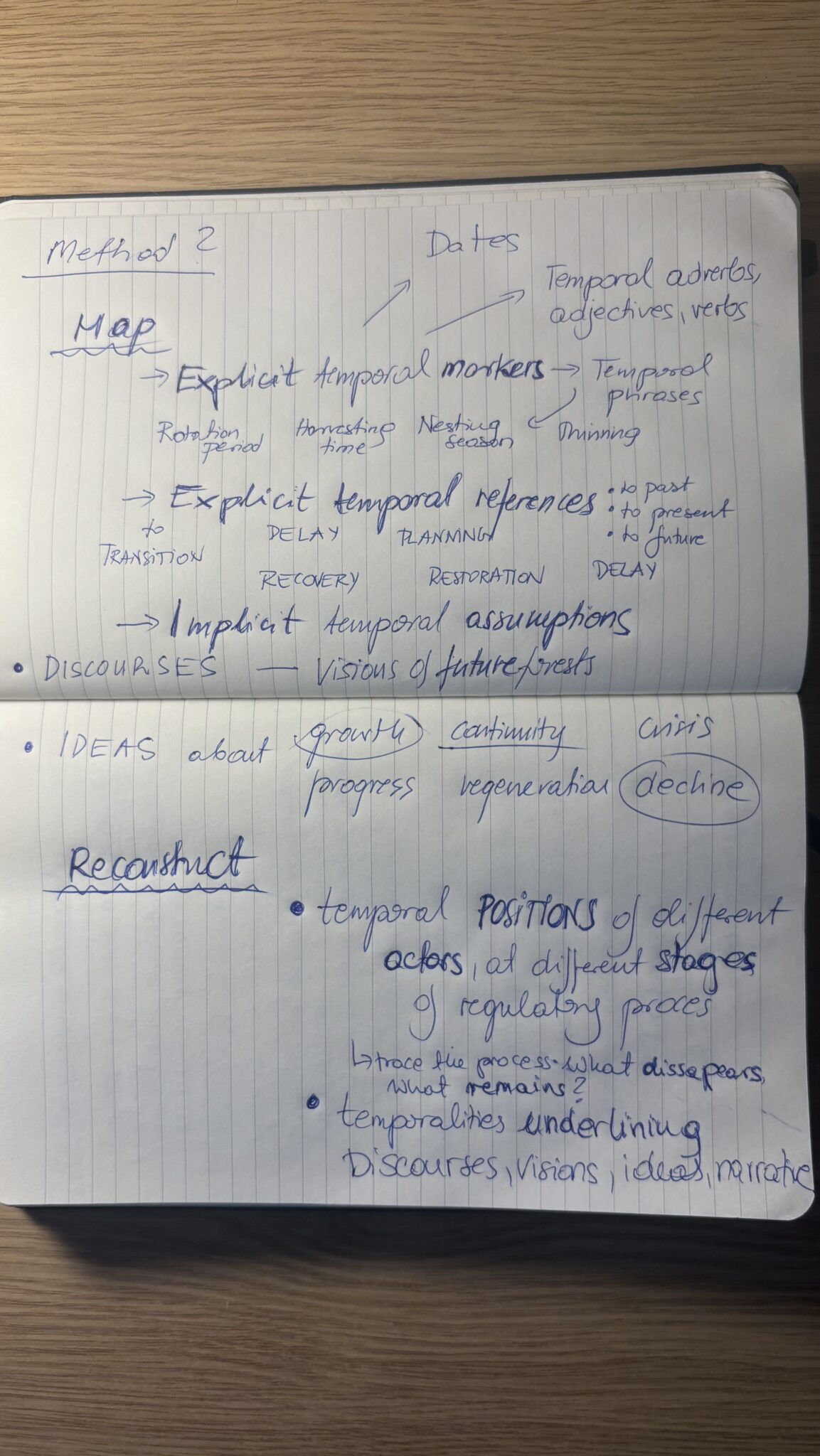
In the second step, we combine close legal and discourse analysis with computational techniques such as topic modelling, semantic analysis, and semantic analysis to scale up our research efforts.
By analysing legislation, policy documents, parliamentary debates, and stakeholder submissions related to broadly understood Finnish forest governance, we hope to map how competing temporalities are negotiated through law and how these negotiations shape the futures that become possible in Finnish forests.