Why Do We Need History? The Early Stages of a Research Project on the Cultural History of Dieting and Body Relations in Modern Finland
Following what turned out to be a short-lived period of body positivity, attitudes toward fatness have once again hardened. This was noted by Katri Mikkilä, an expert at the The Eating Disorder Association of Finland, in an interview with Helsingin Sanomat (21 April 2026). According to Mikkilä, this is a gendered phenomenon that reflects a broader return to conservative values.
The wave of body positivity and the rise of fat activism since the 2010s have generated a wealth of new literature and media content. Essay collections, magazine articles, and nonfiction books have addressed issues such as weight-based discrimination, diet culture, and shame in ways that were previously almost invisible in mainstream public discussion. This is undoubtedly an important and welcome development.
Yet many of these works share a striking omission: a historical perspective is either entirely absent or only superficially addressed. Even when references to history are made, they often rely on second-hand information, such as isolated anecdotes or examples drawn from popular culture. Academic research specializing in the cultural history of fatness is rarely cited, which is hardly surprising given the relatively limited amount of research conducted in the field thus far.
Most of the existing research delving into the history of fatness is Anglo-American and focuses primarily on the history of medicine, examining fatness as a disease or a societal threat. Cultural-historical approaches, which explore how bodies of different sizes have been understood and valued across different periods and cultural contexts, have remained marginal. This is a significant gap, as our understanding of present-day phenomena inevitably remains limited without historical perspective.
Our project group concluded that this is precisely where further academic research is needed.
We first applied for funding for our project in the autumn of 2023, and after two years and several applications, the Kone Foundation awarded us a three-year research grant. We were therefore finally able to begin our project at the beginning of 2026 with great enthusiasm.
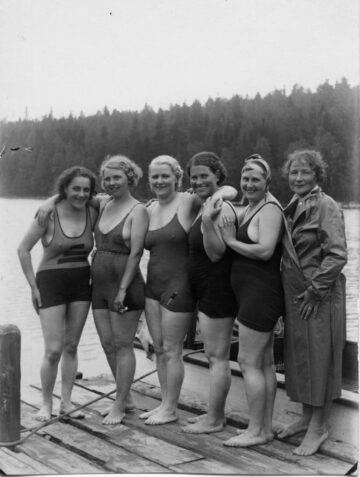
Our project examines the cultural history of body perceptions and dieting in Finland from the late nineteenth century to the twenty-first century. We are interested in both public discussions and people’s personal experiences related to body ideals and body talk. We ask how Finns have constructed their relationships with their bodies over time and how these relationships have been articulated both publicly and privately. More specifically, we investigate how girls’ and women’s body ideals and lived experiences of embodiment have been shaped and contested from the late nineteenth century to the present in the interplay between media discourses and personal experiences. A central theoretical premise of our work is that the body is a culturally constructed and experientially meaningful phenomenon, not merely a medical, biological, or visual object.
Our research draws on perspectives from gender history, media history, and life writing studies, among others. By exploring diaries, letters, biographies, lifestyle guides, literary texts, oral history collections, newspapers and magazines, television series, films, and social media content we seek to investigate and deepen understanding of how meanings attached to different kinds of bodies have been historically and culturally constructed through interactions between the private and the public spheres. Additionally, we are interested in public debates surrounding ideal bodies and how they have shaped people’s well-being, self-esteem, and social status. We regard this interaction between public discourse and personal experience as a particularly important perspective on the topic. In addition, we aim to contribute a long-term historical perspective to contemporary discussions. Historical understanding helps us make sense of present-day realities and may offer insights for addressing future challenges.
So far, we have collected archival material and presented the project in various events. In June, we also organized the project’s launch event, which you can read more about here. As we write this post, we are packing our bags and putting the finishing touches on our presentations as we prepare to travel to Paris for the ISCH Conference. We will also report on the conference in our blog, so stay tuned!
References
Parhiala, Marilla. “Lihavuuskammo on täällä taas” [Fear of Fatness Is Back Again]. Helsingin Sanomat, 21 April 2026.