The Future of Tourism Rests on Softer Skills
Expectations and demands on tourism have changed substantially over the past decades. In particular, the importance of social skills, accessibility and inclusiveness has increased. Our interaction skills and practices can make the travel experience to be good and pleasant or poor and disagreeable, from empathetically greeting guests to ensuring that services are accessible to all on an equal basis. This article explores how strong interpersonal skills and inclusive practices work conjointly to create welcoming, respectful, and rewarding journeys for everyone involved.
The idea of inclusive and accessible tourism has taken hold in the tourism and hospitality industry. It is no longer enough to protect nature and the environment, but increasingly to take into account the encounter with tourists themselves, their individual needs and wishes and, in particular, the skills of employees in these situations. Since tourism is a labour-intensive activity, it is especially the social or soft skills of employees that are crucial in improving customer experience. The soft skills are considered to be personal and behavioural characteristics of an employee. They include a person’s values, beliefs, behaviour, and attitude when encountering a customer or a traveller (Andreu-Guerrero et al. 2024, 1087). With these very skills and inclusive practices, a company and its workers are able to create travel experiences, which are welcoming, accessible and rewarding to everyone, regardless of one’s background or abilities.
European Union level aim and will
The importance of social skills in the tourism sector is well illustrated by the fact that the European Union has addressed the need to upskill and reskill the labour force in its European Skills Agenda set in 2020. It is a five-year plan designed to support public and private organisations in improving the skills needed. The aim of the agenda is to strengthen sustainable competitiveness, ensure social fairness, and build resilience to react to crises (European Commission a., n.d.). It was further reinforced by the Pact for Skills, which targets 14 industrial ecosystems, of which tourism is one. The Pact of Skills concentrates on upskilling and reskilling people to master the digital and green transition (European Commission b., n.d.).
PANTOUR project findings highlight the need to develop socio-cultural skills
The project on Pact for Next Tourism Generation Skills (PANTOUR) was created to design innovative and cooperative solutions to address skills needs in the tourism sector. The findings of the project, presented in the Country Skills Profile reports, highlight how social and cultural skills are central competencies when working in the tourism and hospitality industry. Reports on socio-cultural skills from the project’s ten partner countries revealed that the ability to understand, for example, cross-cultural differences, depends heavily on these skills.
Although new technologies have been developed in this area, socio-cultural skills such as communication, cultural understanding, language proficiency, and empathy, continue to be critical and important in the tourism sector. Research highlights the increasing multiculturalism of the workforce, which makes cross-cultural communication and language barriers current challenges. And, in order to improve quality of service, the tourism industry “must prioritise education and training in cultural awareness, communication and inclusivity”, the report concludes. It also points out that continuous training and development are one of the most important ways to support staff in dealing with cross-cultural communication and new job profiles. Even as the industry rapidly adopts AI, VR and automation, the future of tourism is defined by a customer-centric approach that blends state-of-the-art technology with human interaction. (PANTOUR, 2024).
The social skills that are most needed differ by area of tourism. For example, accommodation providers value communication, language, stress tolerance, diversity and inclusion highly. Tour operators put a high value on multilingualism and cultural awareness, particularly as the industry’s workforce is becoming more and more multicultural. Visitor attractions place a large emphasis on respect and teamwork. Destination Management Organisations (DMOs) are about language, collaboration and communication. Finally, food and beverage operators appreciate the most the interpersonal and empathy skills. (PANTOUR, 2024).
The status of socio-cultural skills in Finland now and in the future
Within the PANTOUR, the current socio-cultural skills were assessed and compared with the anticipated skill requirements of the future. The analysis was carried out in ten European countries, including Finland. The situation in Finland is not alarming: the gap between the current situation and the anticipated future needs is marginal. According to the Country Skills Profile report for Finland, providing excellent customer service is the most important socio-cultural skill for the future. Fortunately for Finland, even the largest gap between current skills and future skill requirements is not very significant. However, communicating with international tourists in their own language proved to be a slightly weaker skill in the Finnish results, although it was not poor either. On the other hand, according to the analysis, this kind of communication skill was considered the least necessary. In any case, communication skills will be increasingly needed, not only to serve tourists but also to work successfully with colleagues. Similarly, diversity skills should be improved in the industry in the future. (PANTOUR, 2024).
Are strong interpersonal skills a prerequisite for the future of inclusive tourism?
Inclusive and accessible tourism has been on the rise for a long time and has strengthened its position as one of the key trends in the future of tourism. Its goal is to remove existing barriers from tourism, barriers such as physical, sensory, or communication barriers, so that everyone can use tourism services independently and safely. In broader terms, the idea of inclusive tourism embraces and welcomes diversity, such as travellers with reduced mobility, senior citizens, families, different cultural backgrounds and genders, or even travellers from different income groups.
The equation is quite clear. On the one hand, the tourism and hospitality industry is a highly customer-oriented industry. On the other hand, customer orientation and customer service are labour-intensive, which require specific skills from employees, and in the case of tourism, particularly strong interpersonal skills. The success of tourism services, therefore, depends largely on the types of employees who encounter tourists and interact with them in creating memorable and pleasant experiences. As highlighted above, these are precisely the skills that are valued and will continue to be valued in the industry, even more so in the future. Customer orientation and a certain level of service remain core values, but they are not everything. The success of the tourism industry requires skilled and competent staff who are able to interact easily with different types of customers and take their specific needs into account (Räsänen et al. 2021, 3).
Furthermore, the concept of social responsibility is spreading more and more widely, not only in terms of customer relations, but also at work. The focus on corporate social responsibility (CSR) is also increasing with a workforce that is increasingly multicultural. Companies must manage employee well-being, equality and safety as carefully as they manage customer satisfaction.
Diversity and internal communication are two important socio-cultural competencies in the future, but another important aspect is the protection and respect of local culture. For example, in Finland, the active participation of indigenous groups such as the Sámi people in sustainable tourism development is seen as essential for authentic and respectful experiences. Finally, as tourism is a complex ecosystem, professionals need to develop their cooperation and networking skills very well in order to work with different regional stakeholders, local authorities and the wider community, the Country Skills Profile report (Finland) highlights (PANTOUR, 2024).
Inclusive tourism (English) vs. osallistava matkailu (Finnish)
It is perhaps appropriate to distinguish the difference in meaning between the English concept of “inclusive tourism” and its direct translation into Finnish “osallistava matkailu” as these do not fully overlap in meaning. This is because “osallistava matkailu” – whose actual meaning in Finnish is “participatory tourism” – has also gained ground in the tourism industry in recent years. The English concept of inclusive tourism is sometimes referred to as responsible or accessible tourism. Inclusive tourism, in general, entails creating positive travel experiences, which are welcoming, accessible, and beneficial to everyone travelling and not depending on person’s personal physical or mental abilities, different cultural or ethnic background, gender or sexual identities, or economic or social status for that matter. Participatory tourism, on the other hand, is more about involving travellers actively in the local life or development, for example, through community projects or cultural heritage preservation. To make this distinction and avoid confusion, one could use esteetön ja yhdenvertainen matkailu (accessible and equitable) in Finnish for inclusive tourism, and, correspondingly, participatory tourism for translating the concept “osallistava matkailu” used in Finnish, just to give some examples.
Joint objectives of the TSE Pori Research Groups LEADS and SusBerg
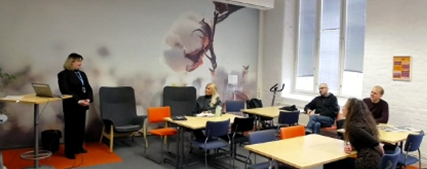
This article was inspired by the presentation given by Olena de Andrés González on 24 February 2025 on the Social skills and inclusiveness topic, which was studied in the PANTOUR Erasmus+ project. The presentation was held during a cooperation meeting between the research groups Leads and SusBerg of the School of Economics at the University of Turku/Pori unit (TSE Pori). Both groups have external experts as members.
Authors:
Kirsi Laitio works as Project specialist at the Pori unit of the Turku School of Economic, University of Turku.
Olena de Andres Gonzalez works as Specialist researcher at the Satakunta University of Applied Sciences.
Main photo: Kirsi Laitio
Sources:
Andreu-Guerrero, Rosario; Rienda-García, Laura & Ruiz-Fernández, Lorena. 2024. “The importance of soft skills development in the tourism sector’s employees.” In Las fronteras del conocimiento: perspectivas y aplicationes en la era digital, edited by Manuel Bermúdez Vázques, Alfonso Chaves-Montero and Julio Otero Santamaría, 1086–1108. Collección Conocimiento Contemporáneo 184, 1st edition. Madrid, Spain: Dykinson S.L.
European Commission a. n.d. “European Skills Agenda.”
European Commission b. n.d. “What is the Pact for Skills?” https://pact-for-skills.ec.europa.eu/index_en.
PANTOUR. 2024. Skills profile report Europe 2024.
PANTOUR. 2024. Country skills profile report: Finland.
Räsänen, Pirjo, Röksä, Iida, Parviainen, Jukka, Halonen, Kari & Rissanen, Petri. 2021. Inklusiivisen matkailun opas. https://www.businessfinland.fi/globalassets/julkaisut/visit-finland/tutkimukset/2021/inklusiivisen_matkailun_opas-2021.pdf.
More on the topic:
PANTOUR project. https://nexttourismgeneration.eu/.
Visit Finland. 2024. Inklusiivisen matkailun opas.