
Memristors and Neuromorphic Computing
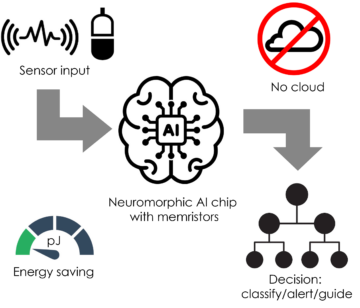 Memristor research at the Wihuri Physical Laboratory focuses on neuromorphic computing devices inspired by the operation of the human brain. Memristors are electronic components whose resistance depends on their previous electrical state, allowing them to store and process information in a way that resembles biological synapses. Neuromorphic systems based on memristors are expected to enable highly energy-efficient artificial intelligence, particularly in applications such as pattern recognition, signal classification, and edge AI.
Our research covers the full development chain from materials and device physics to circuit design and applications. We develop memristive thin film materials, fabricate devices and crossbar structures, study their electrical and physical operating mechanisms, and integrate them into neuromorphic computing systems. A major focus is on perovskite oxide memristors based on Gd1−xCaxMnO3 (GCMO), where resistive switching is related to ionic motion and interface effects at the nanoscale. Unlike many conventional digital memory technologies, these devices can operate in an analog manner, enabling brain-inspired computing architectures.
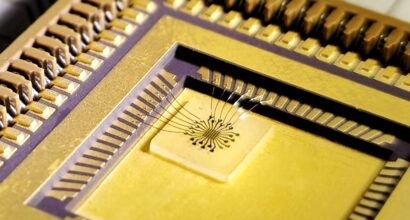 The work combines thin film fabrication, nanofabrication, electrical characterization, simulations, and application development. Current research directions include memristive synapses and neurons, crossbar-based computing, and low-power edge AI systems for real-world sensing applications.
The group leader is professor Petriina Paturi. More information about the ongoing projects, publications, and applications can be found at www.utu.fi/memristors/