RV/RA Pressure Gradient
The pressure gradient between the right ventricle and right atrium is estimated from the tricuspid regurgitation (TR) jet, which is present in most individuals. After measuring the peak velocity of the TR jet using continuous-wave (CW) Doppler, the echocardiography system automatically calculates the pressure gradient using the simplified Bernoulli equation:
ΔP = 4 × v2
This pressure difference corresponds to the systolic pressure gradient (RV/RA pressure gradient) between the right ventricle and the right atrium.
Measuring the Gradient from the Parasternal Short-Axis View
The RV/RA pressure gradient can be measured using continuous-wave Doppler as illustrated below.
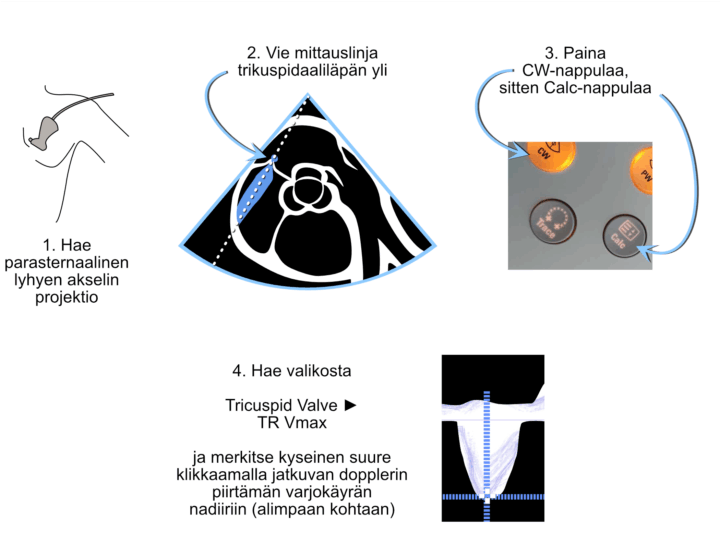
Figure: Measuring the RV/RA pressure gradient from the tricuspid regurgitation jet using the parasternal short-axis view.
Measuring the Gradient from the Apical Four-Chamber View
The RV/RA pressure gradient can also be measured from the apical four-chamber view. In fact, this is the approach used most commonly in clinical practice.
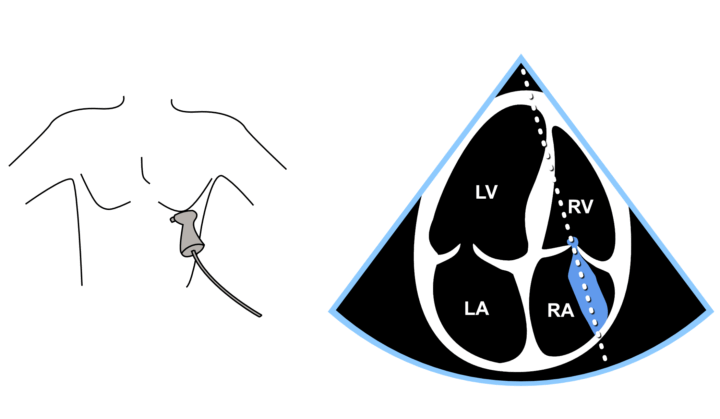
Figure: Measuring the RV/RA pressure gradient from the apical four-chamber view. The alternative four-chamber orientation is shown.
Video: Measuring the RV/RA pressure gradient from the apical four-chamber view. If the regurgitant jet is not adequately visualized with color Doppler, increasing the color Doppler gain may help. Higher gain appears as increased color speckling. The video shows the standard four-chamber orientation.