Pulmonary Artery Systolic Pressure (sPAP)
Upper Communicating Vessel
During systole, the pulmonary valve is open. The right ventricle (RV) and pulmonary arteries (PA) therefore form a communicating vessel, meaning that the pressure is essentially the same throughout the system from the right ventricle to the pulmonary arteries.
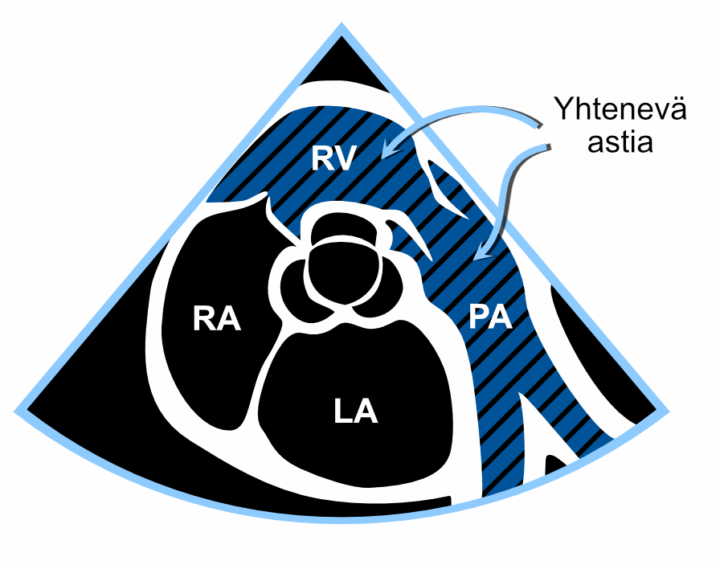
Figure: Parasternal short-axis view during systole. The right ventricle (RV) and pulmonary arteries (PA) form a communicating vessel. RA, right atrium; LA, left atrium.
Lower Communicating Vessel
The right atrium and inferior vena cava likewise form a communicating vessel. Consequently, right atrial pressure can be estimated from the central venous pressure (CVP).
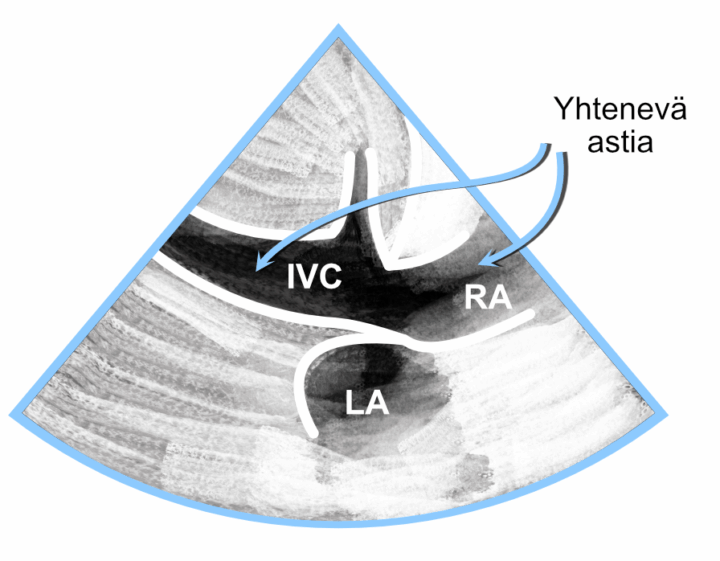
Figure: The inferior vena cava (IVC) and right atrium (RA) form a communicating vessel. LA, left atrium.
Estimating Pulmonary Artery Systolic Pressure
Adding the estimated central venous pressure (CVP) to the RV/RA pressure gradient provides an estimate of the pulmonary artery systolic pressure (sPAP):
sPAP ≈ CVP + RV/RA pressure gradient
CVP is estimated from the diameter of the inferior vena cava (IVC) and its respiratory variation, whereas the RV/RA pressure gradient is calculated from the peak velocity of the tricuspid regurgitation jet. Both measurements are described in the following sections.